

The Great War
Moderator: Community Team
Forum rules
Please read the Community Guidelines before posting.
Please read the Community Guidelines before posting.
-
mookiemcgee

- Posts: 5779
- Joined: Wed Jul 03, 2013 2:33 pm
- Gender: Male
- Location: Northern CA
Re: The Great War
Thanks Guys!
-
CatfishJohn

- Posts: 2
- Joined: Fri Jan 21, 2011 7:40 pm
- Gender: Male
- Location: Johnstown, Pennsylvania
Re: The Great War
Your signature...sounds like...Georgia guidestones?


Re: The Great War
For fifteen hours only, for 12:00 CC Time on August 20th to 15:00 CC Time on August 21st, Gallipoli speed tournaments are up.
This is the dramatic conclusion to the 15 Days in Hell event. It's also a blatant way to give you an easy way to earn a few extra Great War Cannon tokens. Entry is only 2 silver stars, and the top four entrants win one or more Great War Cannon tokens. The winner also gets a Helmet and a Pistol.
This is the dramatic conclusion to the 15 Days in Hell event. It's also a blatant way to give you an easy way to earn a few extra Great War Cannon tokens. Entry is only 2 silver stars, and the top four entrants win one or more Great War Cannon tokens. The winner also gets a Helmet and a Pistol.
“Life is a shipwreck, but we must not forget to sing in the lifeboats.”
― Voltaire
― Voltaire

Re: The Great War
That's 27 hours, right?Dukasaur wrote:For fifteen hours only, for 12:00 CC Time on August 20th to 15:00 CC Time on August 21st, Gallipoli speed tournaments are up.
This is the dramatic conclusion to the 15 Days in Hell event. It's also a blatant way to give you an easy way to earn a few extra Great War Cannon tokens. Entry is only 2 silver stars, and the top four entrants win one or more Great War Cannon tokens. The winner also gets a Helmet and a Pistol.

Re: The Great War
Yeah, I guess it is, lol.Swifte wrote:That's 27 hours, right?Dukasaur wrote:For fifteen hours only, for 12:00 CC Time on August 20th to 15:00 CC Time on August 21st, Gallipoli speed tournaments are up.
This is the dramatic conclusion to the 15 Days in Hell event. It's also a blatant way to give you an easy way to earn a few extra Great War Cannon tokens. Entry is only 2 silver stars, and the top four entrants win one or more Great War Cannon tokens. The winner also gets a Helmet and a Pistol.
“Life is a shipwreck, but we must not forget to sing in the lifeboats.”
― Voltaire
― Voltaire
Re: The Great War
Okay, so I've cleared all this with bigWham, and it's all set.Dukasaur wrote:Well, I said I'd make a decision on the 12th, and the 12th is almost over, so I guess I'd best get to it.
World 2.1
Classic Cities: London
Germany
World War I Gallipoli
Battle for Iraq!
Italy
Rail Europe
Poison Rome
Land and Sea
4 Star Meats
These changes will take effect on August 26th, give or take a day or so for technical reasons. As before, the old list will continue dropping for 30 days afterward, to allow people to wrap up games that have already started.justifications
- World 2.1 I had already intended to add to the list during Worldwide Warfare Week in April, to denote the fact that this was a worldwide conflict.
- Britain and Germany were the ubiquitous combatants, both involved in some way in every single theatre of the war, so I will try to always have a British map and a German map. Classic Cities: London and Germany get the nod this time, because they're smaller maps and a lot of the others on the list are larger maps. This means no disrespect to any of the other British and German maps; they will all get a turn at some point.
- 1915 was definitely the year of Gallipolli, from February to December. After the end of the year, we really won't have any good excuse to use Gallipoli any more, so may as well use it while we can.
- Battle for Iraq! -- a lot of interesting stuff was happening on the Mesopotamian front. Tiny battles, with participants in four digits instead of six digits like the European battles, but tactically interesting. Since we've already used Middle East recently, I'll give the nod to B for I. Don't worry about the fact that a lot of the issues are 100 years into the future. Our next-best Mideast map is Gilgamesh, which takes us 4000 years into the past!
- Italy. Besides Gallipoli, the summer of 1915 saw the entry of Italy into the war.
- Rail Europe. Rail dominated logistic concerns. A lot of the nations involved were landlocked, so could not be supplied by sea, and motorized road transport was only beginning to come into play. Rail definitely was number 1.
- Poison Rome. For several reasons. The war was definitely a family war, as the closely related Royal Families of Russia, Germany, Britain, and Greece all held to somewhat different agendas and all failed to use their family connection to broker an early peace. Assassination, prominent in Poison Rome, had an impact.
- Land And Sea. Celebrating the importance of the Navies.
- 4 Star Meats. As pamoa said, WWI was a butchery.
At the stroke of midnight CC Time, when August 26th begins, the new maps will start dropping tokens on game start.
The previous list will continue dropping tokens for game wins only for another 30 days after that.
“Life is a shipwreck, but we must not forget to sing in the lifeboats.”
― Voltaire
― Voltaire

Re: The Great War
Excellent.
Looking forward to the link of token-eligible games updating, its a very excellent tool for those of us trying to get our hands on a few extra tanks without blowing up our game count
Looking forward to the link of token-eligible games updating, its a very excellent tool for those of us trying to get our hands on a few extra tanks without blowing up our game count
Re: The Great War
Working on it. Last couple days been a bit hectic, and I need to learn to write links for the new Game Finder, but within 48 hours I promise I'll get it done.Tviorr wrote:Excellent.
Looking forward to the link of token-eligible games updating, its a very excellent tool for those of us trying to get our hands on a few extra tanks without blowing up our game count
That, and two new tournaments...

“Life is a shipwreck, but we must not forget to sing in the lifeboats.”
― Voltaire
― Voltaire
Re: The Great War
Okay, the link works.Dukasaur wrote:Working on it. Last couple days been a bit hectic, and I need to learn to write links for the new Game Finder, but within 48 hours I promise I'll get it done.Tviorr wrote:Excellent.
Looking forward to the link of token-eligible games updating, its a very excellent tool for those of us trying to get our hands on a few extra tanks without blowing up our game count
That, and two new tournaments...
https://www.conquerclub.com/player.php? ... ivate%5D=1
As for the second half of my promise, I will need an extension. Too much stuff has come up in R/L this week and I haven't written the new tourneys.
“Life is a shipwreck, but we must not forget to sing in the lifeboats.”
― Voltaire
― Voltaire
-
mookiemcgee
- Posts: 5779
- Joined: Wed Jul 03, 2013 2:33 pm
- Gender: Male
- Location: Northern CA
Re: The Great War
Tviorr wrote:Just a stupid question about tokens. - Do you have to win one of the listed games to get a drop chance?
If you just have to play then can we get an idea of what the drop chance is. - I have 14 newly started games of the current types and so far no tokens. - So if its neccessary to play a hundred games to get 3 tokens, Im thinking that the tournaments will only be joined by the very lucky or the insanely active?
Am I missing something here?
Hmm Tviorr, If you joined 14 - 1v1 games its possible but unlikely you wouldn't get at least 1 token. If you joined 14 large games then there is definitely a bug... That or they totally changed the drop odds. I was having trouble getting tokens even when i won my 1 v1 game in the past, but the big games drop very frequently even for signups. My last 12 person game I think 9-10 people got a token just for joining.
-
iAmCaffeine

- Posts: 11699
- Joined: Mon Apr 01, 2013 5:38 pm
Re: The Great War
Since the post containing the list of maps is a bit messy, I just wanted to double check that these are the maps now dropping tokens:
Upcoming change August 26th:
World 2.1
Classic Cities: London
Germany
World War I Gallipoli
Battle for Iraq!
Italy
Rail Europe
Poison Rome
Land and Sea
4 Star Meats

Re: The Great War
Yes, this should be the list.iAmCaffeine wrote:Since the post containing the list of maps is a bit messy, I just wanted to double check that these are the maps now dropping tokens:Upcoming change August 26th:
World 2.1
Classic Cities: London
Germany
World War I Gallipoli
Battle for Iraq!
Italy
Rail Europe
Poison Rome
Land and Sea
4 Star Meats
“Life is a shipwreck, but we must not forget to sing in the lifeboats.”
― Voltaire
― Voltaire
Re: The Great War
After a bit of a delay, we finally have the next two Great War tournaments ready to go. Both will launch tomorrow (Sept 6) at the usual time of 1500 and will be available for at least 10 days.
These are paired tournaments. Accordingly, there is a special General Achievement medal available if you place in the Top 5 in both. This kind of thing can't be tracked automatically, so PM me or post here in the thread when you become eligible for this special GA.
Hill 60 and Scimitar Hill sept 6 to 16
Hill 60 and Scimitar Hill
These were the last offensive actions undertaken by the Allies at Gallipoli. Trying to revive the lost impetus of the August 6th offensive, Hamilton withdrew the 29th Division from Hellas Cape and shipped it north. Now under the command of Sir Henry de Beauvoir de Lisle, the 29th was to take Scimtar Hill and another unit was to take the "W" Hills north of it. Meanwhile, the Anzacs were to take Hill 60. (You can see Scimitar Hill and Hill 60 on our Gallipoli map, which depicts the campaign with a great deal of accuracy.)
The attacks began on August 21st in very dense fog. The fog was both a curse and a blessing. At "W" hill, the division that was sent there got completely lost in the fog and never showed up on the battlefield at all. At least, that was their story and they're sticking to it. At Scimitar Hill, the fog covered the British advance. The British were able to storm the hill and gain an initial advantage before the Turks even noticed there was a battle going on. At Hill 60, somewhat the opposite happened. The Anzacs rushed the Hill, unable to see the Turkish machine gun nests on their flank, and were brutally mauled.
More detail:
Hill 60
Scimtar Hill
The two tournaments I have written for the occasion are, naturally enough, closely related. The fog was the most dominant feature in both battles, so appropriately enough 100% of the games are foggy. Hill 60 was a smaller battle and Scimitar Hill much larger, so the former has smaller games (3 to 5 players) and the latter has larger games (8 to 12 players.) Both tournaments are three-rounders, beginning on the WW I Gallipoli map (naturally enough) and ending on Random map (representing the general chaos and disorder at the end.)
For the middle rounds, I've chosen maps representing salient unique features. At Scimitar Hill, one of the most noteworthy deviations from the norm was that the heaviest British casualties came after their own artillery started a brush fire which burned backwards against their lines and consumed hundreds of troops. This reminded me of Zhuge Liang and famous incidents during the wars of the Three Kingdoms where fields were set on fire to burn troops marching through them. Thus, the round 2 map for Scimitar Hill will be Three Kingdoms of China. At Hill 60, the greatest woe came from the Ottoman machine-gun nests, so I've chosen a selection of maps where machine guns were significant, including of course WW I and WW II maps but also American Civil War, where the Gatling gun made its debut, and South Africa 1885.
Hill 60
24 players start
General Birdwood's Anzacs were to capture Hill 60
Seven 4-player games on WW I Gallipoli, all Foggy, no Trench, randomly Esc, Flat, No Spoils.
Fifteen players advance
Machine gun nests that they couldn't see in the fog mowed them down
Eight 5-player games on D-Day Omaha, American Civil War, Trench Warfare, Stalingrad, South Africa 1885, WW II Iwo Jima, WW II Australia, WW II Gazala, all Foggy, no Trench, randomly Esc, Flat, No Spoils.
Three players advance
In the end, chaos ruled and the operation was a failure.
Nine 3-player games on Random map, all Foggy, no Trench, randomly Esc, Flat, No Spoils.
Scimitar Hill
24 Players start
The 29th Division was to take Scimitar Hill
Seven 8-player games on WW I Gallipoli, all Foggy, no Trench, randomly Esc, Flat, No Spoils.
Twenty players advance
A fire consumed many British troops, like fire tactics in China's Three Kingdoms War
Eight 10-player games on Three Kingdoms of China, all Foggy, no Trench, randomly Esc, Flat, No Spoils.
Twelve players advance
After much back-and-forth, the demoralized British retreated.
Nine 12-player games on Random map, all Foggy, no Trench, randomly Esc, Flat, No Spoils.
-- DK
These were the last offensive actions undertaken by the Allies at Gallipoli. Trying to revive the lost impetus of the August 6th offensive, Hamilton withdrew the 29th Division from Hellas Cape and shipped it north. Now under the command of Sir Henry de Beauvoir de Lisle, the 29th was to take Scimtar Hill and another unit was to take the "W" Hills north of it. Meanwhile, the Anzacs were to take Hill 60. (You can see Scimitar Hill and Hill 60 on our Gallipoli map, which depicts the campaign with a great deal of accuracy.)
The attacks began on August 21st in very dense fog. The fog was both a curse and a blessing. At "W" hill, the division that was sent there got completely lost in the fog and never showed up on the battlefield at all. At least, that was their story and they're sticking to it. At Scimitar Hill, the fog covered the British advance. The British were able to storm the hill and gain an initial advantage before the Turks even noticed there was a battle going on. At Hill 60, somewhat the opposite happened. The Anzacs rushed the Hill, unable to see the Turkish machine gun nests on their flank, and were brutally mauled.
More detail:
Hill 60
Scimtar Hill
The two tournaments I have written for the occasion are, naturally enough, closely related. The fog was the most dominant feature in both battles, so appropriately enough 100% of the games are foggy. Hill 60 was a smaller battle and Scimitar Hill much larger, so the former has smaller games (3 to 5 players) and the latter has larger games (8 to 12 players.) Both tournaments are three-rounders, beginning on the WW I Gallipoli map (naturally enough) and ending on Random map (representing the general chaos and disorder at the end.)
For the middle rounds, I've chosen maps representing salient unique features. At Scimitar Hill, one of the most noteworthy deviations from the norm was that the heaviest British casualties came after their own artillery started a brush fire which burned backwards against their lines and consumed hundreds of troops. This reminded me of Zhuge Liang and famous incidents during the wars of the Three Kingdoms where fields were set on fire to burn troops marching through them. Thus, the round 2 map for Scimitar Hill will be Three Kingdoms of China. At Hill 60, the greatest woe came from the Ottoman machine-gun nests, so I've chosen a selection of maps where machine guns were significant, including of course WW I and WW II maps but also American Civil War, where the Gatling gun made its debut, and South Africa 1885.
Hill 60
24 players start
General Birdwood's Anzacs were to capture Hill 60
Seven 4-player games on WW I Gallipoli, all Foggy, no Trench, randomly Esc, Flat, No Spoils.
Fifteen players advance
Machine gun nests that they couldn't see in the fog mowed them down
Eight 5-player games on D-Day Omaha, American Civil War, Trench Warfare, Stalingrad, South Africa 1885, WW II Iwo Jima, WW II Australia, WW II Gazala, all Foggy, no Trench, randomly Esc, Flat, No Spoils.
Three players advance
In the end, chaos ruled and the operation was a failure.
Nine 3-player games on Random map, all Foggy, no Trench, randomly Esc, Flat, No Spoils.
Scimitar Hill
24 Players start
The 29th Division was to take Scimitar Hill
Seven 8-player games on WW I Gallipoli, all Foggy, no Trench, randomly Esc, Flat, No Spoils.
Twenty players advance
A fire consumed many British troops, like fire tactics in China's Three Kingdoms War
Eight 10-player games on Three Kingdoms of China, all Foggy, no Trench, randomly Esc, Flat, No Spoils.
Twelve players advance
After much back-and-forth, the demoralized British retreated.
Nine 12-player games on Random map, all Foggy, no Trench, randomly Esc, Flat, No Spoils.
-- DK
“Life is a shipwreck, but we must not forget to sing in the lifeboats.”
― Voltaire
― Voltaire
Re: The Great War
55921
“Life is a shipwreck, but we must not forget to sing in the lifeboats.”
― Voltaire
― Voltaire
Re: The Great War
Something went wrong with the launch. PM sent to BW.Dukasaur wrote:After a bit of a delay, we finally have the next two Great War tournaments ready to go. Both will launch tomorrow (Sept 6) at the usual time of 1500 and will be available for at least 10 days.
These are paired tournaments. Accordingly, there is a special General Achievement medal available if you place in the Top 5 in both. This kind of thing can't be tracked automatically, so PM me or post here in the thread when you become eligible for this special GA.Hill 60 and Scimitar Hill sept 6 to 16
Hill 60 and Scimitar Hill
These were the last offensive actions undertaken by the Allies at Gallipoli. Trying to revive the lost impetus of the August 6th offensive, Hamilton withdrew the 29th Division from Hellas Cape and shipped it north. Now under the command of Sir Henry de Beauvoir de Lisle, the 29th was to take Scimtar Hill and another unit was to take the "W" Hills north of it. Meanwhile, the Anzacs were to take Hill 60. (You can see Scimitar Hill and Hill 60 on our Gallipoli map, which depicts the campaign with a great deal of accuracy.)
The attacks began on August 21st in very dense fog. The fog was both a curse and a blessing. At "W" hill, the division that was sent there got completely lost in the fog and never showed up on the battlefield at all. At least, that was their story and they're sticking to it. At Scimitar Hill, the fog covered the British advance. The British were able to storm the hill and gain an initial advantage before the Turks even noticed there was a battle going on. At Hill 60, somewhat the opposite happened. The Anzacs rushed the Hill, unable to see the Turkish machine gun nests on their flank, and were brutally mauled.
More detail:
Hill 60
Scimtar Hill
The two tournaments I have written for the occasion are, naturally enough, closely related. The fog was the most dominant feature in both battles, so appropriately enough 100% of the games are foggy. Hill 60 was a smaller battle and Scimitar Hill much larger, so the former has smaller games (3 to 5 players) and the latter has larger games (8 to 12 players.) Both tournaments are three-rounders, beginning on the WW I Gallipoli map (naturally enough) and ending on Random map (representing the general chaos and disorder at the end.)
For the middle rounds, I've chosen maps representing salient unique features. At Scimitar Hill, one of the most noteworthy deviations from the norm was that the heaviest British casualties came after their own artillery started a brush fire which burned backwards against their lines and consumed hundreds of troops. This reminded me of Zhuge Liang and famous incidents during the wars of the Three Kingdoms where fields were set on fire to burn troops marching through them. Thus, the round 2 map for Scimitar Hill will be Three Kingdoms of China. At Hill 60, the greatest woe came from the Ottoman machine-gun nests, so I've chosen a selection of maps where machine guns were significant, including of course WW I and WW II maps but also American Civil War, where the Gatling gun made its debut, and South Africa 1885.
Hill 60
24 players start
General Birdwood's Anzacs were to capture Hill 60
Seven 4-player games on WW I Gallipoli, all Foggy, no Trench, randomly Esc, Flat, No Spoils.
Fifteen players advance
Machine gun nests that they couldn't see in the fog mowed them down
Eight 5-player games on D-Day Omaha, American Civil War, Trench Warfare, Stalingrad, South Africa 1885, WW II Iwo Jima, WW II Australia, WW II Gazala, all Foggy, no Trench, randomly Esc, Flat, No Spoils.
Three players advance
In the end, chaos ruled and the operation was a failure.
Nine 3-player games on Random map, all Foggy, no Trench, randomly Esc, Flat, No Spoils.
Scimitar Hill
24 Players start
The 29th Division was to take Scimitar Hill
Seven 8-player games on WW I Gallipoli, all Foggy, no Trench, randomly Esc, Flat, No Spoils.
Twenty players advance
A fire consumed many British troops, like fire tactics in China's Three Kingdoms War
Eight 10-player games on Three Kingdoms of China, all Foggy, no Trench, randomly Esc, Flat, No Spoils.
Twelve players advance
After much back-and-forth, the demoralized British retreated.
Nine 12-player games on Random map, all Foggy, no Trench, randomly Esc, Flat, No Spoils.
-- DK
“Life is a shipwreck, but we must not forget to sing in the lifeboats.”
― Voltaire
― Voltaire

Re: The Great War
1 year in the books now and no fanfare? No celebration? 1/4 of the way done...keep up the good work! 

Re: The Great War
Thank you morleyjoe!morleyjoe wrote:1 year in the books now and no fanfare? No celebration? 1/4 of the way done...keep up the good work!
Yeah, there's enough stuff happening now, another milestone to mark would be just something for the sake of something. I'm glad at least one person noticed, and I'll leave it at that. Hectic time for me, both in R/L and on CC.
“Life is a shipwreck, but we must not forget to sing in the lifeboats.”
― Voltaire
― Voltaire
Re: The Great War
Dukasaur wrote:Thank you morleyjoe!morleyjoe wrote:1 year in the books now and no fanfare? No celebration? 1/4 of the way done...keep up the good work!
Yeah, there's enough stuff happening now, another milestone to mark would be just something for the sake of something. I'm glad at least one person noticed, and I'll leave it at that. Hectic time for me, both in R/L and on CC.
nice work Dukasaur-
iAmCaffeine
- Posts: 11699
- Joined: Mon Apr 01, 2013 5:38 pm
Re: The Great War
It's not often said but it is definitely appreciated. I've played in nearly every tournament from the Great War and thoroughly enjoyed the experience, so I'm hoping that continues! My only issue is the repetition of maps, but the pros far outweigh the cons and getting more experience/practice never hurt.
Cheers Duk.
Cheers Duk.
Re: The Great War
Thanks man!iAmCaffeine wrote:It's not often said but it is definitely appreciated. I've played in nearly every tournament from the Great War and thoroughly enjoyed the experience, so I'm hoping that continues! My only issue is the repetition of maps, but the pros far outweigh the cons and getting more experience/practice never hurt.
Cheers Duk.
Battle of Loos should be coming, so we're basically done with the Gallipoli campaign and back to the Western Front. This should change the map mix slightly...
“Life is a shipwreck, but we must not forget to sing in the lifeboats.”
― Voltaire
― Voltaire
Re: The Great War
Im enjoying it too, even if Im not active enough to get in every tourney - or rather scratch up enough cannons to join all of them.
Im having fun deciding which ones are setup best for my limited talents though.
When is the next one up...? Are we having peace for the olympics as per the ancient greek traditions or am I missing something, cause I havent seen any fresh tourneys for a couple of weeks?
Im having fun deciding which ones are setup best for my limited talents though.
When is the next one up...? Are we having peace for the olympics as per the ancient greek traditions or am I missing something, cause I havent seen any fresh tourneys for a couple of weeks?
Re: The Great War
Battle of Loos should have come out September 25th. I've just been extremely busy in R/L and something had to give. The Olympics gave me a convenient moment to take a breather, but they weren't originally the main reason.Tviorr wrote:Im enjoying it too, even if Im not active enough to get in every tourney - or rather scratch up enough cannons to join all of them.
Im having fun deciding which ones are setup best for my limited talents though.
When is the next one up...? Are we having peace for the olympics as per the ancient greek traditions or am I missing something, cause I havent seen any fresh tourneys for a couple of weeks?
I'll try to have Loos out by the end of the week.
“Life is a shipwreck, but we must not forget to sing in the lifeboats.”
― Voltaire
― Voltaire
Re: The Great War
Great. Looking forward to it
Re: The Great War
Archive of the autotournaments from June 28 to Sept 16, 2015 (4th quarter of the Great War series).
back to main index
battle of Gully Ravine
The battle of Gully Ravine(june 28-july 5)
With hope at its knees and the salted blue in their backs the british failed to realize the atrocity and gore the coming battle would develop into. In one of the allies' most dishonorable episodes, the battle of Gully Ravine turned into a massacre the likes Galipolli had not witnessed. Streams of red slithered from the corpsed bullwark to the cold of the sea.
players: 70
requirements: Premium
June 26th, British naval bombardment burst over the frontline into the Ottoman redoubts:
Random draw, 10 games, 70 move on, games: 5 players, assassin, all spoils, WWI Galipolli, chained, fog, no trench, Round limit 30
June 28th, split attack. The Gully Spur flank was quickly captured with overwhelming artillery:
70 start, random draw, 6 games, 70 move on, games: 10 players, assassin, nuclear, D-day Omaha beach!, chained, sun, no trench, Round limit 30
Safe from bombardments the Ravine center spine held strong against british advance:
70 start, random draw, 4 games, 70 move on, games: 10 players, standard, nuclear, D-day Omaha beach!, chained/no reinforcements, fog, trench, Round limit 30
On the right flank, the 156th was callously sacrificed losing up to 1400 casualties:
70 start, random draw, 5 games, 48 move on, games: 7 players, terminator, escalating, Castle lands, chained/no reinforcements, sun, no trench, Round limit 30
Without any artillery nor machinegun support the Ottomans launch wave after wave:
score reset, 48 start, random draw, 6 games, 40 move on, games: 8 players, assassin, escalating, Pelopponesian war, chained/no reinforcements, fog, no trench, Round limit 30
After a one day's rest on july 1st, the Ottomans continue their attacks:
32 start, random draw, 5 games, 32 move on, games: 8 players, assassin, escalating, Pelopponesian war, chained/no reinforcements, fog, no trench, Round limit 30
The British meanwhile refuse any truce to tend the wounded and bury the dead:
24 start, random draw, 4 games, 16 move on, games: 8 players, assassin, escalating, Pelopponesian war, chained/no reinforcements, fog, no trench, Round limit 30
14.000 Ottoman casualties were used as morbid walls to repulse the enemy:
score reset, 10 start, random draw, 14 games, games: 8 players, assassin, escalating, Rorke's Drift, chained/no reinforcements, fog, no trench, Round limit 30
-- W
With hope at its knees and the salted blue in their backs the british failed to realize the atrocity and gore the coming battle would develop into. In one of the allies' most dishonorable episodes, the battle of Gully Ravine turned into a massacre the likes Galipolli had not witnessed. Streams of red slithered from the corpsed bullwark to the cold of the sea.
players: 70
requirements: Premium
June 26th, British naval bombardment burst over the frontline into the Ottoman redoubts:
Random draw, 10 games, 70 move on, games: 5 players, assassin, all spoils, WWI Galipolli, chained, fog, no trench, Round limit 30
June 28th, split attack. The Gully Spur flank was quickly captured with overwhelming artillery:
70 start, random draw, 6 games, 70 move on, games: 10 players, assassin, nuclear, D-day Omaha beach!, chained, sun, no trench, Round limit 30
Safe from bombardments the Ravine center spine held strong against british advance:
70 start, random draw, 4 games, 70 move on, games: 10 players, standard, nuclear, D-day Omaha beach!, chained/no reinforcements, fog, trench, Round limit 30
On the right flank, the 156th was callously sacrificed losing up to 1400 casualties:
70 start, random draw, 5 games, 48 move on, games: 7 players, terminator, escalating, Castle lands, chained/no reinforcements, sun, no trench, Round limit 30
Without any artillery nor machinegun support the Ottomans launch wave after wave:
score reset, 48 start, random draw, 6 games, 40 move on, games: 8 players, assassin, escalating, Pelopponesian war, chained/no reinforcements, fog, no trench, Round limit 30
After a one day's rest on july 1st, the Ottomans continue their attacks:
32 start, random draw, 5 games, 32 move on, games: 8 players, assassin, escalating, Pelopponesian war, chained/no reinforcements, fog, no trench, Round limit 30
The British meanwhile refuse any truce to tend the wounded and bury the dead:
24 start, random draw, 4 games, 16 move on, games: 8 players, assassin, escalating, Pelopponesian war, chained/no reinforcements, fog, no trench, Round limit 30
14.000 Ottoman casualties were used as morbid walls to repulse the enemy:
score reset, 10 start, random draw, 14 games, games: 8 players, assassin, escalating, Rorke's Drift, chained/no reinforcements, fog, no trench, Round limit 30
-- W
achi baba july 17th to 24th
Attack on Achi Baba
After 4 failed attempts to seize the village of Krithia and Achi Baba hill behind Krithia, General Hunter-Weston was determined to try just one last time and persuaded Hamilton to authorize another attack. The final attack on Achi Baba was a failure again. Huge casualties were inflicted on the Turks -- 10,000 dead on the Turkish side versus only 4,000 dead on the Allied side -- and yet the village and the hill remained in Ottoman hands. The Allies were soon to shift their emphasis further up the coast to Anzac Cove and Suvla Bay.
Basic outline: http://www.firstworldwar.com/battles/achibaba_jul.htm
Achi Baba helped cement Hunter-Weston's reputation as one of the worst British generals of all time.
-----------------------------------------------------------------------------------------------------------------------
24 players start.
Phase 1: The battle for Gallipoli had been going on for two months
Two 1v1 games on WWI Gallipoli, No Spoils, Fog
Phase 2: The hill of Achi Baba controls the high ground over Krithia
We used the San Marion map to represent the hills of Gallipoli during the Battles of Krithia tournament. I just played in that tournament and it was the most fun I've had on CC in at least six months, so I'll put it in here with identical settings.
Three games, 4 player Terminator, San Marino, Trench, Flat Rate, Adjacent, Fog
18 players advance, scores reset
Phase 3: Almost a caricature of a bad general, Hunter-Weston callously disregarded casualties in his ranks.
The 30% casualty rate suffered by the Highlanders during the Battle of Gully Ravine was referred to as "blooding the pups".
Three games, 6-player Terminator, Halloween Hallows, Nuclear, Unlimited
Phase 4: The arrival of new French artillery enabled a massive barrage on the Turkish lines
Three games, 6-player Standard, France, randomly nuclear and zombie, randomly fog and sun, randomly trench and no trench
12 players advance, scores reset
Phase 5: Despite suffering massive casualties, the Turks held on
Three games, 6-player Standard, WWI Ottoman, default settings
Phase 6: Hunter-Weston was recalled to England
Three games, 12-player Standard, England, Foggy Flat Rate Parachute
Phase 7: The Gallipoli campaign was at its half-way point
Two 1v1 games on WWI Gallipoli, No Spoils, Fog
Phase 8: For the duration, the Turks would rule Achi Baba hill
Three games, 4-player assassin, King of the Mountains, Nuclear, Fog, Trench
-- DK
After 4 failed attempts to seize the village of Krithia and Achi Baba hill behind Krithia, General Hunter-Weston was determined to try just one last time and persuaded Hamilton to authorize another attack. The final attack on Achi Baba was a failure again. Huge casualties were inflicted on the Turks -- 10,000 dead on the Turkish side versus only 4,000 dead on the Allied side -- and yet the village and the hill remained in Ottoman hands. The Allies were soon to shift their emphasis further up the coast to Anzac Cove and Suvla Bay.
Basic outline: http://www.firstworldwar.com/battles/achibaba_jul.htm
Achi Baba helped cement Hunter-Weston's reputation as one of the worst British generals of all time.
https://en.wikipedia.org/wiki/Aylmer_Hunter-Westonwikipedia wrote:Nicknamed "Hunter-Bunter", Hunter-Weston has been seen as a classic example of a "donkey" general — he was described by his superior Sir Douglas Haig as a "rank amateur", and has been referred to by one modern writer as "one of the Great War's spectacular incompetents".[1] However, another historian writes that although his poor performance at the battles of Krithia earned his reputation "as one of the most brutal and incompetent commanders of the First World War" [2] "in his later battles (at Gallipoli) he seemed to hit upon a formula for success ...(but) these small achievements were largely forgotten".[3]
-----------------------------------------------------------------------------------------------------------------------
24 players start.
Phase 1: The battle for Gallipoli had been going on for two months
Two 1v1 games on WWI Gallipoli, No Spoils, Fog
Phase 2: The hill of Achi Baba controls the high ground over Krithia
We used the San Marion map to represent the hills of Gallipoli during the Battles of Krithia tournament. I just played in that tournament and it was the most fun I've had on CC in at least six months, so I'll put it in here with identical settings.
Three games, 4 player Terminator, San Marino, Trench, Flat Rate, Adjacent, Fog
18 players advance, scores reset
Phase 3: Almost a caricature of a bad general, Hunter-Weston callously disregarded casualties in his ranks.
The 30% casualty rate suffered by the Highlanders during the Battle of Gully Ravine was referred to as "blooding the pups".
Three games, 6-player Terminator, Halloween Hallows, Nuclear, Unlimited
Phase 4: The arrival of new French artillery enabled a massive barrage on the Turkish lines
Three games, 6-player Standard, France, randomly nuclear and zombie, randomly fog and sun, randomly trench and no trench
12 players advance, scores reset
Phase 5: Despite suffering massive casualties, the Turks held on
Three games, 6-player Standard, WWI Ottoman, default settings
Phase 6: Hunter-Weston was recalled to England
Three games, 12-player Standard, England, Foggy Flat Rate Parachute
Phase 7: The Gallipoli campaign was at its half-way point
Two 1v1 games on WWI Gallipoli, No Spoils, Fog
Phase 8: For the duration, the Turks would rule Achi Baba hill
Three games, 4-player assassin, King of the Mountains, Nuclear, Fog, Trench
-- DK
second isonzo july 24th to 31st
Second Isonzo
Only eleven days after the failure of the First Battle of the Isonzo, Italian commander Luigi Cadorna felt he was ready to try again. 290,000 new Italians had arrived at the front, which he felt gave him a much greater chance of success than he had during the first offensive. Cadorna failed to grasp that it was bad tactics, not numerical inferiority, that led to his previous defeat. In the words of First World War dot com:
21 players begin
Five 7-player games, default settings, on the Yugoslavia map.
18 players advance
Five 6-player Standard games, flat rate, parachute, fog, and trench, on Unification Italy.
15 players advance
Five 3-player Assassin games, nuclear, unlimited, foggy, on Austro-Hungarian Empire map.
Scores reset, 12 players advance
Five Polymorphic Quads games, no spoils, fog, trench, on Napoleonic Europe, Waterloo, Europa, Europe 1914, and Trench Warfare.
10 players advance
Five 10-player Terminator games on WWII Eastern Front, randomly flat, escalating and nuclear, randomly chained and parachute, randomly sunny and foggy
Scores reset, 7 players advance
Eight 7-player Standard games, flat rate and Trench
Italy, Unification Italy, Austro-Hungarian Empire, Yugoslavia, Magyarország, Balkan Peninsula, King of the Mountains, Europe1914
-- DK
Only eleven days after the failure of the First Battle of the Isonzo, Italian commander Luigi Cadorna felt he was ready to try again. 290,000 new Italians had arrived at the front, which he felt gave him a much greater chance of success than he had during the first offensive. Cadorna failed to grasp that it was bad tactics, not numerical inferiority, that led to his previous defeat. In the words of First World War dot com:
... and to summarize the battle:Throughout the Isonzo battles Cadorna consistently persisted with a policy of massed frontal infantry attacks against well prepared defensive positions, despite clear evidence on the Western Front that such tactics were fruitless.
-----------------------------------------------------------------------------------------------------------------------Running from 18 July-3 August 1915, in actuality the second Isonzo battle achieved little more than the first other than increased casualties: 60,000 on the Italian side, 45,000 Austro-Hungarian.
21 players begin
- Much of the Isonzo River flows through what is now the Republic of Slovenia, where it is known as the Soča. Since medieval times this area was known as Carniola in Italian, Krain in German, or Kranjska in the Slovenian, Serbian, and Croatian tongues. For a thousand years there was a relatively stable trinity of influences: The bulk of the population was what were called "Alpine Slavs" (today called Slovenes.) Political and military power was vested in Austrian and other German-speaking overlords. Commercial ties with Venice and Trieste, as well as ecclesiastical ties with the Italian branch of the Church, imparted some Italian influence. There were border changes, mostly resulting from exogenous dynastic rivalries and such, but very little homegrown unrest or upheaval. The three -- Slavic, Germanic, and Italian influences -- coexisted from about 900 A.D. to World War I. As linguistic nationalism gradually became a dominant trend through the 19th century, this area naturally became one of the sources of contention.
Five 7-player games, default settings, on the Yugoslavia map.
18 players advance
- The Isonzo campaigns were overseen by the Chief of the Italian General Staff, Luigi Cadorna. Born in Piedmont prior to Italian Unification, he was too young to participate in most of the reunification wars, but took up active service in the army at the age of 18 and marched at the final occupation of Rome at the age of 20.
Five 6-player Standard games, flat rate, parachute, fog, and trench, on Unification Italy.
15 players advance
- The Austrian defense was organised by Svetozar Borojević. "Sveto" was a hero to his troops, and military historians have rated him as one of the best commanders of WW I on any side. Svetozar Borojević was a true representative of the polyglot Habsburg empire. Descended from Serbian ancestors, born in a Slovene community, he spoke Croatian and always considered himself a Croat. He married a German girl, was educated in Austrian military schools and was a loyal soldier of the Austro-Hungarian Empire. After the war he attempted to live in Croatia, but was treated as a traitor and humiliated, whereupon he settled on the Austrian side of the border. The linguistic intolerance that began in the 19th century intensified in the 20th. The Croats could not accept this honourable man who was a throwback to a nobler time when fealty was given irrespective of linguistic jingoism.
Five 3-player Assassin games, nuclear, unlimited, foggy, on Austro-Hungarian Empire map.
Scores reset, 12 players advance
- Cadorna's only strategy was the basic Napoleonic strategy of a thunderous artillery barrage, followed by a straight-line advance by the infantry. It was already questionable in Napoleon's time, but by 1914 it had been discredited by bloody failures on the Western Front.
Five Polymorphic Quads games, no spoils, fog, trench, on Napoleonic Europe, Waterloo, Europa, Europe 1914, and Trench Warfare.
10 players advance
- Lack of ammunition, coupled with the brutal terrain, meant that much of the battle was fought with bayonets, knives, and improvised weapons including random pieces of scrap metal. (See wikipedia entry.) This face-to-face horror is somewhat reminiscent of the Eastern Front in WW II.
Five 10-player Terminator games on WWII Eastern Front, randomly flat, escalating and nuclear, randomly chained and parachute, randomly sunny and foggy
Scores reset, 7 players advance
- After 16 days and 100,000 casualties, the battle petered out. Both sides were out of ammunition and exhausted. Little of substance had been achieved, except that the Italians had captured a strategic point on Mount Batognica.
Eight 7-player Standard games, flat rate and Trench
Italy, Unification Italy, Austro-Hungarian Empire, Yugoslavia, Magyarország, Balkan Peninsula, King of the Mountains, Europe1914
-- DK
pelagosa july 28th to august 4th
Pelagosa, July 28, 1915
As much as the Italians were struggling at Isonzo, their Regia Marina was also struggling. The entrance of Italy signing the London treaty caused a quick bombardment from the Austrian navy in Italy. However, the submarines would soon dominate the Mediterranean, and the Austrians would be reduced to a "Fleet in Being", as would the Italians. This stalemate was not predicted yet though, and the commander of the Italian Navy wanted to take the islands Pelagosa and Lagosta to set up a lookout for further Austro-Hungarian assaults.
Pelagosa was taken without resistance. However, the Italians had now lost both the Amalfi and Garibaldi to submarine attacks and decided that it was too expensive to continue naval operations so Lagosta was abandoned. Pelagosa was attacked on July 28 and then again on August 17, when the water cistern was successfully destroyed, causing immediate Italian evacuation.

This tournament isn't actually about this operation though. The commander of the Italian navy was Prince Luigi Amedeo, a Duke of the Savoy line. Unfortunately, this is the last chance I will have to write about him, since the next interesting Italian naval battles are in 1917, when the new commander is Paolo Thaon, now known as Duca del Mare, Duke of the Sea. In July and August 1915, these 2 corresponded frequently, so we know that Thaon disagreed with the Pelagosa plan.
18 Start
Round One: Kings of Sicily, Sardinia and Italy The Savoy line is one of the eldest and most successful dynasties of Europe and are most famous for becoming Kings and uniting Italy.
4 games, Unification Italy, Italy 6 Player Terminator, Flat Rate, Fog, Trench, Chained, 100 Rounds
Round Two: King of Spain Luigi was born in 1873, the same year his father abdicated the throne of Spain, which he had held since 1870, after Isabella II's deposition.
1 game Iberia, 6 Player Terminator, Flat Rate, Fog, Trench, Chained, 100 Rounds
12 Continue
Round Three: Exploring Eritrea and Somaliland Eventually Luigi would be instrumental in negotiating treaties for Eastern Africa, but for now (Early 1890s), he was just a young man with wide eyes and wanderlust.
5 games Africa, Africa II, Eastern Hemisphere, 6 Player Terminator, Flat Rate, Fog, Trench, Chained, 100 Rounds
10 Continue
Round Four: The Mountaineer Luigi began climbing in the Alps, but eventually set his goal on Mount St. Elias, which is the second highest mountain in both Canada and the United States. He was the first recorded person to summit it, being in 1897. This is one year after gold was discovered near Dawson City (about 400 KM away). Like a proper gentleman, he paid no heed to the ravenous stampeders, and totally ignored the Klondike Gold Rush.
4 games King of the Mountains, District of Alaska 5 Player Terminator, Flat Rate, Fog, Trench, Chained, 100 Rounds
8 Continue
Round Five: A Polar Expedition In 1899, he left for the North Pole but lost two fingers and returned. The expedition was successful without him though.
8 games, Arctic, 8 Player (Terminator, Assassin, Standard); (Flat Rate, Escalating) Fog, Trench, Chained, 50 Rounds
Epilogue: Pelagosa would become an Italian island again after the war. World War II would see it become Yugoslavian. It is now part of Croatia, and tourists can visit (there are two rooms to stay in).
-- DY
As much as the Italians were struggling at Isonzo, their Regia Marina was also struggling. The entrance of Italy signing the London treaty caused a quick bombardment from the Austrian navy in Italy. However, the submarines would soon dominate the Mediterranean, and the Austrians would be reduced to a "Fleet in Being", as would the Italians. This stalemate was not predicted yet though, and the commander of the Italian Navy wanted to take the islands Pelagosa and Lagosta to set up a lookout for further Austro-Hungarian assaults.
Pelagosa was taken without resistance. However, the Italians had now lost both the Amalfi and Garibaldi to submarine attacks and decided that it was too expensive to continue naval operations so Lagosta was abandoned. Pelagosa was attacked on July 28 and then again on August 17, when the water cistern was successfully destroyed, causing immediate Italian evacuation.
This tournament isn't actually about this operation though. The commander of the Italian navy was Prince Luigi Amedeo, a Duke of the Savoy line. Unfortunately, this is the last chance I will have to write about him, since the next interesting Italian naval battles are in 1917, when the new commander is Paolo Thaon, now known as Duca del Mare, Duke of the Sea. In July and August 1915, these 2 corresponded frequently, so we know that Thaon disagreed with the Pelagosa plan.
18 Start
Round One: Kings of Sicily, Sardinia and Italy The Savoy line is one of the eldest and most successful dynasties of Europe and are most famous for becoming Kings and uniting Italy.
4 games, Unification Italy, Italy 6 Player Terminator, Flat Rate, Fog, Trench, Chained, 100 Rounds
Round Two: King of Spain Luigi was born in 1873, the same year his father abdicated the throne of Spain, which he had held since 1870, after Isabella II's deposition.
1 game Iberia, 6 Player Terminator, Flat Rate, Fog, Trench, Chained, 100 Rounds
12 Continue
Round Three: Exploring Eritrea and Somaliland Eventually Luigi would be instrumental in negotiating treaties for Eastern Africa, but for now (Early 1890s), he was just a young man with wide eyes and wanderlust.
5 games Africa, Africa II, Eastern Hemisphere, 6 Player Terminator, Flat Rate, Fog, Trench, Chained, 100 Rounds
10 Continue
Round Four: The Mountaineer Luigi began climbing in the Alps, but eventually set his goal on Mount St. Elias, which is the second highest mountain in both Canada and the United States. He was the first recorded person to summit it, being in 1897. This is one year after gold was discovered near Dawson City (about 400 KM away). Like a proper gentleman, he paid no heed to the ravenous stampeders, and totally ignored the Klondike Gold Rush.
4 games King of the Mountains, District of Alaska 5 Player Terminator, Flat Rate, Fog, Trench, Chained, 100 Rounds
8 Continue
Round Five: A Polar Expedition In 1899, he left for the North Pole but lost two fingers and returned. The expedition was successful without him though.
8 games, Arctic, 8 Player (Terminator, Assassin, Standard); (Flat Rate, Escalating) Fog, Trench, Chained, 50 Rounds
Epilogue: Pelagosa would become an Italian island again after the war. World War II would see it become Yugoslavian. It is now part of Croatia, and tourists can visit (there are two rooms to stay in).
-- DY
Suvla Bay
The landing at Suvla Bay was an amphibious one, made on the coast of the Gallipoli Penninsula as part of the August Offensive (the final British attempt to break the deadlock of the Battle of Gallipoli). This landing, which commenced on the night of August 6th, 1915, was intended to support a breakout from the Anzac sector. Despite facing only light opposition, the landing at Suvla Bay ended in a stalemate due to mismanagement quickly from the onset, much like that on the Anzac and Helles fronts. On August 15th, British commander Lieutenant-General Sir Frederick Stopford was dismissed due to his inactivity and indecision. His performance in command was one of the most incompetent feats of generalship of the First World War.
Tournament Details:
24 Players, Freemium Friendly
Round 1: Amphibious Landing on the Gallipoli Penninsula
2x 4 Player Games, One Gallipoli and one Land and Sea. Randomly Assign No Spoils or Flat Rate. Both Sunny, Non-Trench, Chained. 30 Round Limit.
24 Move On
Round 2: Initial fighting at Gallipoli
2x 12 Player Games, Both Siege!. Flat Rate Spoils, 30 Round Limit, Fog, Chained
24 Move On
Round 3: The Stalemate Begins...
2x 8 Player Games, Knights (side note- if someone asks if this was an intended pun they definitely deserve a medal!), Trench, Fog, No Spoils, Adjacent, 30 Round Limit
24 Move On
Round 4: ... And it Continues
2x 6 Player Games, Eurasia, No Fog, Trench, No Spoils, Chained, 30 Round Limit
10 Move On, No Score Reset
Round 5: Dismissal of Sir Frederick and a Fresh Start
2x 5 Player Games, Gallipoli, Trench, Flat Rate, Adjacent, 30 Round Limit
5 Move On, No Score Reset
Round 6: (Horrendous) General Hall of Fame
2x 5 Player Games, Waterloo, No Special Gameplay, Flat Rate, Chained, 30 Round Limit
Winner Determined
-- JK1
Tournament Details:
24 Players, Freemium Friendly
Round 1: Amphibious Landing on the Gallipoli Penninsula
2x 4 Player Games, One Gallipoli and one Land and Sea. Randomly Assign No Spoils or Flat Rate. Both Sunny, Non-Trench, Chained. 30 Round Limit.
24 Move On
Round 2: Initial fighting at Gallipoli
2x 12 Player Games, Both Siege!. Flat Rate Spoils, 30 Round Limit, Fog, Chained
24 Move On
Round 3: The Stalemate Begins...
2x 8 Player Games, Knights (side note- if someone asks if this was an intended pun they definitely deserve a medal!
), Trench, Fog, No Spoils, Adjacent, 30 Round Limit24 Move On
Round 4: ... And it Continues
2x 6 Player Games, Eurasia, No Fog, Trench, No Spoils, Chained, 30 Round Limit
10 Move On, No Score Reset
Round 5: Dismissal of Sir Frederick and a Fresh Start
2x 5 Player Games, Gallipoli, Trench, Flat Rate, Adjacent, 30 Round Limit
5 Move On, No Score Reset
Round 6: (Horrendous) General Hall of Fame
2x 5 Player Games, Waterloo, No Special Gameplay, Flat Rate, Chained, 30 Round Limit
Winner Determined
-- JK1
Chunuk Bair
Chunuk Bair
In the night of August 6th the New-zealand and Australian division broke out of their precarious position in the Anzac, whilst the British IX corps landed to the north. Under the command of english general Alexander Godley they led an assault on the Sari Bair range, a set of barren hills projecting in front of the coastline. The capture of the range's two peaks, Hill 971 and Chunuk Bair, would offer considerable relief to beach positions. The operation was one among several in a grand august offensive against the Ottoman empire. Objectif, break the stalemate and capture Chunuk Bair in the night of August 7th 1915.
players: 32 players
requirements: Premium
round details:
A covering force led an assault on an array of nearby Ottoman outposts under the dark of night:
Random draw, 3 games, 32 move on, polymorphic 3, Lunar War, no spoils, chained, fog, no trench, round limit: 20
Delayed, no longer in sync with support at the Nek, a daylight offensive started their ascent:
32 start, Random draw, 3 games, 26 move on, polymorphic 2, King of the Mountains, no spoils, chained, no fog, trench, round limit: 20
Having lost 300 men, and only 100 making it to the first apex, the batallion dug in for cover:
26 start, Random draw, 3 games, 20 move on, polymorphic 2, Dawn of Ages, no spoils, chained, no fog, trench, round limit: 20
Cowered by day, a naval bombardment and new reinforcements prelude the final attack:
Score reset, 20 start, Random draw, 3 games, 20 move on, polymorphic 4, WWI Gallipoli, no spoils, chained, fog, no trench, round limit: 20
August 8th at 3 am British forces reached Chunuk Bair almost unopposed:
20 start, Random draw, 3 games, 16 move on, polymorphic 2, Lunar War, no spoils, chained, fog, no trench, round limit: 20
The hill was untenable, too rocky for deep trenches, Ottoman counter-attacks were inevitable:
16 start, Random draw, 3 games, 12 move on, polymorphic 2, Dawn of Ages, no spoils, chained, no fog, no trench, round limit: 20
With 38th brigade having lost their way, Chunuk Bair came under renewed offensive August 9th:
Score reset, 12 start, Random draw, 3 games, 12 move on, polymorphic 2, WWI Ottoman Empire, no spoils, no reinforcements, no fog, no trench, round limit: 20
August 10th, the 2000 British soldiers were annihilated in overwhelming Ottoman attack:
12 start, Random draw, 3 games, 8 move on, polymorphic 3, All your base belong to us, no spoils, no reinforcements, no fog, trench, round limit: 20
The 38th finally having found "The farm" lost 1000 men in further enemy advance:
8 start, Random draw, 3 games, polymorphic 3, All your Base belong to us, no spoils, no reinforcements, no fog, no trench, round limit: 20
-- W
In the night of August 6th the New-zealand and Australian division broke out of their precarious position in the Anzac, whilst the British IX corps landed to the north. Under the command of english general Alexander Godley they led an assault on the Sari Bair range, a set of barren hills projecting in front of the coastline. The capture of the range's two peaks, Hill 971 and Chunuk Bair, would offer considerable relief to beach positions. The operation was one among several in a grand august offensive against the Ottoman empire. Objectif, break the stalemate and capture Chunuk Bair in the night of August 7th 1915.
players: 32 players
requirements: Premium
round details:
A covering force led an assault on an array of nearby Ottoman outposts under the dark of night:
Random draw, 3 games, 32 move on, polymorphic 3, Lunar War, no spoils, chained, fog, no trench, round limit: 20
Delayed, no longer in sync with support at the Nek, a daylight offensive started their ascent:
32 start, Random draw, 3 games, 26 move on, polymorphic 2, King of the Mountains, no spoils, chained, no fog, trench, round limit: 20
Having lost 300 men, and only 100 making it to the first apex, the batallion dug in for cover:
26 start, Random draw, 3 games, 20 move on, polymorphic 2, Dawn of Ages, no spoils, chained, no fog, trench, round limit: 20
Cowered by day, a naval bombardment and new reinforcements prelude the final attack:
Score reset, 20 start, Random draw, 3 games, 20 move on, polymorphic 4, WWI Gallipoli, no spoils, chained, fog, no trench, round limit: 20
August 8th at 3 am British forces reached Chunuk Bair almost unopposed:
20 start, Random draw, 3 games, 16 move on, polymorphic 2, Lunar War, no spoils, chained, fog, no trench, round limit: 20
The hill was untenable, too rocky for deep trenches, Ottoman counter-attacks were inevitable:
16 start, Random draw, 3 games, 12 move on, polymorphic 2, Dawn of Ages, no spoils, chained, no fog, no trench, round limit: 20
With 38th brigade having lost their way, Chunuk Bair came under renewed offensive August 9th:
Score reset, 12 start, Random draw, 3 games, 12 move on, polymorphic 2, WWI Ottoman Empire, no spoils, no reinforcements, no fog, no trench, round limit: 20
August 10th, the 2000 British soldiers were annihilated in overwhelming Ottoman attack:
12 start, Random draw, 3 games, 8 move on, polymorphic 3, All your base belong to us, no spoils, no reinforcements, no fog, trench, round limit: 20
The 38th finally having found "The farm" lost 1000 men in further enemy advance:
8 start, Random draw, 3 games, polymorphic 3, All your Base belong to us, no spoils, no reinforcements, no fog, no trench, round limit: 20
-- W
battle of the nek
Battle of the Nek
This is one of the classic battles used as an example of the folly of war. You may remember this battle as the final scene of the movie Gallipoli.
This battle was planned to go off at the same time as the New Zealanders had captured Chunuk Bair, so the heavily fortified trenches were going to be attacked from behind and the front. Since that offensive failed, and the Lone Pine diversion also failed, this was basically a suicide charge. However, the plan went forth.
Through the wee hours of the night, a naval bombardment on the Ottoman position continued. At 430 AM, it was to halt, and the waves of Australians (light horse regiments of 150 men) were to take the 27 m trip and storm the enemy trenches. The naval bombardment ended at 423 AM, meaning the Turks had already returned to their machine gun posts, as they were now expecting an offensive. The first wave went over the bags in a bayonet charge. It took 30 seconds for them to be totally eliminated. Then the second charge at 432. Then the third at 434. Finally, the last charge went, although half the men received new orders to cease this futile trip. The last wave was cut down as the previous 3.
At 445 AM, there were 372 Australian casualties, and not a single Ottoman injury. This battle is now known as Godley's Abattoir.

To represent this senseless and almost impossible battle, the settings will be senseless and almost impossible. High levels of knowledge of the toughest settings and maps on CC will be required, as well as an extreme amount of luck.
This is a single elimination, 1v1 tournament with each round best of 3. 16 players make the bracket.
All rounds have random settings, except there is no Chained Reinforcements and no Escalating Spoils.
All rounds are standard except the exceptions noted below. All games are Nuclear/Zombie/No Spoils/Flat Rate; Parachute/Unlimited/Adjacent and Fog/No Fog random.
Round 1: The 8th Light Horse Regiment, led by Lt. Col. A. H. White
Pearl Harbour
Conquer Rome
Spanish Armada
Round 2: Since the commander was dead, the second wave went without question
Cricket
Oasis
USA 2.1
Manual/Automatic
Round 3: The 10th Light Horse Regiment, were able to dive for cover behind the bodies of their fallen comrades
Stalingrad
Supermax
King's Court II
Freestyle/Sequential
Round 4: The final round consisted only of those unlucky enough not to hear the command that the battle was called off
Waterloo
Das Schloss
Hive
Trench/No Trench
-- DY
This is one of the classic battles used as an example of the folly of war. You may remember this battle as the final scene of the movie Gallipoli.
This battle was planned to go off at the same time as the New Zealanders had captured Chunuk Bair, so the heavily fortified trenches were going to be attacked from behind and the front. Since that offensive failed, and the Lone Pine diversion also failed, this was basically a suicide charge. However, the plan went forth.
Through the wee hours of the night, a naval bombardment on the Ottoman position continued. At 430 AM, it was to halt, and the waves of Australians (light horse regiments of 150 men) were to take the 27 m trip and storm the enemy trenches. The naval bombardment ended at 423 AM, meaning the Turks had already returned to their machine gun posts, as they were now expecting an offensive. The first wave went over the bags in a bayonet charge. It took 30 seconds for them to be totally eliminated. Then the second charge at 432. Then the third at 434. Finally, the last charge went, although half the men received new orders to cease this futile trip. The last wave was cut down as the previous 3.
At 445 AM, there were 372 Australian casualties, and not a single Ottoman injury. This battle is now known as Godley's Abattoir.
To represent this senseless and almost impossible battle, the settings will be senseless and almost impossible. High levels of knowledge of the toughest settings and maps on CC will be required, as well as an extreme amount of luck.
This is a single elimination, 1v1 tournament with each round best of 3. 16 players make the bracket.
All rounds have random settings, except there is no Chained Reinforcements and no Escalating Spoils.
All rounds are standard except the exceptions noted below. All games are Nuclear/Zombie/No Spoils/Flat Rate; Parachute/Unlimited/Adjacent and Fog/No Fog random.
Round 1: The 8th Light Horse Regiment, led by Lt. Col. A. H. White
Pearl Harbour
Conquer Rome
Spanish Armada
Round 2: Since the commander was dead, the second wave went without question
Cricket
Oasis
USA 2.1
Manual/Automatic
Round 3: The 10th Light Horse Regiment, were able to dive for cover behind the bodies of their fallen comrades
Stalingrad
Supermax
King's Court II
Freestyle/Sequential
Round 4: The final round consisted only of those unlucky enough not to hear the command that the battle was called off
Waterloo
Das Schloss
Hive
Trench/No Trench
-- DY
battle of lone pine
2000 Australians died to capture Lone Pine Ridge, and 6000 Ottoman soldiers died trying to take it back. Although nominally a victory, the battle of Lone Pine accomplished little except to buy one-sixth of a square mile of land at an expensive price.
This tourney features a large number of Standard or Terminator games on site-default settings (sunny chained escalating). If you love this type of game (basically, SoC-style games) you will love this tournament.
Some accounts of the battle:
On the Australian Gallipoli site: http://www.gallipoli.gov.au/bravery-awa ... e-pine.php
On wikipedia: https://en.wikipedia.org/wiki/Battle_of_Lone_Pine
On firstworldwar.com: http://www.firstworldwar.com/battles/lonepine.htm
On youtube:
-----------------------------------------------------------------------------------------------------------------------
All games randomly Standard/Terminator multiplayer, sunny chained escalating. Only the map varies. Odd-numbered rounds are four games, and even-numbered rounds are five games. There is an elimination after every two rounds and a score reset after every four rounds.
Thirty players begin
Phase 1: On Allied maps, it was Plateau 400. To Aussie soldiers, it was Lone Pine Ridge
Map: Classic, 6-p
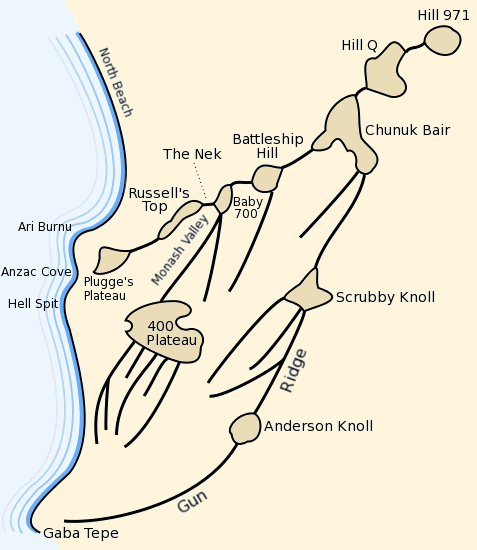
Phase 2: Plateau 400 overlooked ANZAC Cove to the north and Gaba Tepe to the south
"Anzac plateaus and ridges" by Gsl at English Wikipedia - Transferred from en.wikipedia to Commons.. Licensed under Public Domain via Wikimedia Commons - https://commons.wikimedia.org/wiki/File ... ridges.png
Map: WWI Gallipoli, 6-p
Twenty-four players continue.
Phase 3: Before the war, a lush growth of Turkish Pine covered Plateau 400
Map: Third Crusade, 6-p
Phase 4: Ottoman troops cut down most of the trees to get timbers for their trenchworks

Map: WWI Ottoman, 6-p
Score resets, Twenty-one players continue
Phase 5: A single lone pine survived
Map: Doodle Earth, 3-p
Phase 6: As part of the August Offensive, the Aussies were to take Plateau 400
Map: WWI Gallipoli, 7-p
Eighteen players continue
Phase 7: The Australian 1st Infantry Division was commanded by Neville Smyth
Map: Australia, 6-p

Phase 8: Smyth had won a Victoria Cross at the Battle of Khartoum
Map: Eastern Hemisphere, 6-p
Score resets, fifteen players continue
Phase 9: In preparation for the attack, Australian engineers dug a secret tunnel
Map: Siege!, 5-p
Phase 10: The initial attack was successful, and captured the Ridge

Map: World 2.1, 5-p
Twelve players continue
Phase 11: That night the Ottoman forces began a counter-attack
Map: AOR III, 6-p
Phase 12: For three days and four nights the battle raged
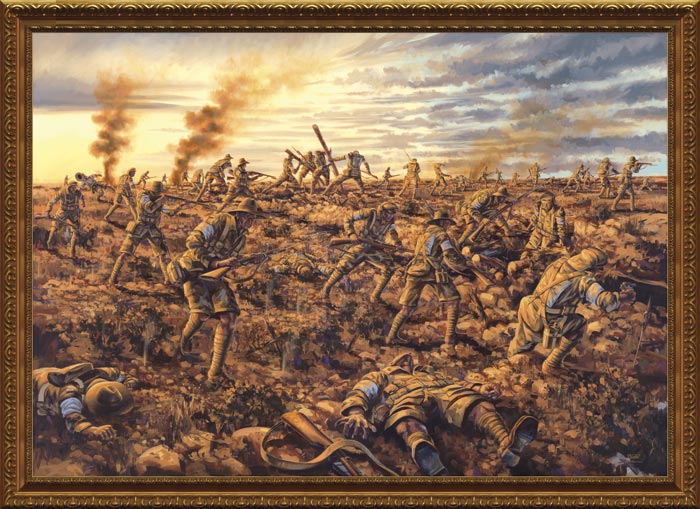
http://www.sandsofgallipoli.com.au/coll ... /sog13.php"This beautiful collection features images from the painting The Battle of Lone Pine by the renowned Australian artist Drew Harrison. The painting was commissioned by Military Shop and was completed in late 2012."
Map: Trench Warfare, 6-p
Score resets, nine players continue
Phase 13: In the confusing network of tunnels, it was brutal hand-to-hand fighting
Map: Draknor, 9-p
Phase 14: At a cost of 8000 lives, an area of about one-sixth of a square mile had been captured
Map: Cricket, 9-p
Six players continue
Phase 15: The pine tree was obliterated, but seeds were taken home by Aussie soldiers
Map: Rail Australia, 6-p
Phase 16: They were planted at various locations around Australia, and commemorate the battle
Map: Oceania, 6-p
https://en.wikipedia.org/wiki/Lone_Pine_%28tree%29
This tourney features a large number of Standard or Terminator games on site-default settings (sunny chained escalating). If you love this type of game (basically, SoC-style games) you will love this tournament.
Some accounts of the battle:
On the Australian Gallipoli site: http://www.gallipoli.gov.au/bravery-awa ... e-pine.php
On wikipedia: https://en.wikipedia.org/wiki/Battle_of_Lone_Pine
On firstworldwar.com: http://www.firstworldwar.com/battles/lonepine.htm
On youtube:
-----------------------------------------------------------------------------------------------------------------------
All games randomly Standard/Terminator multiplayer, sunny chained escalating. Only the map varies. Odd-numbered rounds are four games, and even-numbered rounds are five games. There is an elimination after every two rounds and a score reset after every four rounds.
Thirty players begin
Phase 1: On Allied maps, it was Plateau 400. To Aussie soldiers, it was Lone Pine Ridge
Map: Classic, 6-p
Phase 2: Plateau 400 overlooked ANZAC Cove to the north and Gaba Tepe to the south
- Click image to enlarge.
Map: WWI Gallipoli, 6-p
Twenty-four players continue.
Phase 3: Before the war, a lush growth of Turkish Pine covered Plateau 400
Map: Third Crusade, 6-p
Phase 4: Ottoman troops cut down most of the trees to get timbers for their trenchworks
Map: WWI Ottoman, 6-p
Score resets, Twenty-one players continue
Phase 5: A single lone pine survived
Map: Doodle Earth, 3-p
Phase 6: As part of the August Offensive, the Aussies were to take Plateau 400
Map: WWI Gallipoli, 7-p
Eighteen players continue
Phase 7: The Australian 1st Infantry Division was commanded by Neville Smyth
Map: Australia, 6-p
Phase 8: Smyth had won a Victoria Cross at the Battle of Khartoum
Map: Eastern Hemisphere, 6-p
Score resets, fifteen players continue
Phase 9: In preparation for the attack, Australian engineers dug a secret tunnel
Map: Siege!, 5-p
Phase 10: The initial attack was successful, and captured the Ridge
Map: World 2.1, 5-p
Twelve players continue
Phase 11: That night the Ottoman forces began a counter-attack
Map: AOR III, 6-p
Phase 12: For three days and four nights the battle raged
http://www.sandsofgallipoli.com.au/coll ... /sog13.php"This beautiful collection features images from the painting The Battle of Lone Pine by the renowned Australian artist Drew Harrison. The painting was commissioned by Military Shop and was completed in late 2012."
Map: Trench Warfare, 6-p
Score resets, nine players continue
Phase 13: In the confusing network of tunnels, it was brutal hand-to-hand fighting
Map: Draknor, 9-p
Phase 14: At a cost of 8000 lives, an area of about one-sixth of a square mile had been captured
Map: Cricket, 9-p
Six players continue
Phase 15: The pine tree was obliterated, but seeds were taken home by Aussie soldiers
Map: Rail Australia, 6-p
Phase 16: They were planted at various locations around Australia, and commemorate the battle
Map: Oceania, 6-p
https://en.wikipedia.org/wiki/Lone_Pine_%28tree%29
-- DKwikipedia wrote:Keith McDowell, an Australian soldier of the 23rd Battalion who fought at Gallipoli, brought a pine cone from the battle site home to Australia.[5] Many years later seeds from the cone were planted by his wife's aunt Emma Gray of Grassmere, near Warrnambool, Victoria and five seedlings emerged, with four surviving. These seedlings were planted in four different locations in Victoria: Wattle Park (May 8, 1933), the Shrine of Remembrance (June 11, 1933), the Soldiers Memorial Hall at The Sisters near Terang (June 18, 1933) and Warrnambool Botanic Gardens (January 23, 1934).[2]
The tree at the Shrine Reserve was planted near the north-east corner of the building by Lieutenant-General Sir Stanley Savige, founder of Melbourne Legacy at a formal ceremony.[6] In 2005 the tree required cable bracing following the loss of a major limb and in 2012, despite measures taken to try to save the tree from the effects of disease caused by the fungus Diplodia pinea, it was removed in August.[7][8] A "grandchild tree" was planted nearby in 2006.[8] A Middle Park man, Andrew Lees, collected cones from the broken limb in 2005 and by 2015 had managed to germinate about 20 seedlings.[9]
Another soldier, Lance Corporal Benjamin Smith from the 3rd Battalion, also retrieved a cone from the battle site and sent it back to his mother (Mrs McMullen) in Australia, who had lost another son at the battle. Seeds from the cone were planted by Mrs McMullen in 1928, from which two seedlings were raised.[3] One was presented to her home town of Inverell, New South Wales and the other was forwarded to Canberra where it was planted by Prince Henry, Duke of Gloucester at the Australian War Memorial (AWM) in October 1934.[3] The AWM lone pine lost two of its large lower limbs from strong winds preceding a thunderstorm on 27 December 2008, although tree surgeons were brought in to save the historic tree.[10][11]
Both Melbourne Legacy and the Yarralumla Nursery in Canberra have raised and grown seedlings over a number of years, sourced from the tree at the Shrine of Remembrance and the Australian War Memorial respectively, which they have presented to schools as well as ex-service and other organisations throughout Australia.[12]
According to plaques at its base, this pine tree at the Oatley Park Avenue entrance to Oatley Park, NSW, was grown from pine cones taken from Lone Pine, Gallipoli.
According to plaques at its base, the pine tree at the Oatley Park Avenue entrance to Oatley Park in NSW was planted in 1920 by Owen Jones Davies from pine cones obtained from Lone Pine, Gallipoli.
According to plaques at its base, this pine tree at the Oatley Park Avenue entrance to Oatley Park, NSW, was grown from pine cones taken from Lone Pine, Gallipoli. https://commons.wikimedia.org/wiki/File ... y_Park.JPG
- Click image to enlarge.
---
In Auckland, two trees identified as "Lone Pines" have been planted. One is a Pinus canariensis planted at Waikumete cemetery in 1961 and another is a Pinus radiata at Auckland War Memorial Museum, planted on Anzac Day in 1950.[12] A tree identified as "The Anzac Pine" stands on Te Mata Peak at Havelock North in Hawkes Bay. Although a specimen of Pinus brutia was originally planted, the current tree is identified as the species Pinus radiata.[12] Two specimens of Pinus halepensis, planted in 1951, are located at the Lone Pine Memorial at the cemetery in Taradale, and further specimens are located at King Edward Park in Stratford and Queens Park in Wanganui.[12] There is a "Lone Pine" at the Paeroa golf course, at the ladies tee, on the second hole. This tree appears to be New Zealand's only authentic Pinus brutia that can be traced back to the original pines, according to "Excerpts from NZ Journal of Forestry, May 2007". Also, in Victoria Park, Christchurch, there is a plaque which claims that the nearby pine tree was grown from a seedling of the Gallipoli Lone Pine.


krithia vineyard
Krithia Vineyard
The landings at Suvla Bay were conceived because the previous landing zones at Cape Hellas and Anzac Cove were showing no progress. Sir Ian Hamilton anticipated shifting the emphasis of the Gallipoli offensive northward to Suvla. However, an important part of his plan for the August Offensive was that the troops at Anzac Cove and Cape Hellas would at least try to break out from their landing zones. Their attacks were meant to be diversions for the most part. However, he did not inform the commanders in those areas that their attacks were diversionary. Thus, they launched full-scale breakout efforts. Terrible leadership and terrible miscommunications were endemic to the entire Gallipoli campaign.
General Aylmer Hunter-Weston, regarded by many as one of the worst generals of the war, had been removed from his command. The real reason was his horrific casualties and his lack of results, but nobody was willing to put it that bluntly, so the nominal reason was poor health due to sunstroke. General Francis Davies had arrived at Cape Helles to take over, but had not yet formally accepted command. The actual battle plan, therefore, was put together by General Harold Edward Street, a student of Hunter-Weston, and every bit as unimaginative in planning and callous with casualties.
Starting on the 6th, attack after attack was made. The British 88th brigade suffered massive casualties and was effectively destroyed as a fighting force. To the right of the 88th, the 127th Brigade did break through the Ottoman lines for a short distance and made some small gains. It suffered repeated counter-attacks. The fighting subsided by the 13th, by which point there had been 4,000 British and 7,000 Ottoman casualties.
-----------------------------------------------------------------------------------------------------------------------
DoomYoshi suggested the idea of making this an assassin tournament. It often happens that, in the playing of an Assassin game, a player will expend all his troops trying to achieve his objective, and will leave himself completely vulnerable to the next attacker. This is roughly what happened here, with the 88th Brigade and their Ottoman counterparts completely exsanguinating themselves in the pursuit of the Vineyard trench systems.
There will be only four rounds in this tournament, all Assassin, Automatic Sequential Chained Non-Trench with a 30-round limit. Spoils will be randomly escalating/flat/nuclear. Rounds 1 and 3 will be all sunny, rounds 2 and 4 will be randomly sunny/foggy.
28 players begin
Round 1, five 7-player games
16 players continue
Round 2, seven 8-player games
Score reset, 10 players advance
Round 3, nine 5-player games
6 players proceed to the Final.
Round 4, eleven 6-player games
All games in all four rounds will be randomly chosen from the 25 maps in the lists below:
Seven maps representing the combatants at Gallipoli:
Unification Germany
Classic Cities: Istanbul
British Isles
France
Australia
New Zealand
Indian Empire
Four maps representing the backdrop of the Gallipoli campaign:
Europe1914
WW I Ottoman
WW I Gallipoli
Balkan Peninsula
Three maps representing the convoluted politics in the British Army:
King's Court
Forbidden City
Poison Rome
Three maps representing the broken terrain:
Midkemdil
San Marino
Scotland
Five maps representing the complexities of the trenches and communication routes:
Labyrinth
Patch Wars
Trench Warfare
Rail Europe
Northwest Passage
Three maps representing the desperate, bloody, hand-to-hand combat:
Stalingrad
Battle for Iraq!
WWII Ardennes
-- DK
The landings at Suvla Bay were conceived because the previous landing zones at Cape Hellas and Anzac Cove were showing no progress. Sir Ian Hamilton anticipated shifting the emphasis of the Gallipoli offensive northward to Suvla. However, an important part of his plan for the August Offensive was that the troops at Anzac Cove and Cape Hellas would at least try to break out from their landing zones. Their attacks were meant to be diversions for the most part. However, he did not inform the commanders in those areas that their attacks were diversionary. Thus, they launched full-scale breakout efforts. Terrible leadership and terrible miscommunications were endemic to the entire Gallipoli campaign.
General Aylmer Hunter-Weston, regarded by many as one of the worst generals of the war, had been removed from his command. The real reason was his horrific casualties and his lack of results, but nobody was willing to put it that bluntly, so the nominal reason was poor health due to sunstroke. General Francis Davies had arrived at Cape Helles to take over, but had not yet formally accepted command. The actual battle plan, therefore, was put together by General Harold Edward Street, a student of Hunter-Weston, and every bit as unimaginative in planning and callous with casualties.
Starting on the 6th, attack after attack was made. The British 88th brigade suffered massive casualties and was effectively destroyed as a fighting force. To the right of the 88th, the 127th Brigade did break through the Ottoman lines for a short distance and made some small gains. It suffered repeated counter-attacks. The fighting subsided by the 13th, by which point there had been 4,000 British and 7,000 Ottoman casualties.
-----------------------------------------------------------------------------------------------------------------------
DoomYoshi suggested the idea of making this an assassin tournament. It often happens that, in the playing of an Assassin game, a player will expend all his troops trying to achieve his objective, and will leave himself completely vulnerable to the next attacker. This is roughly what happened here, with the 88th Brigade and their Ottoman counterparts completely exsanguinating themselves in the pursuit of the Vineyard trench systems.
There will be only four rounds in this tournament, all Assassin, Automatic Sequential Chained Non-Trench with a 30-round limit. Spoils will be randomly escalating/flat/nuclear. Rounds 1 and 3 will be all sunny, rounds 2 and 4 will be randomly sunny/foggy.
28 players begin
Round 1, five 7-player games
16 players continue
Round 2, seven 8-player games
Score reset, 10 players advance
Round 3, nine 5-player games
6 players proceed to the Final.
Round 4, eleven 6-player games
All games in all four rounds will be randomly chosen from the 25 maps in the lists below:
Seven maps representing the combatants at Gallipoli:
Unification Germany
Classic Cities: Istanbul
British Isles
France
Australia
New Zealand
Indian Empire
Four maps representing the backdrop of the Gallipoli campaign:
Europe1914
WW I Ottoman
WW I Gallipoli
Balkan Peninsula
Three maps representing the convoluted politics in the British Army:
King's Court
Forbidden City
Poison Rome
Three maps representing the broken terrain:
Midkemdil
San Marino
Scotland
Five maps representing the complexities of the trenches and communication routes:
Labyrinth
Patch Wars
Trench Warfare
Rail Europe
Northwest Passage
Three maps representing the desperate, bloody, hand-to-hand combat:
Stalingrad
Battle for Iraq!
WWII Ardennes
-- DK
Hill 60 and Scimitar Hill sept 6 to 16
Hill 60 and Scimitar Hill
These were the last offensive actions undertaken by the Allies at Gallipoli. Trying to revive the lost impetus of the August 6th offensive, Hamilton withdrew the 29th Division from Hellas Cape and shipped it north. Now under the command of Sir Henry de Beauvoir de Lisle, the 29th was to take Scimtar Hill and another unit was to take the "W" Hills north of it. Meanwhile, the Anzacs were to take Hill 60. (You can see Scimitar Hill and Hill 60 on our Gallipoli map, which depicts the campaign with a great deal of accuracy.)
The attacks began on August 21st in very dense fog. The fog was both a curse and a blessing. At "W" hill, the division that was sent there got completely lost in the fog and never showed up on the battlefield at all. At least, that was their story and they're sticking to it. At Scimitar Hill, the fog covered the British advance. The British were able to storm the hill and gain an initial advantage before the Turks even noticed there was a battle going on. At Hill 60, somewhat the opposite happened. The Anzacs rushed the Hill, unable to see the Turkish machine gun nests on their flank, and were brutally mauled.
More detail:
Hill 60
Scimtar Hill
The two tournaments I have written for the occasion are, naturally enough, closely related. The fog was the most dominant feature in both battles, so appropriately enough 100% of the games are foggy. Hill 60 was a smaller battle and Scimitar Hill much larger, so the former has smaller games (3 to 5 players) and the latter has larger games (8 to 12 players.) Both tournaments are three-rounders, beginning on the WW I Gallipoli map (naturally enough) and ending on Random map (representing the general chaos and disorder at the end.)
For the middle rounds, I've chosen maps representing salient unique features. At Scimitar Hill, one of the most noteworthy deviations from the norm was that the heaviest British casualties came after their own artillery started a brush fire which burned backwards against their lines and consumed hundreds of troops. This reminded me of Zhuge Liang and famous incidents during the wars of the Three Kingdoms where fields were set on fire to burn troops marching through them. Thus, the round 2 map for Scimitar Hill will be Three Kingdoms of China. At Hill 60, the greatest woe came from the Ottoman machine-gun nests, so I've chosen a selection of maps where machine guns were significant, including of course WW I and WW II maps but also American Civil War, where the Gatling gun made its debut, and South Africa 1885.
Hill 60
24 players start
General Birdwood's Anzacs were to capture Hill 60
Seven 4-player games on WW I Gallipoli, all Foggy, no Trench, randomly Esc, Flat, No Spoils.
Fifteen players advance
Machine gun nests that they couldn't see in the fog mowed them down
Eight 5-player games on D-Day Omaha, American Civil War, Trench Warfare, Stalingrad, South Africa 1885, WW II Iwo Jima, WW II Australia, WW II Gazala, all Foggy, no Trench, randomly Esc, Flat, No Spoils.
Three players advance
In the end, chaos ruled and the operation was a failure.
Nine 3-player games on Random map, all Foggy, no Trench, randomly Esc, Flat, No Spoils.
Scimitar Hill
24 Players start
The 29th Division was to take Scimitar Hill
Seven 8-player games on WW I Gallipoli, all Foggy, no Trench, randomly Esc, Flat, No Spoils.
Twenty players advance
A fire consumed many British troops, like fire tactics in China's Three Kingdoms War
Eight 10-player games on Three Kingdoms of China, all Foggy, no Trench, randomly Esc, Flat, No Spoils.
Twelve players advance
After much back-and-forth, the demoralized British retreated.
Nine 12-player games on Random map, all Foggy, no Trench, randomly Esc, Flat, No Spoils.
-- DK
These were the last offensive actions undertaken by the Allies at Gallipoli. Trying to revive the lost impetus of the August 6th offensive, Hamilton withdrew the 29th Division from Hellas Cape and shipped it north. Now under the command of Sir Henry de Beauvoir de Lisle, the 29th was to take Scimtar Hill and another unit was to take the "W" Hills north of it. Meanwhile, the Anzacs were to take Hill 60. (You can see Scimitar Hill and Hill 60 on our Gallipoli map, which depicts the campaign with a great deal of accuracy.)
The attacks began on August 21st in very dense fog. The fog was both a curse and a blessing. At "W" hill, the division that was sent there got completely lost in the fog and never showed up on the battlefield at all. At least, that was their story and they're sticking to it. At Scimitar Hill, the fog covered the British advance. The British were able to storm the hill and gain an initial advantage before the Turks even noticed there was a battle going on. At Hill 60, somewhat the opposite happened. The Anzacs rushed the Hill, unable to see the Turkish machine gun nests on their flank, and were brutally mauled.
More detail:
Hill 60
Scimtar Hill
The two tournaments I have written for the occasion are, naturally enough, closely related. The fog was the most dominant feature in both battles, so appropriately enough 100% of the games are foggy. Hill 60 was a smaller battle and Scimitar Hill much larger, so the former has smaller games (3 to 5 players) and the latter has larger games (8 to 12 players.) Both tournaments are three-rounders, beginning on the WW I Gallipoli map (naturally enough) and ending on Random map (representing the general chaos and disorder at the end.)
For the middle rounds, I've chosen maps representing salient unique features. At Scimitar Hill, one of the most noteworthy deviations from the norm was that the heaviest British casualties came after their own artillery started a brush fire which burned backwards against their lines and consumed hundreds of troops. This reminded me of Zhuge Liang and famous incidents during the wars of the Three Kingdoms where fields were set on fire to burn troops marching through them. Thus, the round 2 map for Scimitar Hill will be Three Kingdoms of China. At Hill 60, the greatest woe came from the Ottoman machine-gun nests, so I've chosen a selection of maps where machine guns were significant, including of course WW I and WW II maps but also American Civil War, where the Gatling gun made its debut, and South Africa 1885.
Hill 60
24 players start
General Birdwood's Anzacs were to capture Hill 60
Seven 4-player games on WW I Gallipoli, all Foggy, no Trench, randomly Esc, Flat, No Spoils.
Fifteen players advance
Machine gun nests that they couldn't see in the fog mowed them down
Eight 5-player games on D-Day Omaha, American Civil War, Trench Warfare, Stalingrad, South Africa 1885, WW II Iwo Jima, WW II Australia, WW II Gazala, all Foggy, no Trench, randomly Esc, Flat, No Spoils.
Three players advance
In the end, chaos ruled and the operation was a failure.
Nine 3-player games on Random map, all Foggy, no Trench, randomly Esc, Flat, No Spoils.
Scimitar Hill
24 Players start
The 29th Division was to take Scimitar Hill
Seven 8-player games on WW I Gallipoli, all Foggy, no Trench, randomly Esc, Flat, No Spoils.
Twenty players advance
A fire consumed many British troops, like fire tactics in China's Three Kingdoms War
Eight 10-player games on Three Kingdoms of China, all Foggy, no Trench, randomly Esc, Flat, No Spoils.
Twelve players advance
After much back-and-forth, the demoralized British retreated.
Nine 12-player games on Random map, all Foggy, no Trench, randomly Esc, Flat, No Spoils.
-- DK
“Life is a shipwreck, but we must not forget to sing in the lifeboats.”
― Voltaire
― Voltaire
Re: The Great War
And we are back in action with a new tournament:
I have taken out the turns-taken requirement. It was not particularly popular, but more importantly it wasn't really a great success in terms of avoiding deadbeats in the tourneys. I think I might use it again but only in tourneys that have a predominance of Assassin games.
battle of loos
Battle of Loos
The German strategy for 1915 had emphasized the Eastern Front, and many German troops had been sent east. The Allies on the Western Front, therefore, enjoyed numerical superiority for almost an entire year, and yet time and time again failed to make any gains.

The best account of Loos that I have found is at http://www.1914-1918.net/bat13.htm
The overall strategic plan:


British Commander Sir Douglas Haig was not at all enthused about the prospects for the battle. He was concerned about the fatigue of his long-suffering troops, the unsuitability of the soggy fields for offensive movements, and above all the shortage of artillery shells that had plagued the British forces since the spring of 1915. Against his better judgement, Haig was ordered by his superior, Sir John French, to proceed with the offensive.
The British used every tool at their disposal. The Royal Flying Corps stocked up on extra planes, the Medical Corps made preparations to treat and evacuate up to 40,000 casualties, the artillery was as stocked as the shell shortage allowed, and most significantly, large amounts of chlorine gas were to be used.
In the fields between the La Bassee Canal and Hulloch, Haig deployed his I Corps, while IV Corps was given the southern half of the attack zone, between Hulloch and Cite St. Laurent. II and III Corps were to make diversionary attacks along the flanks.
The IX Corps was to form a strategic reserve to exploit any breakthrough made. Significantly, however, the IX Corp reserves were not put under Haig's command and could only be used by order of Sir John French. The reserves were 16 miles from the front. Haig protested vehemently, but was overruled. This divisive element was to prove significant. The British forces essentially made a breakthrough late in the day on the 25th, but were unable to exploit it. By the time reserves were authorized and moved up, it was the 26th and the moment had passed. This was a catastrophic mistake which turned a potentially huge victory into an eventual defeat.
Sir John French tried to cover up his mistake with the reserves by telling blatant untruths in his post-action dispatch, but the truth was exposed, and the defeat at Loos was a major contributor to French's dismissal later that year.
The Tournament:
To reflect the very large and ambitious nature of the battle, all games will be large standard multiplayer games with five to eleven players. To reflect the spotty quality of the reconnaissance, fog and no fog will run randomly throughout, except in Phase 4, which will be all-sunny. To represent the fact that the battle was mostly fought in the trenches, and very slow moving even on the level ground, all games will use the Trench setting. Spoils will randomly shift between flat rate and nuclear -- flat rate representing the normal pace of battle, and nuclear representing the devastation wrought by the gas attacks. Three reinforcement options will be randomly mixed: adjacent representing the normal slow pace of reinforcement, no forts representing the days when it was extra bad, and chained representing the days when it was extra good.
Three games per round, except the last round.
30 players start
Phase 1: Since 1914, Europa had been at war, characterized by trench warfare
Maps: Europa, Europe1914, Trench Warfare. 6-p games, other settings as discussed above.
no eliminations
Phase 2: The countryside in the area of Loos was much like Waterloo
Map: Waterloo. 10-p games, other settings as discussed above.
28 players advance
Phase 3: Much of what went on was driven by politics in the combatant nations
Maps: England, France, Land and Sea. 7-p games, other settings as discussed above.
24 players advance
Phase 4: The attack was no secret. Not even tactical surprise was achieved
Map: Classic. 6-p games, other settings as discussed above, except no fog in this round.
no eliminations
Phase 5: September 21st saw a massive artillery barrage
Maps: 3 maps drawn randomly from Feudal War, Arms Race!, New World, Feudal Epic, WWII Poland, Age Of Realms 3: Mayhem, City Mogul, Conquer Rome, Antarctica, Eastern Hemisphere, Supermax: Prison Riot!, Pearl Harbor, WWII Western Front, King's Court, Duck And Cover, for the same reasons given in the Maubeuge tournament. 6-p games, other settings as discussed above.
20 players advance
Phase 6: Poison gas is released at 550 in the morning, and the infantry follows 40 minutes later. All is pandemonium
Map: Clandemonium. 10-p games, other settings as discussed above.
18 players advance
There is a score reset here. Phases 1 to 6 represent preliminaries. Phases 7 to 12 represent the actions of September 25th, when the main part of the offensive opened and all hell broke loose.
Phase 7: The 2nd division found no success and suffered heavy casualties, including from its own gas blowing the wrong way
Map: AOR3 Mayhem. 6-p games, other settings as discussed above.
16 players advance
Phase 8: The 9th Scots advanced through a hellish landscape of deep trenches full of residual gas
Map: Labyrinth. 8-p games, other settings as discussed above.
14 players advance
Phase 9: The 7th Division faced some of the strongest German defenses, including the Hohenzollern Redoubt
Maps: Germany, Unification Germany, Holy Roman Empire. 7-p games, other settings as discussed above.
12 players advance
Phase 10: The 1st Division started late and ran into trouble early, and was effectively halted by the Germans
Map: Das Schloss. 6-p games, other settings as discussed above.
11 players advance
Phase 11: The 15th Scots had the most impressive advance, capturing the town of Loos
Map: Scotland. 11-p games, other settings as discussed above.
10 players advance
Phase 12: The 2nd Londoners also made impressive gains, capturing the Double Crassier south of Loos
They did, however, make the critical mistake of not fortifying the Double Crassier after taking it.
Map: Classic Cities London. 5-p games, other settings as discussed above.
Score reset, 9 players advance
Phase 13: Lack of reserves meant that Haig was unable to exploit the breakthrough at Loos
Casting about for some excuse to broaden the map selection beyond Western Europe, I am struck by the similarities between this decision and Halsey's much criticized decision at the Battle of Leyte Gulf to pull the 3rd Fleet so far north of the 7th Fleet. Of course, Halsey was playing in a war which was almost over, so his mistake didn't have the catastrophic consequences that French's did.
Map: Phillipines. 9-p games, other settings as discussed above.
8 players advance
Phase 14: During the night, the IX Corps shuffled forward. The Germans beat them to the punch
Like Arminius at Kalkriese.
Map: Conquer Rome. 8-p games, other settings as discussed above.
7 players advance
Phase 15: The IX Corps was finally committed, but too late. A vicious see-saw battle developed
Maps: WWII Ardennes, WWII Iwo Jima, WWII Gazala. 7-p games, other settings as discussed above.
6 players advance
Phase 16: On Oct 3rd a German counterattack developed
Map: Unification Germany. 6-p games, other settings as discussed above.
no eliminations
Phase 17: The British made one final attempt on Oct 13, but it too failed
Map: British Isles. FIVE 6-p games, other settings as discussed above.
The German strategy for 1915 had emphasized the Eastern Front, and many German troops had been sent east. The Allies on the Western Front, therefore, enjoyed numerical superiority for almost an entire year, and yet time and time again failed to make any gains.
The best account of Loos that I have found is at http://www.1914-1918.net/bat13.htm
The overall strategic plan:
1914 to 1918 dot net wrote:Whilst in the planning for the spring offensives a shortage of men and munitions had limited the French attack to Artois in the north, the situation was now changed. The French Army was 200,000 men stronger than it had been in October 1914. Joffre was anxious to strike while there was a superiority of numbers against the enemy in the West. This time, the Artois attack would be renewed, along with a large northward attack in the Champagne. The Champagne attack would be the larger of the two, aiming to seize much open country of that area, forcing the enemy back. The Artois attack would aim at the critical rail networks between Douai and Noyon that the Germans relied upon to maintain much of the front. An advance of only 20 miles would surely force a German withdrawal. So Joffre's strategic plan included three converging offensives designed to break through the German defensive lines, although only two attacks were eventually made:
This was very much along the same lines as his failed plan for spring 1915, but bigger and broader.
- An advance from the Artois plateau, east across the plain of Douai to the German communications centres in the Noyon area.
- An attack from Rheims in the Champagne, against the Mezières - Hirson railway.
- An attack from the area Verdun - Nancy, north to the Rhine crossings.
The tactical plan in the British sector:1914 to 1918 dot net wrote:The combined Franco-British offensive would attack eastwards against the German Sixth Army. The whole force, supervised by General Foch, would consist of French Tenth Army and British First Army. It would attack on a 20-mile front between Arras and La Bassée. Although artillery would bombard the whole front, no attack would be made on a central 4000-yard strip facing the towns of Liévin and Lens. South of this gap, the French Tenth Army would throw 17 infantry Divisions against the enemy, supported by 420 heavy guns with two cavalry Divisions ready to exploit the expected breakthrough. To the North, British First Army would attack with the six Divisions of I and IV Corps, having 70 heavy guns available, with two cavalry corps (Indian and III) to push the advance forward. The objectives were imprecise but optimistic; the cavalry were to reach the area of Ath and Mons, 50 miles away in Belgium.
British Commander Sir Douglas Haig was not at all enthused about the prospects for the battle. He was concerned about the fatigue of his long-suffering troops, the unsuitability of the soggy fields for offensive movements, and above all the shortage of artillery shells that had plagued the British forces since the spring of 1915. Against his better judgement, Haig was ordered by his superior, Sir John French, to proceed with the offensive.
The British used every tool at their disposal. The Royal Flying Corps stocked up on extra planes, the Medical Corps made preparations to treat and evacuate up to 40,000 casualties, the artillery was as stocked as the shell shortage allowed, and most significantly, large amounts of chlorine gas were to be used.
In the fields between the La Bassee Canal and Hulloch, Haig deployed his I Corps, while IV Corps was given the southern half of the attack zone, between Hulloch and Cite St. Laurent. II and III Corps were to make diversionary attacks along the flanks.
The IX Corps was to form a strategic reserve to exploit any breakthrough made. Significantly, however, the IX Corp reserves were not put under Haig's command and could only be used by order of Sir John French. The reserves were 16 miles from the front. Haig protested vehemently, but was overruled. This divisive element was to prove significant. The British forces essentially made a breakthrough late in the day on the 25th, but were unable to exploit it. By the time reserves were authorized and moved up, it was the 26th and the moment had passed. This was a catastrophic mistake which turned a potentially huge victory into an eventual defeat.
Sir John French tried to cover up his mistake with the reserves by telling blatant untruths in his post-action dispatch, but the truth was exposed, and the defeat at Loos was a major contributor to French's dismissal later that year.
The Tournament:
To reflect the very large and ambitious nature of the battle, all games will be large standard multiplayer games with five to eleven players. To reflect the spotty quality of the reconnaissance, fog and no fog will run randomly throughout, except in Phase 4, which will be all-sunny. To represent the fact that the battle was mostly fought in the trenches, and very slow moving even on the level ground, all games will use the Trench setting. Spoils will randomly shift between flat rate and nuclear -- flat rate representing the normal pace of battle, and nuclear representing the devastation wrought by the gas attacks. Three reinforcement options will be randomly mixed: adjacent representing the normal slow pace of reinforcement, no forts representing the days when it was extra bad, and chained representing the days when it was extra good.
Three games per round, except the last round.
30 players start
Phase 1: Since 1914, Europa had been at war, characterized by trench warfare
Maps: Europa, Europe1914, Trench Warfare. 6-p games, other settings as discussed above.
no eliminations
Phase 2: The countryside in the area of Loos was much like Waterloo
Map: Waterloo. 10-p games, other settings as discussed above.
28 players advance
Phase 3: Much of what went on was driven by politics in the combatant nations
Maps: England, France, Land and Sea. 7-p games, other settings as discussed above.
24 players advance
Phase 4: The attack was no secret. Not even tactical surprise was achieved
Map: Classic. 6-p games, other settings as discussed above, except no fog in this round.
no eliminations
Phase 5: September 21st saw a massive artillery barrage
Maps: 3 maps drawn randomly from Feudal War, Arms Race!, New World, Feudal Epic, WWII Poland, Age Of Realms 3: Mayhem, City Mogul, Conquer Rome, Antarctica, Eastern Hemisphere, Supermax: Prison Riot!, Pearl Harbor, WWII Western Front, King's Court, Duck And Cover, for the same reasons given in the Maubeuge tournament. 6-p games, other settings as discussed above.
20 players advance
Phase 6: Poison gas is released at 550 in the morning, and the infantry follows 40 minutes later. All is pandemonium
Map: Clandemonium. 10-p games, other settings as discussed above.
18 players advance
There is a score reset here. Phases 1 to 6 represent preliminaries. Phases 7 to 12 represent the actions of September 25th, when the main part of the offensive opened and all hell broke loose.
Phase 7: The 2nd division found no success and suffered heavy casualties, including from its own gas blowing the wrong way
Map: AOR3 Mayhem. 6-p games, other settings as discussed above.
16 players advance
Phase 8: The 9th Scots advanced through a hellish landscape of deep trenches full of residual gas
Map: Labyrinth. 8-p games, other settings as discussed above.
14 players advance
Phase 9: The 7th Division faced some of the strongest German defenses, including the Hohenzollern Redoubt
Maps: Germany, Unification Germany, Holy Roman Empire. 7-p games, other settings as discussed above.
12 players advance
Phase 10: The 1st Division started late and ran into trouble early, and was effectively halted by the Germans
Map: Das Schloss. 6-p games, other settings as discussed above.
11 players advance
Phase 11: The 15th Scots had the most impressive advance, capturing the town of Loos
Map: Scotland. 11-p games, other settings as discussed above.
10 players advance
Phase 12: The 2nd Londoners also made impressive gains, capturing the Double Crassier south of Loos
- Click image to enlarge.
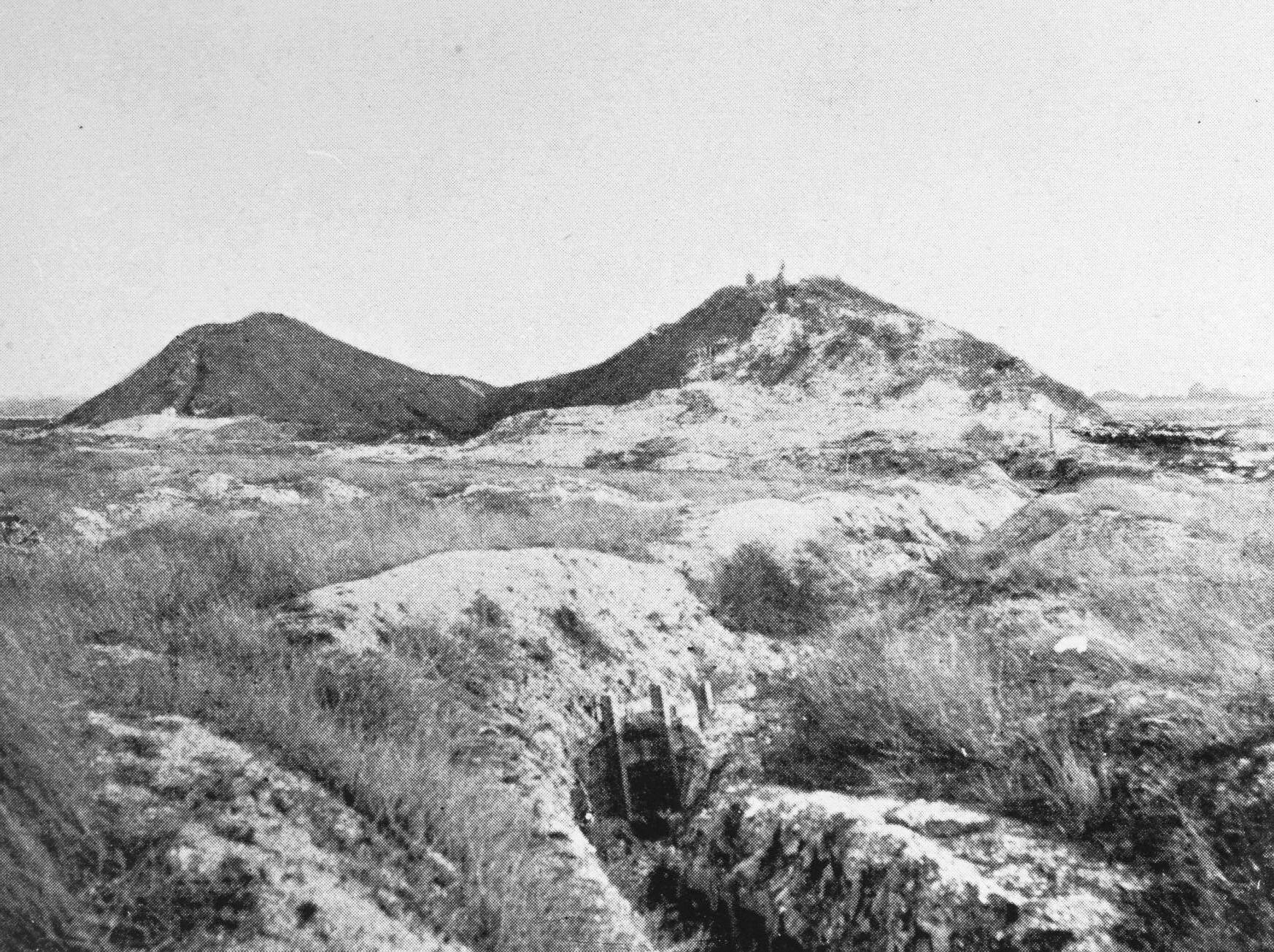
Map: Classic Cities London. 5-p games, other settings as discussed above.
Score reset, 9 players advance
Phase 13: Lack of reserves meant that Haig was unable to exploit the breakthrough at Loos
Casting about for some excuse to broaden the map selection beyond Western Europe, I am struck by the similarities between this decision and Halsey's much criticized decision at the Battle of Leyte Gulf to pull the 3rd Fleet so far north of the 7th Fleet. Of course, Halsey was playing in a war which was almost over, so his mistake didn't have the catastrophic consequences that French's did.
Map: Phillipines. 9-p games, other settings as discussed above.
8 players advance
Phase 14: During the night, the IX Corps shuffled forward. The Germans beat them to the punch
Like Arminius at Kalkriese.
Map: Conquer Rome. 8-p games, other settings as discussed above.
7 players advance
Phase 15: The IX Corps was finally committed, but too late. A vicious see-saw battle developed
Maps: WWII Ardennes, WWII Iwo Jima, WWII Gazala. 7-p games, other settings as discussed above.
6 players advance
Phase 16: On Oct 3rd a German counterattack developed
Map: Unification Germany. 6-p games, other settings as discussed above.
no eliminations
Phase 17: The British made one final attempt on Oct 13, but it too failed
Map: British Isles. FIVE 6-p games, other settings as discussed above.
“Life is a shipwreck, but we must not forget to sing in the lifeboats.”
― Voltaire
― Voltaire