The Race to the Sea
 http://en.wikipedia.org/wiki/Race_to_the_Sea
Wikipedia wrote:The Race to the Sea took place from about 17 September – 19 October 1914, after the Battle of the Frontiers (7 August–13 September) and the German advance into France, which had been stopped at the First Battle of the Marne (5–12 September) and was followed by the First Battle of the Aisne (13 September – 28 September), a Franco-British counter-offensive.[Note 1] The term described reciprocal attempts by the Franco-British and German armies to envelop the northern flank of the opposing army through Picardy, Artois and Flanders, rather than an attempt to advance northwards to the sea. The "race" ended on the North Sea coast of Belgium around 19 October, when the last open area from Dixmude to the North Sea was occupied by Belgian troops, who had been withdrawn from the Siege of Antwerp (28 September – 10 October). The outflanking attempts had resulted in a number of encounter battles but neither side was able to gain a decisive victory.[Note 2]
In this tournament, the odd-numbered phases consist of a variety of games. These represent the attempt by either the Germans or the Allies to gain an advantage with a flanking maneouvre. The even-numbered phases consist of Polymorphic Dubs games on the Trench Warfare map. These represent the failure of the flanking movement and the resumption of trench warfare. After every pair of rounds, two players are eliminated.
-----------------------------------------------------------------------------------------------------------------------
Phase 1 (17-18 Sep.) On the left flank of their positions on the Aisne, the French Sixth Army attempted to advance. Their aircraft were grounded by bad weather and their cavalry scouts were worn out, resulting in chaos, confusion, and a very indecisive result.
Tournament Phase 1: Three 5-player Standard game on Random map, Foggy, Escalating, Trench, No Reinforcement.
Phase 2 (18 Sep.) The German II Corps arrived and halted the French advance.
Tournament Phase 2: 3 games, Polymorphic Dubs, on the Trench Warfare Map. Fog, Trench, Spoils, and Reinforcement options are randomized.
-----------------------------------------------------------------------------------------------------------------------
Phase 3 (22 Sep.) The French made a major push in the region of Noyon, a city with a great history. The cathedral of Noyon was where Charlemagne was crowned. Two centuries later Hugh Capet was crowned there, marking the beginning of a distinct French state. After another six centuries, the treaty of Noyon in 1516 marked the end of the destructive wars between Francis I of France and Charles V of the Holy Roman Empire.
Tournament Phase 3: Three 9-player Terminator games, on France, Third Crusade, and Holy Roman Empire. Flat Rate and Escalating, Chained and Unlimited, Fog and No Fog, No Trench
Phase 4 (24 Sep.) The German XVIII Corps counterattacked.
Tournament Phase 4: Same as Phase 2.
-----------------------------------------------------------------------------------------------------------------------
Phase 5 (25-27 Sep.) A general confrontation took place all along the front from the Vosges to the Somme. This is the main component of what became known as the First Battle of Picardy.
Tournament Phase 5: Three 8-player Standard games on the France 2.1 map. Flat Rate and Escalating, Chained and Unlimited, Fog and No Fog, No Trench.
Phase 6 The situation between the Somme and the Oise rivers was rapidly turning into a stalemate, as the situation along the Aisne already had.
Tournament Phase 6: Same as Phase 2.
-----------------------------------------------------------------------------------------------------------------------
Phase 7 (24-25 Sep.) Two German corps attacked near Peronne, attempting to cut off the French troops on the south bank of the Somme.
Tournament Phase 7: Three 7-player Terminator games on Random map, Escalating, Chained, Fog and No Fog, No Trench.
Phase 8 The German redeployment found itself directly colliding with a French redeployment. The French dug in along the Somme, as the Germans had along the Aisne.
Tournament Phase 8: Same as Phase 2.
-----------------------------------------------------------------------------------------------------------------------
Phase 9 (27 Sep.) The German cavalry corps, recently arrived from its debacle at Haelen, drove the French 61st and 62nd Reserve Division away from Bapaume. Georg von der Marwitz, the German commander, was a Prussian from Pomerania who gained significant fame on the Eastern front later.
Tournament Phase 9: Three 6-player games on the Baltic Crusades map, No Spoils, Nuclear, and Escalating, Chained and Adjacent, Fog and No Fog, Trench and No Trench.
Phase 10 (28-29) The situation in the Albret/Somme sector also degenerated into trench warfare.
Tournament Phase 10: Same as Phase 2.
-----------------------------------------------------------------------------------------------------------------------
Phase 11 (1-5 Oct.) A large confrontation known as the
First Battle of Arras took place when both the German and French High Commands decided to seize Arras before the other and sent large forces towards the city. One of the great advantages of the Prussians since the 1860s had been their early mastery of using rail to move troops quickly and gain an operational advantage. The French, adapting on the fly, were now catching up in this regard, and at Arras they used rail to bring more troops more quickly than the Germans.
Tournament Phase 11: Three 5-player Terminator Games on the Rail Europe map, Escalating and Flat Rate, Fog and No Fog, all No Trench.
Phase 12 ( 4-6 Oct.) Once again there was no decisive result and Arras became another stop along the great line of trenches.
Tournament Phase 12: Same as Phase 2.
-----------------------------------------------------------------------------------------------------------------------
Phase 13 (12 Oct to 2 Nov)
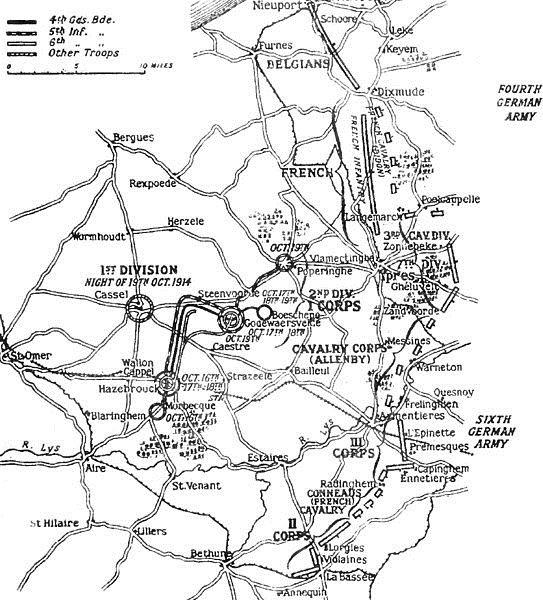
Flanders was essentially controlled swamp. The area around the Lys river was cut by numerous canals and ditches, dykes and causeways. The ground on the often-flooded flats has been described as having the consistency of cream cheese. The BEF was ordered to advance east of Ypres, to deny the Germans the use of key transportation hubs in the area, and also to cover the retreat of the survivors from the fall of Antwerp. Ypres itself was captured by the British without difficulty, but south of Ypres the Germans inflicted massive casualties and halted the Allied advance. In three weeks of bloody back-and-forth fighting, several British divisions were almost annihalated, and French units had to temporarily take up British positions. Messines Ridge changed hands several times. In the end it was back in German hands, as were the towns of Messines and Wytchaete, but ridges west and south were held by the Allies, along with the key river port of Warneton.
Tournament Phase 13: In casting about for an appropriate map to represent the swampy bloodbath of Messines, I decided on Labyrinth. The Traps represent the many hazards posed by the swamps, while the belts of Medusa's gaze represent fields swept by machinegun fire. For reasons of play balance, I decided to move the Battle of Messines ahead of the Battle of La Bassée, which is wrong from a purely chronological viewpoint, but allows us to play Labyrinth 8-player. (6-player games on Labyrinth give a big advantage to players who start with neutrals on one flank.) Three 8-player games, Flat Rate, Fog, No Trench.
Phase 14 (19 Oct to 2 Nov) The now almost-nauseating refrain, "there was no decisive result, and both sides after terrible casualties settled into their trenches"
Tournament Phase 14: Same as Phase 2.
-----------------------------------------------------------------------------------------------------------------------
Phase 15 (10 Oct to 2 Nov) The
Battle of La Bassée took place at the junction of the French and British lines. Among other things, it marked the first appearance of Indian troops of the Lahore Division.
wikipedia wrote:The German 6th Army took Lille before a British force could secure the town and the 4th Army attacked the exposed British flank at Ypres. The British were driven back and the German Army occupied La Bassée and Neuve Chapelle. Around 15 October, the British recaptured Givenchy-lès-la-Bassée but failed to recover La Bassée.
Tournament Phase 15: Three 6-player Standard games, on France, Great Britain, and Indian Empire, Flat Rate and Escalating, Chained and Unlimited, Fog and No Fog, No Trench.
Phase 16 (30 Oct to 2 Nov) Would you be surprised to find that there was no decisive result, and both sides had to settle for an extension of the line of trenches?
Tournament Phase 16: Same as Phase 2.
-----------------------------------------------------------------------------------------------------------------------
Phase 17 (13 Oct to 2 Nov) South of the Lys, an offensive by III Corps Progressed in much the same fashion as the Messines battle north of the Lys. After early gains by the British, they ran into a determined German defense around the village of Armentières. The village was captured, but not much else, and the original British dream of pushing all the way to Lille soon evaporated.

Tournament Phase 17: Trying hard not to further overuse the Trench Warfare map, I look for parallels and find the
other great battle in the trenches represented on Conquer Club: Tobruk. Three four-player Standard games on WWII Gazala, one each of Escalating, Flat, and No Spoils, all Fog and no Trench.
Phase 18 (19 Oct to 2 Nov) By October 19th, the British offensive had petered out, and the Germans pushed back, with equally unspectacular success.
Tournament Phase 18: Same as Phase 2.
-----------------------------------------------------------------------------------------------------------------------
Phase 19 (16-30 Oct) On October 6th, Antwerp fell, and the remnants of the British and Belgian forces retreated to the Yser river. Ten days later, they were entrenched on a line from Nieuport to Dixmunde. On October 16th, the Germans began an offensive at Dixmunde and on October 18th at Nieuport.

Several breakthroughs were made, but a combination of heroic defenses by the Belgian infantry, powerful artillery support from the British Navy, and the insertion of French reserves at key weak points managed to hold most of the line intact.
Preservation of this tiny sliver of Belgian territory under Belgian control was a massive propaganda victory, as well as a victory in real terms. It meant that, although 96% of Belgium was under enemy occupation, the country did not fall. King Albert was hailed as a hero, as was General Alphonse Jacques, the commander of the Dixmunde garrison.


Jacques had first gained fame as an explorer in the Congo, now he gained fame as one of the saviours of Flanders. King Albert was already a hero for beginning to reform his father's cruel governance of the Congo, now he was a hero as a legitimate king who earned his throne and successfully commanded troops in the field, preserving his country's independence. We will therefore celebrate them with the Africa map representing the Congo, the Flanders 1302 map representing Flanders, and the Dark Continent map showing the link between the two.
Tournament Phase 19: Three 1v1 games on Africa, Dark Continent, and Flanders 1302. Randomized spoils, Chained, Fog and No Fog, Trench and No Trench.
Phase 20 (26-31 Oct) During the nights of October 26 to 29, the Belgians managed to open the sluices in the sea dykes, and flooded much of the area behind the German lines. The Germans still made some vigourous attacks, but they were rapidly being cut off by the implacable waters, and by October 31st had to abandon the attack.
The Battle of the Yser was the last phase of the Race to the Sea. With the closing of the Yser to the German advance, there was no longer any point between Switzerland and the Atlantic where the Germans and the Allies did not face each other from behind fortified positions. A great network of trenches, supported by pillbox artillery bunkers, barbed wire entanglements, minefields, and assorted other works, stretched the entire distance. The war of maneouvre was over, at least on the Western Front, and four years of trench warfare was under way.
Tournament Phase 20: Same as Phase 2.
-----------------------------------------------------------------------------------------------------------------------
-DK