

Global Warming - Poll
Moderator: Community Team
Forum rules
Please read the Community Guidelines before posting.
Please read the Community Guidelines before posting.
-
Phatscotty

- Posts: 3714
- Joined: Mon Dec 10, 2007 5:50 pm
- Gender: Male
Re: Global Warming - Poll
Anyone? what % of the earth's annual carbon output are humans responsible for?
-
danfrank666

- Posts: 170
- Joined: Tue Feb 18, 2014 7:32 pm
Re: Global Warming - Poll
please excuse my ignorance , ah , thats what a troll is . Thanks for the enlightenment.Phatscotty wrote:I gave you a fair chance.kuthoer wrote:Spitting out things straight from that partisan brain of yours, is what makes your posts so silly.Phatscotty wrote:I challenge you to make a post that has the tiniest bit of value or relevance. Let's try this.kuthoer wrote:I saw a study? Puhleeeeze!Phatscotty wrote:how much of the annual carbon output is from man and how much is normal. I saw a study that suggest mankind was accountable for roughly 3%, and the other 97% is natural from decaying plants and volcanoes etc
Kuthoer, what % of the earth's annual carbon output would you say humans are responsible for? And you don't get to google your answer. You don't have to remember the source of what you think it is or anything dumb like that, just spit out an answer strictly drawing from your knowledge base, like I did. Kuthoer, what % of the earth's annual carbon output would you say humans are responsible for?
You chose Troll
Re: Global Warming - Poll
IIRC the balance is fairly delicate, meaning that 3% is actually quite significant.
-
tzor
- Posts: 4076
- Joined: Thu Feb 22, 2007 9:43 pm
- Gender: Male
- Location: Long Island, NY, USA
- Contact:
Re: Global Warming - Poll
Seriously?Phatscotty wrote:Seriously, is there any difference between buying carbon credits to somehow make it okay to pump as much carbon dioxide into the environment as a corporation can afford, and paying the Catholic church money to somehow forgive all your sins?
The last time someone protested by seceding from the Church; (over this issue) the Reformation the result was a success.
The last time someone protested by seceding from the federal government; (different taxes, but still taxes) the result was civil war and a complete failure.
More over, after this was done, the Church changed its policy and prohibited the practice.
It will be a cold day in Hell (Michigan) before the federal government will ever change anything.

-
tzor
- Posts: 4076
- Joined: Thu Feb 22, 2007 9:43 pm
- Gender: Male
- Location: Long Island, NY, USA
- Contact:
Re: Global Warming - Poll
It was a tiny winy, itsy bitsy, yellow polka dot bikini.Phatscotty wrote:Anyone? what % of the earth's annual carbon output are humans responsible for?
If I recall it's about two percent.
Re: Global Warming - Poll
2%? That's not "tiny winy, itsy bitsy, yellow polka dot bikini."
Lemme ask this question. If I have a system and within that system I add 2% per year to one component of that system, how long until I've doubled that amount of that particular component within that system?
The answer will be about 35 years.
Now, if there is, say 100PPM of CO2 in a system (the atmosphere) and I double the amount of CO2 within that system, how many PPM of CO2 will then be in that system?
I honestly don't know the answer to that. But when you are talking about a percentage of growth per annual then you are dealing with the law of exponential growth.
The PPM has gone from 280 PPM (which seems to be the equilibrium amount) in 1775-1800 or so, to between 330-400 PPM today, depending on what chart one happens to be looking at. We are talking about 50-120 Parts Per Million increase in 225 years. Have we actually doubled the amount of uncaptured CO2 yet?
CO2 is constantly be released and recaptured in nature. The theory goes that excluding man made CO2 nature is in balance in regards to CO2 in that basically what is released is also recaptured. For the most part, it is a dynamic system after all.
I don't know if we've doubled the amount of CO2 in the atmosphere yet, but if we pick a specific point to begin measuring, and then how long after that we actually doubled the amount, then we can easily figure out the average percentage added within that time frame with some fairly easy maths.
So, does anyone know how many tons of CO2 was in the atmosphere in 1800, the beginning of the industrial revolution, and how many tons of CO2 is in the atmosphere today?
With the law of exponential growth we know that if you add 10% of something per/period, then in 7 periods that something will have doubled in size. If we continue at the same growth, then in 7 more periods that will double again, and so on and so on.
A 3% increase means a doubling every 22.5 periods or so. 2% every 35 periods. 1% every 70 periods. And though pretty much all the graphs one can look at measuring PPM of CO2 in the atmosphere is different (which brings a whole new set of questions in itself), one thing remains constant. The exponential growth curve is the same in every one of them.
We are dealing with an exponential growth issue when talking about percentages. So, has the total CO2 doubled? If so, when? And in what time period?
I'm pretty sure that the CO2 makes up about around .04% of the total atmosphere. High, given the historical data of fairly recent history we know of, but it's a trace gas and even today CO2 is still a trace gas.
And then there is the false rhetoric that we are going to "destroy the earth" because of our CO2 emissions. I'm not sure what that means, but there is no way we can destroy the earth. No matter how much CO2 we pump out. We won't kill everything on earth. In certain times in the earth's history the were over 7,000PPM of CO2 in the atmosphere (Cambrian age) and you can damn well bet there were still living things and there was still an earth that could support life. In fact, it was the lowering of CO2 during the Cambrian that led to the Cambrian extinction event. Also, the increase in CO2 just prior to the Cambrian age led to the "Cambrian explosion", one of the greatest amounts of unprecedented diversity of organisms ever suddenly appeared on the earth coinciding with a massive increase of CO2. Most of which died off when the CO2 dropped.
Can humans survive in such environments?
I don't know, but we are an adaptable species. But either way, we can't destroy the earth.
Regardless, it's still not a good idea to burn all the rain forests, waste fossil fuels and such. Not so much because I want to protect the earth, but that it's just not a good idea to waste resources because there is always a finite supply at any given time. And it takes a long time to grow another tree, for carbon to transform into a drop of oil. Not to mention the cost of waste is a huge burden to most.
Saving the earth? Not only can man not destroy the earth (yet), man can't "save" the earth either. Hell, we could go ahead and fire off every single nuke that exists in one big fireball of violence and the earth will still be circling the sun and life will still go on in some form or another. We won't be here, but then again, the earth doesn't really care one way or another what lives on her. Human beings included.
Maybe one day we will harness the tech to actually turn the earth into a rocky, lifeless chunk of rock (or blasted to component atoms), but we ain't anywhere close to that yet. And let's hope we never are!
I'm not convinced that our "solutions" to global warming are solutions at all. Those steps have the potential to just cause plenty of problems in and of themselves that are as bad as the problems we are trying to solve. I recommend proceeding with caution. Lets not get all panicky because panic never solves anything. Just makes things worse.
The arrogance of man is thinking nature is under our control and not the other way around
Ichiro Serizawa
Lemme ask this question. If I have a system and within that system I add 2% per year to one component of that system, how long until I've doubled that amount of that particular component within that system?
The answer will be about 35 years.
Now, if there is, say 100PPM of CO2 in a system (the atmosphere) and I double the amount of CO2 within that system, how many PPM of CO2 will then be in that system?
I honestly don't know the answer to that. But when you are talking about a percentage of growth per annual then you are dealing with the law of exponential growth.
The PPM has gone from 280 PPM (which seems to be the equilibrium amount) in 1775-1800 or so, to between 330-400 PPM today, depending on what chart one happens to be looking at. We are talking about 50-120 Parts Per Million increase in 225 years. Have we actually doubled the amount of uncaptured CO2 yet?
CO2 is constantly be released and recaptured in nature. The theory goes that excluding man made CO2 nature is in balance in regards to CO2 in that basically what is released is also recaptured. For the most part, it is a dynamic system after all.
I don't know if we've doubled the amount of CO2 in the atmosphere yet, but if we pick a specific point to begin measuring, and then how long after that we actually doubled the amount, then we can easily figure out the average percentage added within that time frame with some fairly easy maths.
So, does anyone know how many tons of CO2 was in the atmosphere in 1800, the beginning of the industrial revolution, and how many tons of CO2 is in the atmosphere today?
With the law of exponential growth we know that if you add 10% of something per/period, then in 7 periods that something will have doubled in size. If we continue at the same growth, then in 7 more periods that will double again, and so on and so on.
A 3% increase means a doubling every 22.5 periods or so. 2% every 35 periods. 1% every 70 periods. And though pretty much all the graphs one can look at measuring PPM of CO2 in the atmosphere is different (which brings a whole new set of questions in itself), one thing remains constant. The exponential growth curve is the same in every one of them.
We are dealing with an exponential growth issue when talking about percentages. So, has the total CO2 doubled? If so, when? And in what time period?
I'm pretty sure that the CO2 makes up about around .04% of the total atmosphere. High, given the historical data of fairly recent history we know of, but it's a trace gas and even today CO2 is still a trace gas.
And then there is the false rhetoric that we are going to "destroy the earth" because of our CO2 emissions. I'm not sure what that means, but there is no way we can destroy the earth. No matter how much CO2 we pump out. We won't kill everything on earth. In certain times in the earth's history the were over 7,000PPM of CO2 in the atmosphere (Cambrian age) and you can damn well bet there were still living things and there was still an earth that could support life. In fact, it was the lowering of CO2 during the Cambrian that led to the Cambrian extinction event. Also, the increase in CO2 just prior to the Cambrian age led to the "Cambrian explosion", one of the greatest amounts of unprecedented diversity of organisms ever suddenly appeared on the earth coinciding with a massive increase of CO2. Most of which died off when the CO2 dropped.
Can humans survive in such environments?
I don't know, but we are an adaptable species. But either way, we can't destroy the earth.
Regardless, it's still not a good idea to burn all the rain forests, waste fossil fuels and such. Not so much because I want to protect the earth, but that it's just not a good idea to waste resources because there is always a finite supply at any given time. And it takes a long time to grow another tree, for carbon to transform into a drop of oil. Not to mention the cost of waste is a huge burden to most.
Saving the earth? Not only can man not destroy the earth (yet), man can't "save" the earth either. Hell, we could go ahead and fire off every single nuke that exists in one big fireball of violence and the earth will still be circling the sun and life will still go on in some form or another. We won't be here, but then again, the earth doesn't really care one way or another what lives on her. Human beings included.
Maybe one day we will harness the tech to actually turn the earth into a rocky, lifeless chunk of rock (or blasted to component atoms), but we ain't anywhere close to that yet. And let's hope we never are!
I'm not convinced that our "solutions" to global warming are solutions at all. Those steps have the potential to just cause plenty of problems in and of themselves that are as bad as the problems we are trying to solve. I recommend proceeding with caution. Lets not get all panicky because panic never solves anything. Just makes things worse.
The arrogance of man is thinking nature is under our control and not the other way around
Ichiro Serizawa

Re: Global Warming - Poll
patches70 wrote:2%? That's not "tiny winy, itsy bitsy, yellow polka dot bikini."
Lemme ask this question. If I have a system and within that system I add 2% per year to one component of that system, how long until I've doubled that amount of that particular component within that system?
The answer will be about 35 years.
Now, if there is, say 100PPM of CO2 in a system (the atmosphere) and I double the amount of CO2 within that system, how many PPM of CO2 will then be in that system?
I honestly don't know the answer to that. But when you are talking about a percentage of growth per annual then you are dealing with the law of exponential growth.
The PPM has gone from 280 PPM (which seems to be the equilibrium amount) in 1775-1800 or so, to between 330-400 PPM today, depending on what chart one happens to be looking at. We are talking about 50-120 Parts Per Million increase in 225 years. Have we actually doubled the amount of uncaptured CO2 yet?
CO2 is constantly be released and recaptured in nature. The theory goes that excluding man made CO2 nature is in balance in regards to CO2 in that basically what is released is also recaptured. For the most part, it is a dynamic system after all.
I don't know if we've doubled the amount of CO2 in the atmosphere yet, but if we pick a specific point to begin measuring, and then how long after that we actually doubled the amount, then we can easily figure out the average percentage added within that time frame with some fairly easy maths.
So, does anyone know how many tons of CO2 was in the atmosphere in 1800, the beginning of the industrial revolution, and how many tons of CO2 is in the atmosphere today?
With the law of exponential growth we know that if you add 10% of something per/period, then in 7 periods that something will have doubled in size. If we continue at the same growth, then in 7 more periods that will double again, and so on and so on.
A 3% increase means a doubling every 22.5 periods or so. 2% every 35 periods. 1% every 70 periods. And though pretty much all the graphs one can look at measuring PPM of CO2 in the atmosphere is different (which brings a whole new set of questions in itself), one thing remains constant. The exponential growth curve is the same in every one of them.
We are dealing with an exponential growth issue when talking about percentages. So, has the total CO2 doubled? If so, when? And in what time period?
I'm pretty sure that the CO2 makes up about around .04% of the total atmosphere. High, given the historical data of fairly recent history we know of, but it's a trace gas and even today CO2 is still a trace gas.
And then there is the false rhetoric that we are going to "destroy the earth" because of our CO2 emissions. I'm not sure what that means, but there is no way we can destroy the earth. No matter how much CO2 we pump out. We won't kill everything on earth. In certain times in the earth's history the were over 7,000PPM of CO2 in the atmosphere (Cambrian age) and you can damn well bet there were still living things and there was still an earth that could support life. In fact, it was the lowering of CO2 during the Cambrian that led to the Cambrian extinction event. Also, the increase in CO2 just prior to the Cambrian age led to the "Cambrian explosion", one of the greatest amounts of unprecedented diversity of organisms ever suddenly appeared on the earth coinciding with a massive increase of CO2. Most of which died off when the CO2 dropped.
Can humans survive in such environments?
I don't know, but we are an adaptable species. But either way, we can't destroy the earth.
Regardless, it's still not a good idea to burn all the rain forests, waste fossil fuels and such. Not so much because I want to protect the earth, but that it's just not a good idea to waste resources because there is always a finite supply at any given time. And it takes a long time to grow another tree, for carbon to transform into a drop of oil. Not to mention the cost of waste is a huge burden to most.
Saving the earth? Not only can man not destroy the earth (yet), man can't "save" the earth either. Hell, we could go ahead and fire off every single nuke that exists in one big fireball of violence and the earth will still be circling the sun and life will still go on in some form or another. We won't be here, but then again, the earth doesn't really care one way or another what lives on her. Human beings included.
Maybe one day we will harness the tech to actually turn the earth into a rocky, lifeless chunk of rock (or blasted to component atoms), but we ain't anywhere close to that yet. And let's hope we never are!
I'm not convinced that our "solutions" to global warming are solutions at all. Those steps have the potential to just cause plenty of problems in and of themselves that are as bad as the problems we are trying to solve. I recommend proceeding with caution. Lets not get all panicky because panic never solves anything. Just makes things worse.
The arrogance of man is thinking nature is under our control and not the other way around
Ichiro Serizawa
My God! You started to make sense! But as usual your argument fell through the cracks and you tell us we can't destroy the Earth, regardless of what happens to human habitat.
Re: Global Warming - Poll
We can't, unless you'd like to explain how we can?kuthoer wrote: you tell us we can't destroy the Earth, regardless of what happens to human habitat.
We can certainly destroy human habitat in the blink of an eye. No need for climate change to accomplish that goal. We could do that far more quickly and efficiently than global warming could ever get that job done. Hahahaha!
An asteroid could do it even faster than we could ourselves!
Which goes to the point that there are a lot of other worse things that can happen to us than global warming. Some of which are actually within our control.
At what point will the CO2 levels need to reach to led to the complete destruction of human beings?
I don't think anyone can answer that. The climate change fear mongers say if we reach 540PPM of CO2 is over for us. That's BS.
I'm just asking a question, anyone have the answers?
Anyway, I was addressing the concept of what percentage CO2 we are pumping out and pointing out that it is an exponential growth issue, as is always the case when one asks "how much percentage of <anything> is being added per <time frame>?"
There is a nice, neat formula that expresses said phenomenon and adding even 2% of something in exponential terms is a massive amount that leads to the doubling of whatever it is you are talking about in 23 years.
I simply ask have we doubled the amount of CO2 in the atmosphere yet? I don't know, that's why I asked.
And then, if we have, in what time frame have we doubled it?
From there we can determine the percentage growth. And if we know the percentage growth we can figure out the time frame upon which that figure doubles, and doubles yet again and again.
All the graphs I can find always show different figures for the same time period. The only constant is the exponential growth spike of CO2 in the atmosphere.
So I simply ask the logical question, when did we double the amount of uncaptured CO2?
What I can say for near certainty is that if we have been even pumping 1% of CO2 increase into the atmosphere since the beginning of the Industrial Revolution, then we've doubled the CO2 in the atmosphere at least 3 times. It the rate is 2% a year then we've doubled the CO2 in the atmosphere at least 7 times since 1800.
So, is that truly the case? I don't know, that's why I ask.
It's more likely that the rate we are increasing the CO2 (assuming we are increasing the CO2) is more a percent of a percent. Given the time frame we are supposedly have started this, beginning with the Industrial Revolution.
And that's the answer to PS' question, how much percentage of CO2 are we pumping into the atmosphere? A percent of a percent.
That's my guess without further information.
I think it's around 3,000 gigatonnes of CO2 in the atmosphere now, so it's said. How many gigatonnes of CO2 was in the atmosphere in 1800? Hell, 1900 would work. Failing that, how about 1950? or 2000? If we knew how many gigatonnes were in the atmosphere in 2000 and know how much is in the atmosphere today, we can start working out the math.
The figures have to be out there somewhere, I just don't feel like looking for it because I don't really care. I'm just trying to answer PS' question, and there is an answer. We just need the figures to get to it.
So Kuethor, why don't you actually help and just answer some of my questions instead of being a bitch ass troll?
Re: Global Warming - Poll
Waaaaaah! You started it in other threads. Waaaaah, ha-ha -ha, funny how fast you resort to swearing and whining in these threads, if I step on the toes of your homeboys.patches70 wrote:We can't, unless you'd like to explain how we can?kuthoer wrote: you tell us we can't destroy the Earth, regardless of what happens to human habitat.
We can certainly destroy human habitat in the blink of an eye. No need for climate change to accomplish that goal. We could do that far more quickly and efficiently than global warming could ever get that job done. Hahahaha!
An asteroid could do it even faster than we could ourselves!
Which goes to the point that there are a lot of other worse things that can happen to us than global warming. Some of which are actually within our control.
At what point will the CO2 levels need to reach to led to the complete destruction of human beings?
I don't think anyone can answer that. The climate change fear mongers say if we reach 540PPM of CO2 is over for us. That's BS.
I'm just asking a question, anyone have the answers?
Anyway, I was addressing the concept of what percentage CO2 we are pumping out and pointing out that it is an exponential growth issue, as is always the case when one asks "how much percentage of <anything> is being added per <time frame>?"
There is a nice, neat formula that expresses said phenomenon and adding even 2% of something in exponential terms is a massive amount that leads to the doubling of whatever it is you are talking about in 23 years.
I simply ask have we doubled the amount of CO2 in the atmosphere yet? I don't know, that's why I asked.
And then, if we have, in what time frame have we doubled it?
From there we can determine the percentage growth. And if we know the percentage growth we can figure out the time frame upon which that figure doubles, and doubles yet again and again.
All the graphs I can find always show different figures for the same time period. The only constant is the exponential growth spike of CO2 in the atmosphere.
So I simply ask the logical question, when did we double the amount of uncaptured CO2?
What I can say for near certainty is that if we have been even pumping 1% of CO2 increase into the atmosphere since the beginning of the Industrial Revolution, then we've doubled the CO2 in the atmosphere at least 3 times. It the rate is 2% a year then we've doubled the CO2 in the atmosphere at least 7 times since 1800.
So, is that truly the case? I don't know, that's why I ask.
It's more likely that the rate we are increasing the CO2 (assuming we are increasing the CO2) is more a percent of a percent. Given the time frame we are supposedly have started this, beginning with the Industrial Revolution.
And that's the answer to PS' question, how much percentage of CO2 are we pumping into the atmosphere? A percent of a percent.
That's my guess without further information.
I think it's around 3,000 gigatonnes of CO2 in the atmosphere now, so it's said. How many gigatonnes of CO2 was in the atmosphere in 1800? Hell, 1900 would work. Failing that, how about 1950? or 2000? If we knew how many gigatonnes were in the atmosphere in 2000 and know how much is in the atmosphere today, we can start working out the math.
The figures have to be out there somewhere, I just don't feel like looking for it because I don't really care. I'm just trying to answer PS' question, and there is an answer. We just need the figures to get to it.
So Kuethor, why don't you actually help and just answer some of my questions instead of being a bitch ass troll?
You can copy/paste all you want of nonsense, but it's science my dear Watson. This planet is filling up with heat trapping gases and we can slow that rate with eliminating coal burning plants. Eventually science will come up with new technology to reduce heat trapping gases.
But, for many it will come too late, as the Oceans rise. Chaos will reign in those areas and the neighboring regions. Of course once the Oceans become acidic, our diets might to change. We can always resort to cannabalism.
-
Metsfanmax

- Posts: 6722
- Joined: Wed Apr 11, 2007 11:01 pm
- Gender: Male
Re: Global Warming - Poll
According to IPCC AR4*, 60% of the annual increase in carbon dioxide each year can be directly attributed to fossil fuels and cement manufacture (this is a well-known quantity because these anthropogenic sources of CO2 have a unique signature). It is harder to estimate the contribution from land-use changes like deforestation, and IPCC AR4 cites a rather-large range of 6% to 39%. So at worst less than 1% of CO2 increases are due to natural sources and at best it's more like one-third. (The new IPCC report probably has updated figures on this, I'll get them to you once I've looked carefully at that part of it.) There is no scientific doubt that the majority of CO2 increase is from humans.Phatscotty wrote:how much of the annual carbon output is from man and how much is normal. I saw a study that suggest mankind was accountable for roughly 3%, and the other 97% is natural from decaying plants and volcanoes etc
This is partially the result of a miscommunication. The annual growth rate of new CO2 emissions is about 2-3% per year. That's not the same thing as the annual growth rate of the atmospheric CO2 concentration, of course, because you need to take into account the existing CO2 concentration. If you take into account the existing concentration of about 400 ppm, and the current estimate that we are increasing the concentration at a rate of about 2 ppm per year, then the rate of increase of atmospheric CO2 is 0.5% per year. At that rate, it takes about 140 years to double the atmospheric concentration. Now, it's important to realize that this growth rate has not been constant in time; IPCC AR4 suggests that the growth rate of anthropogenic CO2 emissions was less than 1% per year in the 1990s. If the trend is higher growth rates of CO2 emissions in the future, then that doubling time is going to keep getting shorter.patches70 wrote: Lemme ask this question. If I have a system and within that system I add 2% per year to one component of that system, how long until I've doubled that amount of that particular component within that system?
The answer will be about 35 years.
*See page 139 of this document for the specifics.
kuthoer: if your argument is just that Phatscotty is an idiot and doesn't understand science, you've made your point. No need to keep repeating it.
Re: Global Warming - Poll
Thank you for your answer mets, I can see where you get your 0.5% as 2PPM is .05% of 400.Metsfanmax wrote: If you take into account the existing concentration of about 400 ppm, and the current estimate that we are increasing the concentration at a rate of about 2 ppm per year, then the rate of increase of atmospheric CO2 is 0.5% per year. At that rate, it takes about 140 years to double the atmospheric concentration.
However, I'm not sure you can go by that to determine the doubling of the total CO2 uncaptured in the atmosphere. For the following reason.
Let us say, for instance, the PPM of CO2 in the air is exactly 100PPM and that there is 1,000 gigatonnes of CO2 in the atmosphere. The doubling of the CO2 would be when the amount of CO2 reaches 2,000 gigatonnes. But that 2,000 gigatonnes would not necessarily translate into 200PPM because the total atmosphere mass would have changed as well.
Lets say the entire mass of the atmosphere is 1 tonne. The total amount of CO2 at 100PPM would be what? 100 grams. Ok? So now we double the amount of CO2 in the atmosphere to 200 grams. Assuming nothing else changes except the CO2, then the total atmospheric mass would be 1,000,100 grams. 200 grams of that would be CO2. What is the new PPM concentration of CO2? It's less than 200PPM.
That's why I can't say that the doubling of the CO2 from the equilibrium value of 280 PPM would be 560PPM. the concentration could be much different depending on all the other changes in the atmosphere with all the other gases. And that's why I can't see the exponential growth using just the PPM values.
That's why I'm asking for the simple amount of total CO2 in the atmosphere by mass, instead of concentration. If there is 3,000 gigatonnes of CO2 in the atmosphere now, then a doubling of CO2 in the atmosphere would be 6,000 gigatonnes. But I have no idea what the PPM would be when that happens.
Does that make sense or am I missing something? It's a complex system, I know.
As the concentration of CO2 increases, is there a corresponding decrease in other gases in the atmosphere? If that's the case, then sure, PPM doubled would be a doubling of the total CO2 in the atmosphere, but I don't think that's the case. So mets, as the resident scientist at CC, can you answer these exact questions in nice simple terms mostly yes/no questions I think (I hope)-
1. Is freed CO2 in the atmosphere growing at an exponential rate?
2. If so, what is the total mass of CO2 from various periods in very recent history? (as in today, a decade ago, two decades ago, etc etc)
3. Does the total mass of the atmosphere, all the gases present in the air, stay at a constant mass? As in do all the values of all these gases change like CO2 apparently changes? (see graphic)
4. As the CO2 rises, is the a corresponding decrease in other gases in the atmosphere?
graphic-
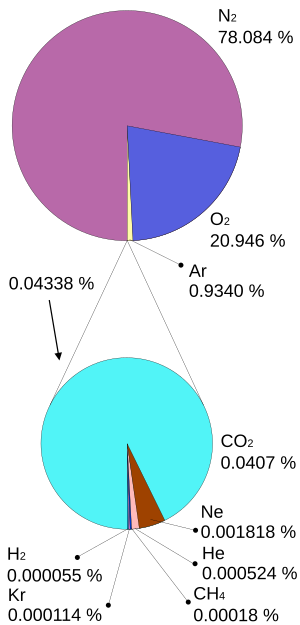
For the record, IMO, the reason people give blank stares to the climate change mongers is because a lot of times people just don't understand what the hell is being talked about.
Using the line "You have to care about global warming because science says you should" doesn't work.
Coercion is also counter productive- "care about global warming because you'll be sorry if you don't!". Such a line isn't helpful and probably does more to turn people away from caring about global warming than anything else. Hell, you might be right, but that line just makes people want to ignore the coercion or resist it.
And calling people stupid is absolutely the worst thing to do if one wishes those people to come on board and care.
I want to know the answer to the above questions because that's how I'll be able to wrap my head around it. I'm not worried enough or care enough to go looking for myself, but I'm curious enough to at least ask.
The climate screamers want people to listen to them then the climate screamers have to put their arguments in ways that people can understand without being snide, arrogant or otherwise rude in doing so (not implying you are like that, mets). Different people have different ways of understanding, and for me the above is my way of being able to wrap my own head around the issue.
If no answers are forthcoming then that's ok as well, I'll just keep on not giving a shit and resisting any changes or policies that I deem will affect me negatively. For me to be willing to sacrifice or accept said negative short term consequences, then it's best if I have some idea of what's the issue in ways I can understand. The "because I said so" ain't gonna work, sorry, but that's just how it is.
It might not have been so bad, except that the whole global warming issue has become so politicized that it's pretty much a farce now. Because politics is a farce and it makes people distrustful, even if the science is sound, people just won't believe or care. You can try and bully your way through, but that just leads to further and greater resistance.
And it doesn't help when everything under the sun is blamed on climate change. Like severe acne is caused by climate change or heroin addiction is up because of climate change (actual titles of articles blaming said things being caused by climate change). People just don't believe it.
Hell, I laughed my ass off at that one hollywood actor who blamed the earthquake in Haiti on climate change! Hahahaha! That's some funny stuff right there. Maybe he was right, but good luck getting me (and a whole hell of a lot of other people) believing that.
Anyways, thanks in advance, Mets, whether or not you give answers to those questions. At least you are willing to somewhat try I guess. Hopefully you won't be offended by the stuff after the graphic, I don't mean to offend, just trying to put it into perspective and why it's important to try and educate based on individual's understandings. I understand exponential growth, so putting it into those terms would be helpful in convincing me of anything on this. Otherwise, well, you get the idea I think.
Cheers.
-
Metsfanmax
- Posts: 6722
- Joined: Wed Apr 11, 2007 11:01 pm
- Gender: Male
Re: Global Warming - Poll
Yes, that is a valid concern. The total mass of carbon in the atmosphere is about 750 billion tons, and we are emitting roughly 9 billion more tons each year just from fossil fuels and cement production. So if you prefer to talk about that instead of PPM values, then the current rate of increase is about 1% per year by mass. This is slightly different from the 0.5% per year quantity when discussing concentration increases, but that has to do with other factors (such as that "PPM" really means parts per million of volume, which is not equivalent to parts per million of mass). Now, when you're talking about concentrations that are less than 0.1% of the total mass of the atmosphere, such as for carbon dioxide, a small change in mass of that constituent has a negligible effect on the mass of the atmosphere (which is measured in the quadrillions of tons). So, to a very good approximation, a doubling in the mass of a minute constituent is the same as a doubling of its concentration (again, by mass, not volume). As an analogy, let's take your toy example of an atmosphere with 1000 tons of mass. In that atmosphere is, say, methane with a total mass of 1 ton. If we doubled the methane mass to 2 tons, we'd still only increase the mass of the atmosphere to 1001 tons, and the concentration would increase from 0.1% to 0.1998%, or basically exactly 0.2%.patches70 wrote: Let us say, for instance, the PPM of CO2 in the air is exactly 100PPM and that there is 1,000 gigatonnes of CO2 in the atmosphere. The doubling of the CO2 would be when the amount of CO2 reaches 2,000 gigatonnes. But that 2,000 gigatonnes would not necessarily translate into 200PPM because the total atmosphere mass would have changed as well.
...
That's why I'm asking for the simple amount of total CO2 in the atmosphere by mass, instead of concentration. If there is 3,000 gigatonnes of CO2 in the atmosphere now, then a doubling of CO2 in the atmosphere would be 6,000 gigatonnes. But I have no idea what the PPM would be when that happens.
I understand that there's a lot to think about here, so don't hesitate to keep asking if it's not clear.
What we are really talking about is not whether the total CO2 mass in the atmosphere is growing exponentially, because humans don't have control over that directly. What we are responsible for is the amount of new CO2 added to the atmosphere each year. That is determined by lots of factors, like total industrial growth and various other economic effects, as well as government policies to reduce emissions. As a result, there is no single rate at which emissions grow. But, roughly speaking, since human economic growth is exponential, so is the growth rate of CO2 emissions. The result on the total CO2 concentration is not an exponential increase but is certainly something that accelerates with time.1. Is freed CO2 in the atmosphere growing at an exponential rate?
I don't know of an easily available data source for this. You can estimate it based on the emissions rate I quote above though -- a typical rate of increase between 1990 and today was about 6-10 gigatons per year, so just subtract that off from about 750 gigatons and work backwards. It's enough to demonstrate that the change of the total CO2 mass is not a simple exponential function.2. If so, what is the total mass of CO2 from various periods in very recent history? (as in today, a decade ago, two decades ago, etc etc)
That's a very complicated question -- the mass of the atmosphere is based on many, many factors. As an example, we pick up small amounts of mass every day just from things like collisions with small space rocks. If you want to know whether fossil fuel burning changes the mass of the atmosphere, it's also still complicated, and based on one scientific study it's possible that the net effect on the Earth's mass is actually negative. Note from our above conversation that even if we assume that the total mass of the atmosphere increases by the same amount as the increase in carbon mass, it's a minute change to the total atmosphere mass.3. Does the total mass of the atmosphere, all the gases present in the air, stay at a constant mass? As in do all the values of all these gases change like CO2 apparently changes? (see graphic)
In general, no -- CO2 emissions don't directly cause other gases to change their total mass (though it of course may change their concentration). Note though that carbon dioxide doesn't come for free into the atmosphere -- you are essentially taking two oxygen atoms from the atmosphere and sticking a carbon atom onto it, so in a sense you're decreasing the amount of other sources of oxygen in the atmosphere, such as water.4. As the CO2 rises, is the a corresponding decrease in other gases in the atmosphere?
I know that people don't want to feel like they're being taken advantage of. All I ask is that they have an open mind when we try to explain it.For the record, IMO, the reason people give blank stares to the climate change mongers is because a lot of times people just don't understand what the hell is being talked about.
Re: Global Warming - Poll
Thanks mets, some more questions then?
Oh, and if my doubling effect of CO2 is bothering you, I ask because it's the climate models that predict a rise of temperature between 2-4.5+ degrees C by doubling of atmospheric CO2. It was characterized as "all the models confirm" BTW, and I'll post some of that eventually.
I know enough that even that modest change in temperature would cause some major problems. Thus, why I am wondering about the doubling effect.
I guess this is climate sensitivity, the definition as I understand it is thus-
"is the estimate of how much the earth's climate will warm in response to the increased greenhouse effect if we double the amount of carbon dioxide in the atmosphere."
Is this correct?
I guess to measure climate sensitivity there are two methods used, the first being models (which frankly have proven to be pretty unreliable, yes?)
and the second by looking physical evidence as in looking at climate change in the distant past. I guess with ice cores, or other geological evidence.
I this correct?
I guess I'l revisit this climate sensitivity later.
Ok, good. From the charts I've seen, around 1775-1800, right around the start of the industrial revolution, the PPM of CO2 was about 280PPM.
Is this about correct?
If so, and the PPM today is 400PPM, then we haven't actually doubled the amount of CO2, since the industrial revolution began, in the atmosphere yet, correct?
And is it generally considered the industrial revolution that is the main catalyst for the releasing of man made CO2 to such levels that it's supposedly a problem?
Questions-
1. How is it determined today how many gigatonnes are in the atmosphere and are those calculations correct or are they just best guesses based on information at hand? Are they basically just estimates or are hard cold actually facts?
2. If we are adding 6-10 gigatons per year then the CO2 doubling rate would take about 70 years. Since it's been 225 years since the start of the industrial revolution, then has the CO2 in the atmosphere actually doubled since the start of the Industrial revolution?
It should have, but has it?
Various predictions have been made over the decades and a lot of times those predictions don't come true. To be fair, the predictions I hear the most which end up being total bullshit are predictions made by non scientists, like what's his name, former crown Prince of England said something just a few months ago to the effect about how we have something like "25 months to do something or it's all over".
Ha!
By now the polar caps were supposed to be completely gone. Etc etc.
Do you think it's problematic to make predictions based on knowledge that there is no way we yet completely understand?
Or do we supposedly understand global warming already?
Also,
Trees and plants are carbon traps, since their structure is made of carbon. Correct?
Is not the human body also a carbon trap?
Sure we expel CO2 but we hold a lot of carbon in our bodies anyway, correct?
Thanks mets, we are just talking here, so forgive me if I don't understand the scientific terms or ask questions that are stupid. I'm not stupid but that doesn't mean I can't ask dumb questions or act stupid on occasion.
Oh, and if my doubling effect of CO2 is bothering you, I ask because it's the climate models that predict a rise of temperature between 2-4.5+ degrees C by doubling of atmospheric CO2. It was characterized as "all the models confirm" BTW, and I'll post some of that eventually.
I know enough that even that modest change in temperature would cause some major problems. Thus, why I am wondering about the doubling effect.
I guess this is climate sensitivity, the definition as I understand it is thus-
"is the estimate of how much the earth's climate will warm in response to the increased greenhouse effect if we double the amount of carbon dioxide in the atmosphere."
Is this correct?
I guess to measure climate sensitivity there are two methods used, the first being models (which frankly have proven to be pretty unreliable, yes?)
and the second by looking physical evidence as in looking at climate change in the distant past. I guess with ice cores, or other geological evidence.
I this correct?
I guess I'l revisit this climate sensitivity later.
Ok, I suspected as much. Thanks!Metsfanmax wrote:
(such as that "PPM" really means parts per million of volume, which is not equivalent to parts per million of mass).
mets wrote:Now, when you're talking about concentrations that are less than 0.1% of the total mass of the atmosphere, such as for carbon dioxide, a small change in mass of that constituent has a negligible effect on the mass of the atmosphere (which is measured in the quadrillions of tons). So, to a very good approximation, a doubling in the mass of a minute constituent is the same as a doubling of its concentration (again, by mass, not volume). As an analogy, let's take your toy example of an atmosphere with 1000 tons of mass. In that atmosphere is, say, methane with a total mass of 1 ton. If we doubled the methane mass to 2 tons, we'd still only increase the mass of the atmosphere to 1001 tons, and the concentration would increase from 0.1% to 0.1998%, or basically exactly 0.2%.
I understand that there's a lot to think about here, so don't hesitate to keep asking if it's not clear.
Ok, good. From the charts I've seen, around 1775-1800, right around the start of the industrial revolution, the PPM of CO2 was about 280PPM.
Is this about correct?
If so, and the PPM today is 400PPM, then we haven't actually doubled the amount of CO2, since the industrial revolution began, in the atmosphere yet, correct?
And is it generally considered the industrial revolution that is the main catalyst for the releasing of man made CO2 to such levels that it's supposedly a problem?
Now, if this were true, does that mean a collapse in human economic growth would then lead to a lowering of CO2 emissions?mets wrote: since human economic growth is exponential, so is the growth rate of CO2 emissions.
I read information saying that there is 3,000 gigatonnes of CO2 in the atmosphere right now. (one gigatonne is a quadrillion grams). I don't know if that's true or not, or if it's 750 gigatonnes, or whatever, that's not so much an issue per say other than being vastly different estimates and a frustrating inconsistency of data presented. It seems like it all depends on who one asks and everyone has different answers.mets wrote:I don't know of an easily available data source for this. You can estimate it based on the emissions rate I quote above though -- a typical rate of increase between 1990 and today was about 6-10 gigatons per year, so just subtract that off from about 750 gigatons and work backwards. It's enough to demonstrate that the change of the total CO2 mass is not a simple exponential function.
Questions-
1. How is it determined today how many gigatonnes are in the atmosphere and are those calculations correct or are they just best guesses based on information at hand? Are they basically just estimates or are hard cold actually facts?
2. If we are adding 6-10 gigatons per year then the CO2 doubling rate would take about 70 years. Since it's been 225 years since the start of the industrial revolution, then has the CO2 in the atmosphere actually doubled since the start of the Industrial revolution?
It should have, but has it?
Yeah, I figured. Sorry bout dat.Mets wrote:That's a very complicated question
Well yeah, burning fossil fuels changes the atmosphere, one can see the changes. Especially in the big cities where there are huge concentrations. Smog is pretty hard to miss, for instance.Mets wrote: If you want to know whether fossil fuel burning changes the mass of the atmosphere, it's also still complicated, .....it's possible that the net effect on the Earth's mass is actually negative.
So the changes in CO2 concentration and mass are minute as well?mets wrote: Note from our above conversation that even if we assume that the total mass of the atmosphere increases by the same amount as the increase in carbon mass, it's a minute change to the total atmosphere mass.
I'm pretty sure that water vapor makes up the majority of the mass of the atmosphere, correct?mets wrote: such as water.
That's fine and dandy, sir. How do you feel about making predictions?mets wrote:I know that people don't want to feel like they're being taken advantage of. All I ask is that they have an open mind when we try to explain it.
Various predictions have been made over the decades and a lot of times those predictions don't come true. To be fair, the predictions I hear the most which end up being total bullshit are predictions made by non scientists, like what's his name, former crown Prince of England said something just a few months ago to the effect about how we have something like "25 months to do something or it's all over".
Ha!
By now the polar caps were supposed to be completely gone. Etc etc.
Do you think it's problematic to make predictions based on knowledge that there is no way we yet completely understand?
Or do we supposedly understand global warming already?
Also,
Trees and plants are carbon traps, since their structure is made of carbon. Correct?
Is not the human body also a carbon trap?
Sure we expel CO2 but we hold a lot of carbon in our bodies anyway, correct?
Thanks mets, we are just talking here, so forgive me if I don't understand the scientific terms or ask questions that are stupid. I'm not stupid but that doesn't mean I can't ask dumb questions or act stupid on occasion.
-
Metsfanmax
- Posts: 6722
- Joined: Wed Apr 11, 2007 11:01 pm
- Gender: Male
Re: Global Warming - Poll
Climate sensitivity in general measures the change in temperature that comes from some change in a warming or cooling component. It would be meaningful, for example, to talk about the climate sensitivity of (say) a 1% increase in the Sun's output, and we would be asking how many degrees warmer the Earth gets as a result of it. When it comes to carbon dioxide, we've chosen by convention to define climate sensitivity as the number of degrees of temperature increase as a result of the doubling of CO2. It's merely a convenient convention in the scientific community that we've chosen to use the effect of a CO2 doubling as the meter stick for global warming. It is a measure to help us understand what would happen to the Earth's climate if the carbon dioxide concentration were to double. It is not a statement on how much we have actually increased the concentration -- it is just a very crude proxy to help us predict what the planet would look like if we were to do that. In order to estimate it, we don't necessarily need to have the CO2 concentration double in our lifetimes. For example, we could watch the effect of a 25% increase and then extrapolate what the effect of a 100% increase would be. In practice, trying to actually do it this way is very difficult. So our best estimates come from an understanding of the basic physics of the climate system (a model) -- we artificially add some warming or cooling term to the equations, crank out the numbers, and see what comes out. This is actually a very straightforward quantity to get out of a climate model, it's just complicated by our incomplete understanding of some of the physical processes that occur when you warm or cool the planet. So there are significant uncertainties associated with our best guess -- nevertheless, we can have a meaningful best guess (like the 2-4 degrees Celsius number you quote).patches70 wrote:Thanks mets, some more questions then?
Oh, and if my doubling effect of CO2 is bothering you, I ask because it's the climate models that predict a rise of temperature between 2-4.5+ degrees C by doubling of atmospheric CO2. It was characterized as "all the models confirm" BTW, and I'll post some of that eventually.
I know enough that even that modest change in temperature would cause some major problems. Thus, why I am wondering about the doubling effect.
I guess this is climate sensitivity, the definition as I understand it is thus-
"is the estimate of how much the earth's climate will warm in response to the increased greenhouse effect if we double the amount of carbon dioxide in the atmosphere."
Is this correct?
I guess to measure climate sensitivity there are two methods used, the first being models (which frankly have proven to be pretty unreliable, yes?)
and the second by looking physical evidence as in looking at climate change in the distant past. I guess with ice cores, or other geological evidence.
I this correct?
Yes.Ok, good. From the charts I've seen, around 1775-1800, right around the start of the industrial revolution, the PPM of CO2 was about 280PPM.
Is this about correct?
That's correct.If so, and the PPM today is 400PPM, then we haven't actually doubled the amount of CO2, since the industrial revolution began, in the atmosphere yet, correct?
Yes. As I alluded to earlier, various sources of CO2 have unique signatures that can allow you to trace their origins. By looking at the signature of CO2 that is presently in the atmosphere, we can make the determination I stated that significantly more than half of present emissions each year come specifically from fossil fuel burning and cement production. Natural sources like plant decay can't produce CO2 with the signature we're seeing.And is it generally considered the industrial revolution that is the main catalyst for the releasing of man made CO2 to such levels that it's supposedly a problem?
Yes. Since the vast majority of CO2 emissions are the result of human industrial activity (fossil fuel burning, cement production, deforestation), if human economic activity were to radically drop, so too would CO2 emissions. Alternatively, if we sharply declined fossil fuel burning and found an alternative to traditional cement, that too would significantly decrease CO2 emissions.Now, if this were true, does that mean a collapse in human economic growth would then lead to a lowering of CO2 emissions?
The numbers are not inconsistent -- you just really have to be careful to make sure you know what you're referring to. You stated a quantity of 3,000 gigatons of carbon dioxide. I stated a quantity of 750 gigatons of carbon. These are approximately the same, because to make a CO2 atom out of a carbon atom, you need to add two oxygen atoms to it. An oxygen atom is about 33% heavier than a carbon atom, so a CO2 atom is close to 4 times times heavier than a carbon atom. Therefore the number of gigatons of carbon dioxide is about 4 times the number of gigatons of carbon. This is a constant source of confusion in the available information, because different scientists just use different lingo, so just be careful when you're parsing literature on this subject.I read information saying that there is 3,000 gigatonnes of CO2 in the atmosphere right now. (one gigatonne is a quadrillion grams). I don't know if that's true or not, or if it's 750 gigatonnes, or whatever, that's not so much an issue per say other than being vastly different estimates and a frustrating inconsistency of data presented. It seems like it all depends on who one asks and everyone has different answers.
These are the result of direct measurement. A way to do it is that we know the total mass of the atmosphere, and simply by analyzing air that we capture from the atmosphere, we can very precisely determine what fraction of it is carbon dioxide. We multiply that fraction by the total mass of the atmosphere, and get the mass of carbon dioxide. So, similar to measurements of temperature, these are about as close to "cold hard facts" as you can get.1. How is it determined today how many gigatonnes are in the atmosphere and are those calculations correct or are they just best guesses based on information at hand? Are they basically just estimates or are hard cold actually facts?
No, it has not yet doubled. This is because the CO2 emissions rate has not been that high since the start of the industrial revolution. In the 1800s, the only significant sources of fossil fuel burning would have been the trains we operated. In the early 1900s, we added cars to the mix, and we've been increasing our industrial capacity the whole time:2. If we are adding 6-10 gigatons per year then the CO2 doubling rate would take about 70 years. Since it's been 225 years since the start of the industrial revolution, then has the CO2 in the atmosphere actually doubled since the start of the Industrial revolution?
It should have, but has it?

If the emissions rate were constant, this would just be a straight line. But actually it looks more like an exponential curve, reflecting the nature of human economic growth. There's just a lot more humans than there were in 1900, and a lot more of them have access to fossil-fuel burning technology, so there's a lot more CO2 emissions each year than there was then.
Minute with respect to the total mass of the atmosphere, yes. But large compared to its own concentration and mass. It's pretty amazing (even when I still think about it) that concentrations of gas of less than 0.1% have very strong effects on the climate. But that's because the dominant constituents of the atmosphere (nitrogen and oxygen) have no greenhouse effect. On the other hand, the dominant component of the atmosphere of Venus is carbon dioxide, and its surface temperature is over 800 degrees Fahrenheit.So the changes in CO2 concentration and mass are minute as well?
Nope -- take another look at the graphs you linked above, showing the fractions of the Earth's dry atmosphere (that shows volume and not mass, but it's close enough for this discussion). The dominant contribution to the Earth's atmosphere is nitrogen and oxygen, which combined make up 99% of the Earth's atmosphere. 0.9% comes from argon, and the last 0.1% is literally everything else (of which the dominant component is carbon dioxide). Now, when that dry air absorbs some water vapor, it typically contributes about a quarter of a percent to the total mass of the atmosphere. It's still dwarfed by the nitrogen and oxygen.I'm pretty sure that water vapor makes up the majority of the mass of the atmosphere, correct?
Predictions are a tough subject. The most important things climate scientists give us are projections, not predictions. A projection from a climate model says: "given this scenario of carbon emissions, and given our understanding of the physics and chemistry of the atmosphere and land and oceans, here's our best estimate of what will happen to the climate, and here's how much we think we can be off by." That only turns into a serious prediction if we can predict the carbon emissions in the future. This is why the IPCC makes projections for various future projections of carbon emissions -- they can't know that, because that's based on politics and economics, not on hard science.That's fine and dandy, sir. How do you feel about making predictions?
The important point here is that with a climate model, given inputs like the carbon emissions which depend on uncertain human activities, the numbers that the climate model spits out are really just the result of cranking out equations. There's no guesswork in that sense. The uncertainties in climate models come mainly because we don't have a perfect understanding of some climate processes like cloud formation. So we have to put in our best guess and run the equations with that model of cloud formation. What comes out is incontrovertible -- the debate is how closely the equation you wrote down to begin with resembles the actual physical process. So --
I'll kind of skirt your question by saying that climate scientists are not really trying to make predictions in the sense that you're thinking of. They're saying, given our best understanding of the physics and chemistry of the climate, this is our best guess for what will happen. The answers get better with time because our understanding of the physics and chemistry becomes more precise (and also for other reasons, like increased computing power). But because it's not yet perfect, we associate an uncertainty with our best guess. Because we don't completely understanding every aspect of the climate, we say that the answer is likely to lie in a certain range, rather than trying to pin to a specific number. The size of that range reflects how uncertain we are about the model. So another way of saying this is that the size of the range gets smaller with time, and it becomes closer to an actual prediction the way you mean, rather than a range of possible outcomes.Do you think it's problematic to make predictions based on knowledge that there is no way we yet completely understand?
So the predictions that climate scientists make are that the future climate will lie in this range of possible outcomes -- we can't know exactly which one it will be, but we're pretty sure it will be one of them. (And we can quantify what we mean by "pretty sure".) And the important points are that 1) this range does not include zero warming (or cooling) and 2) the best models from the past (like earlier IPCC reports) have never been wrong, as far as I know, in the sense that the future outcome always did lie in the range of outcomes predicted. A very common problem with reporting of the science in the media is that the journalists pick the number in the middle of the range, and don't report the size of the range. Without that uncertainty, you aren't saying something meaningful.
Still, there have been isolated projections for specific things like ice melt that have been wrong -- of course there have, it would be remarkable and basically impossible for every scientific prediction to have been right. In part that is because there are certain systems we don't understand as well as others. It is in the nature of uncertain predictions that every once in a while you will be wrong. What vindicates the climate science community is that when you look at the totality of the predictions made, and make a kind of average over them (this is what the IPCC report does, essentially), you get a result that is completely consistent with what we have observed until now. Notably, no reliable climate model has ever been able to reproduce (as far as i know) the warming we've seen until today without including a substantial increase in carbon dioxide.
Yes, it is true that all living organisms (which are carbon-based) essentially act as a carbon sink while they are alive. And then, when they die, they release the carbon they have built up. So there is no net effect from any individual. However, if you look at an entire group, and assume the population remains constant, then it acts as a 'permanent' carbon sink, because at any given time there's always X humans alive, storing carbon. The same is true for trees. That's why deforestation is such a devastating threat when it comes to climate change -- the less trees there are, the less of a carbon sink forests can be.Also,
Trees and plants are carbon traps, since their structure is made of carbon. Correct?
Is not the human body also a carbon trap?
Sure we expel CO2 but we hold a lot of carbon in our bodies anyway, correct?
I'm anticipating your followup question to be something like: what is the total mass of carbon sink made up by humans themselves, compared to the amount they have emitted by fossil fuels? We can make an estimate for this as follows. Carbon makes up about 1/5 of the mass of a human. Adding up the total world population, that makes about 100 billion kilograms worth of carbon in humans at any time. Since a tonne is just 1000 kilograms, this naive calculation means humans are a permanent carbon sink of about 0.1 gigatons of carbon.
Re: Global Warming - Poll
I probably have more questions, but I want to ask just this this little bit.
I asked how we measure how much CO2 is in the atmosphere and how close those measurements are to hard fact. You said this-
For instance, if I capture a cubic meter of air from downtown New York (or even more striking, downtown Beijing!) wouldn't the amount of CO2 in that sample be far more concentrated than if I captured atmosphere in the middle of a forest?
CO2 concentrates in some areas over others. Correct?
It just seems logical to me, there will be a higher concentration of CO2 where there is greater amounts of CO2 being emitted, correct?
And such samples would give a false estimate of actual CO2 concentrations world wide. If one wanted to make a point and over blow the amount of CO2 concentrations then one would need only take the samples from such areas. Conversely, if one wanted to discredit the data they could simply sample from a completely undeveloped area and thus show a lower estimate. Correct?
Oh, and one other thing, CO2 isn't the only greenhouse gas, correct?
What are the other greenhouse gases, and would you be able to list them in order of potency? That is from top to bottom taking into account the amount of infra-red absorbed by said gas from the light spectrum. It's that infra-red absorption that is primarily trapping the heat, correct?
I asked how we measure how much CO2 is in the atmosphere and how close those measurements are to hard fact. You said this-
And that's pretty much how I imagined that it would be done. But I have to ask, doesn't it matter from where one captures atmosphere to measure from?mets wrote:These are the result of direct measurement. A way to do it is that we know the total mass of the atmosphere, and simply by analyzing air that we capture from the atmosphere, we can very precisely determine what fraction of it is carbon dioxide. We multiply that fraction by the total mass of the atmosphere, and get the mass of carbon dioxide. So, similar to measurements of temperature, these are about as close to "cold hard facts" as you can get.
For instance, if I capture a cubic meter of air from downtown New York (or even more striking, downtown Beijing!) wouldn't the amount of CO2 in that sample be far more concentrated than if I captured atmosphere in the middle of a forest?
CO2 concentrates in some areas over others. Correct?
It just seems logical to me, there will be a higher concentration of CO2 where there is greater amounts of CO2 being emitted, correct?
And such samples would give a false estimate of actual CO2 concentrations world wide. If one wanted to make a point and over blow the amount of CO2 concentrations then one would need only take the samples from such areas. Conversely, if one wanted to discredit the data they could simply sample from a completely undeveloped area and thus show a lower estimate. Correct?
Oh, and one other thing, CO2 isn't the only greenhouse gas, correct?
What are the other greenhouse gases, and would you be able to list them in order of potency? That is from top to bottom taking into account the amount of infra-red absorbed by said gas from the light spectrum. It's that infra-red absorption that is primarily trapping the heat, correct?
-
Metsfanmax
- Posts: 6722
- Joined: Wed Apr 11, 2007 11:01 pm
- Gender: Male
Re: Global Warming - Poll
Yes. The concentration of CO2 varies slightly from location to location. When people speak of the carbon dioxide concentration being at "397 ppm" (say) they are often talking about a global average. But, you might ask, how can a measurement at any one location represent a global average? Well, this is because we say that CO2 is "well mixed." That is, carbon dioxide molecules live long enough that local averages tend to wash out; it doesn't tend to pile up in any one area. So the differences between various stations tend to smear out with time (if you were to stop producing any new CO2). And, in general, the differences between locations are therefore not that large.patches70 wrote: And that's pretty much how I imagined that it would be done. But I have to ask, doesn't it matter from where one captures atmosphere to measure from?
Now, the most well-known source of CO2 concentration measurements comes from the top of Mauna Loa, a volcano in Hawaii. The station is two miles above the ground and is obviously pretty far from major metropolitan areas. We think it is a pretty good representation of what the average CO2 concentration is around the world. Note though that even if one (incorrectly) thought that this represented an artificially low choice for CO2 concentration, they'd have to deal with the fact that climate scientists generally regard this as the best data source we have. So they'd have to explain why climate scientists are picking the most remote observatory.
Note also that we use measurements from more than 50 stations worldwide to get a sense of CO2 concentrations.
Finally, note that what is important is not so much the absolute reading, but the trend with time. Even if one station says 397 ppm and another says 400 ppm due to location effects, they both showed that the concentration was substantially lower decades ago.
Greenhouse gases are essentially defined based on the fact that they absorb or emit in the infrared, and not the visible, as you say. The other major greenhouse gases that result in warming on the Earth are water, methane, and nitrogen oxides. These are major because of the combination of their abundance and their individual absorption capability. (That is, there are other atoms I didn't list that can absorb even more strongly in the infrared but there are much less of them.) Ranked by this total warming potential, water is the dominant contributor, with carbon dioxide, methane, and nitrous oxide following (in that order).Oh, and one other thing, CO2 isn't the only greenhouse gas, correct?
What are the other greenhouse gases, and would you be able to list them in order of potency? That is from top to bottom taking into account the amount of infra-red absorbed by said gas from the light spectrum. It's that infra-red absorption that is primarily trapping the heat, correct?

Re: Global Warming - Poll
@Mets: Electricity demand (one of the major CO2 producing industries) has stagnated in both the US and where I live in the last 5-10 years. I would expect the "exponential" growth curve to dampen in coming years (I would guess long term that a emmissions chart will look like a elongated s - with very little impact from regulartory intervention (no matter what level it manifests in) - China will do what China wants).
TLDR: We're probably fucked, but well, maybe not too fucked?
TLDR: We're probably fucked, but well, maybe not too fucked?
I go to the gym to justify my mockery of fat people.
Re: Global Warming - Poll
And once it reaches that stage, we'll need someone to slaughter that meat for us. I'm guessing we can count on you to lend a hand?k*thoer wrote:Of course once the Oceans become acidic, our diets might to change. We can always resort to cannabalism.
Re: Global Warming - Poll
mrswdk wrote:And once it reaches that stage, we'll need someone to slaughter that meat for us. I'm guessing we can count on you to lend a hand?k*thoer wrote:Of course once the Oceans become acidic, our diets might to change. We can always resort to cannabalism.
If you look anything like your avatar, you'll make a fine meal.
I'm looking at all the long winded posts, sheesh we're getting global warming from all that hot air.
Here's a short fact, total CO2 emissions have declined in the US the last several years. Due mainly to increase use of natural gas and using less dirty coal.
-
Phatscotty
- Posts: 3714
- Joined: Mon Dec 10, 2007 5:50 pm
- Gender: Male
Re: Global Warming - Poll
not you! Was talking to Kuth the troll.danfrank666 wrote:please excuse my ignorance , ah , thats what a troll is . Thanks for the enlightenment.Phatscotty wrote:I gave you a fair chance.kuthoer wrote:Spitting out things straight from that partisan brain of yours, is what makes your posts so silly.Phatscotty wrote:I challenge you to make a post that has the tiniest bit of value or relevance. Let's try this.kuthoer wrote:I saw a study? Puhleeeeze!Phatscotty wrote:how much of the annual carbon output is from man and how much is normal. I saw a study that suggest mankind was accountable for roughly 3%, and the other 97% is natural from decaying plants and volcanoes etc
Kuthoer, what % of the earth's annual carbon output would you say humans are responsible for? And you don't get to google your answer. You don't have to remember the source of what you think it is or anything dumb like that, just spit out an answer strictly drawing from your knowledge base, like I did. Kuthoer, what % of the earth's annual carbon output would you say humans are responsible for?
You chose Troll
You are okay in my book
-
Phatscotty
- Posts: 3714
- Joined: Mon Dec 10, 2007 5:50 pm
- Gender: Male
Re: Global Warming - Poll
ftfykuthoer wrote:mrswdk wrote:And once it reaches that stage, we'll need someone to slaughter that meat for us. I'm guessing we can count on you to lend a hand?k*thoer wrote:Of course once the Oceans become acidic, our diets might to change. We can always resort to cannabalism.
If you look anything like your avatar, you'll make a fine meal.
I'm looking at all the long winded posts, sheesh we're getting global warming from all that hot air.
Here's a short fact, total CO2 emissions have declined in the US the last several years. Due mainly to increase use of natural gas and using less dirty coal. the Free Market
Re: Global Warming - Poll
If you had your way, there would be no regulations on energy producers. NO EPA and NO REGULATIONS, which equals more pollution in our environment.Phatscotty wrote:ftfykuthoer wrote:mrswdk wrote:And once it reaches that stage, we'll need someone to slaughter that meat for us. I'm guessing we can count on you to lend a hand?k*thoer wrote:Of course once the Oceans become acidic, our diets might to change. We can always resort to cannabalism.
If you look anything like your avatar, you'll make a fine meal.
I'm looking at all the long winded posts, sheesh we're getting global warming from all that hot air.
Here's a short fact, total CO2 emissions have declined in the US the last several years. Due mainly to increase use of natural gas and using less dirty coal. the Free Market
-
Metsfanmax
- Posts: 6722
- Joined: Wed Apr 11, 2007 11:01 pm
- Gender: Male
Re: Global Warming - Poll
"I have no idea why emissions declined, but attributing it to the free market is convenient for my worldview, so let's do that."Phatscotty wrote:ftfyHere's a short fact, total CO2 emissions have declined in the US the last several years. Due mainly to increase use of natural gas and using less dirty coal. the Free Market
-
danfrank666
- Posts: 170
- Joined: Tue Feb 18, 2014 7:32 pm
Re: Global Warming - Poll
Heres another idea , since todays american society is reluctant to teach judeo christian values , what have they replaced the deadly sins with. Emitting Carbon into the atmosphere . Racism . Homophobia. Private Health Care. Public Education . What else am i missing 
-
Phatscotty
- Posts: 3714
- Joined: Mon Dec 10, 2007 5:50 pm
- Gender: Male
Re: Global Warming - Poll
You always look bad when you try to come at me like this .Know you nothing of the exploding natural gas market and industry? That's where all the jobs are, that's where all the big money is, because that's where there is little government, and that is why the market is very free indeed. Everyone knows if you really want to make some money to get your ass to North Dakota. You'll have 2 full time jobs lined up by the end of your first week. It has nothing to do with convenience, and everything to do with you 'not getting it'.Metsfanmax wrote:"I have no idea why emissions declined, but attributing it to the free market is convenient for my worldview, so let's do that."Phatscotty wrote:ftfyHere's a short fact, total CO2 emissions have declined in the US the last several years. Due mainly to increase use of natural gas and using less dirty coal. the Free Market
The market demands better fuel and energy, and the market is going to get that as long as the government isn't skimming 30%-40% off every dollar produced.