Moderator: Community Team
ntcbadabing wrote:I don't know.. I do know you can't have a truly random number generator for CC games if you also want to implement something to make the players average dice rolls to be 3.5 .. that by design defeats the purpose of RNG. Without the feature to equalize rolling averages, you'd have random average dice rolls for each player. So now you have random.org using a mathematical equation to interpret atmoshperic noise (which has to be predictable) and a CC equation to manipulate those results to keep the players even. I'm just guessing at all this..

degaston wrote:Random.org is highly regarded as a source of true random data, and CC would have no reason to try to manipulate it. Here's an easy to see example of the difference between true random and pseudo-random: http://boallen.com/random-numbers.html
Metsfanmax wrote:There are non-trivial reasons to want to manipulate it. In particular, to soften streaks. It might be like the iTunes effect where they coded it so that you were less likely to get two songs from the same album in a row than what random chance would dictate. We don't do this, but it's an interesting idea.

ntcbadabing wrote:degaston... if it was truly random there would have to be a higher variance between players average rolls. The entire site's rolls might average pretty close to 3.5, but it should not work out to anyone with (random number pick here) say 100 games or more gets a 3.5 or 3.51 average. That would be statistically extremely unlikely. The wider the range of samples should result in a range of average dice rolls and all the results together should average out to 3.5. Instead, we have every sample averaging to 3.5 or 3.51, which is as unlikely, if not more, than 2's and 4's being significantly more probable. There's manipulation somewhere, but that's because, and back to my original statement, a true RNG is pretty much impossible.

ntcbadabing wrote:"I don't think you have a very good understanding of what you are saying" - guilty as charged. I have no background in mathematical or statistical analysis, it just interests me which is why I posted here. No need to apologize.. The idea of a true RNG being next to impossible is from all the science channel shows I watch. I can't cite the exact show or who said it, but it would have been one of the scientists you see on those kinds of shows. The same show also pointed to all the patterns you find in nature as a supporting fact of how difficult true randomness is. It really just doesn't exist in our universe, according to the show.
ntcbadabing wrote:To think we've developed a truly random RNG using mathematical equations designed to manipulate data is a fundamentally flawed concept, in my mind anyway.
ntcbadabing wrote:It does seem odd to me that you use the term 'necessary' that true randomness should result in uniform distribution (if I understand you correctly). It seems to me that by definition of random, you shouldn't expect uniform distribution.
Random House Kernerman Webster's College Dictionary wrote:ran•dom (ˈræn dəm)
adj.
1. occurring or done without definite aim, reason, or pattern: random examples.
2. Statistics. of or characterizing a process of selection in which each item of a set has an equal probability of being chosen.
ntcbadabing wrote:Perhaps our 'true' RNG's are designed to produce results consistent with the average, which would in turn make the RNG not random. Or maybe I have no idea what I'm talking about
This is not true because the order of events matters when figuring out combinations, but not when calculating an average. If you roll a die 6 times, there are 46,656 possible combinations, each of them equally likely to occur. But while there is exactly one way to get all 5's, there are 720 ways to get one of each number (and many other combinations that would also average out to 3.5).ntcbadabing wrote:...By the first definition of random, this could result in all 5's as easily as it could and average of 3.5
(1,4,6,4,2,5) is just as improbable as (5,5,5,5,5,5), but we would think nothing of the first sequence, and be very surprised by the second. It's just more cognitive bias.ntcbadabing wrote:... by the 2nd definition of random, all numbers should be rolled equally 1/6th of the time. Then if you apply mathematical formulas to predict outcomes, it becomes highly improbable to roll all 5's. It is correct to say the 2nd definition is more applicable in real life.
I've been a mod for quite a while now and I see no evidence of tampering, but I can't say for certain that it wasn't done.Metsfanmax wrote:CC does not currently intentionally tamper with the results to alter the distribution of rolls.
I'm not saying it's intentional, but the evidence is everywhere you look:chapcrap wrote:I've been a mod for quite a while now and I see no evidence of tampering, but I can't say for certain that it wasn't done.Metsfanmax wrote:CC does not currently intentionally tamper with the results to alter the distribution of rolls.
I think you're veering back into philosophy and confusing "pattern" with "order". What does it mean to you (and how is is even possible) to have absolutely no order? The dice follow rules that limit what you will get to an integer from 1-6. You will never get a 7 or pi, so obviously there is some "order" in that each roll has a limited range of outcomes. All that is required to meet the first definition is for it to be impossible to know the next outcome ahead of time.ntcbadabing wrote:The way I see it, a 'true' RNG could be defined as either having absolutely no order by the first definition, but to meet the 2nd definition, you'd have to have order.. to quote you, it is necessary.
Go back and look at the law of large numbers. With a small number of rolls, there is plenty of variance between players, but as the number of rolls increases the results for everyone should converge.ntcbadabing wrote:To match the first, there should be a greater variance from one player's results to another.
Go back and look at the law of large numbers. As the number of samples increases, the absolute difference between the count for individual numbers is also likely to increase, but not as fast as the total number of rolls. So as a percentage of the total rolls, they should all get closer to 16.66%.ntcbadabing wrote:To match the 2nd definition, all the results for individual numbers amongst all players rolls should be equal.
degaston wrote:I admit, it did not occur to me to take into account the philosophical views of Determinists who believe that randomness cannot exist in the universe because everything is causal. I might even be inclined to agree with them, but I can't find any practical application for that idea in real life, so I don't often think about it.ntcbadabing wrote:"I don't think you have a very good understanding of what you are saying" - guilty as charged. I have no background in mathematical or statistical analysis, it just interests me which is why I posted here. No need to apologize.. The idea of a true RNG being next to impossible is from all the science channel shows I watch. I can't cite the exact show or who said it, but it would have been one of the scientists you see on those kinds of shows. The same show also pointed to all the patterns you find in nature as a supporting fact of how difficult true randomness is. It really just doesn't exist in our universe, according to the show.
Yes, pseudo-random number generators tend to have a problem with predictability, but even if CC did use a PRNG, I don't think it would be that big an issue because the dice are not given out sequentially in large batches (or, at least, I think that's what happens). In any case, the Random.org website has a lot of information about true random number generation if you're interested.ntcbadabing wrote:To think we've developed a truly random RNG using mathematical equations designed to manipulate data is a fundamentally flawed concept, in my mind anyway.
Actually, by definition, you should:ntcbadabing wrote:It does seem odd to me that you use the term 'necessary' that true randomness should result in uniform distribution (if I understand you correctly). It seems to me that by definition of random, you shouldn't expect uniform distribution.The whole point of a die is that each side should have an equal chance of coming up. If you find that one side consistently appears more or less than 1/6th of the time, then that is evidence that the die is not "fair".Random House Kernerman Webster's College Dictionary wrote:ran•dom (ˈræn dəm)
adj.
1. occurring or done without definite aim, reason, or pattern: random examples.
2. Statistics. of or characterizing a process of selection in which each item of a set has an equal probability of being chosen.
It appears that your ideas about what random numbers should and should not do are being colored by one or more cognitive biases. Lots of people have them regarding the probability of random events (see: Las Vegas), but if you're interested you might want to read more on the subject.ntcbadabing wrote:Perhaps our 'true' RNG's are designed to produce results consistent with the average, which would in turn make the RNG not random. Or maybe I have no idea what I'm talking about
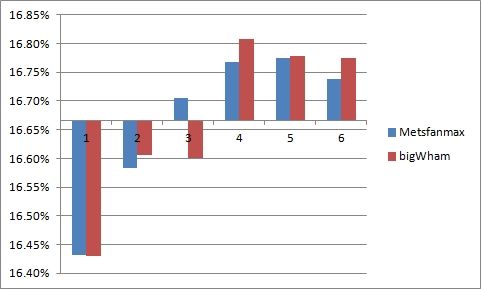
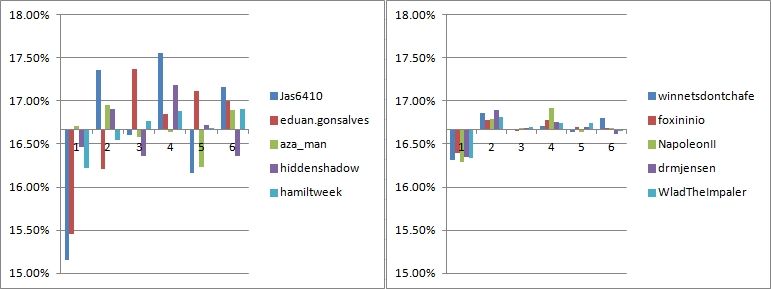
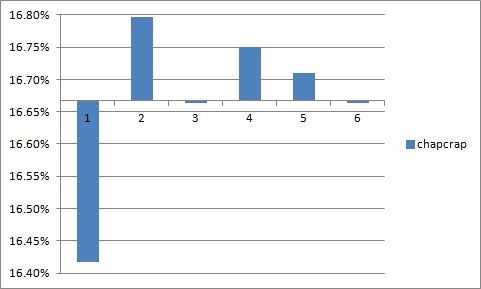
What applies here is the "law of large numbers" which states that "the average of the results obtained from a large number of trials should be close to the expected value, and will tend to become closer as more trials are performed." (http://en.wikipedia.org/wiki/Law_of_large_numbers) This is saying that the more rolls you have, the closer you should be to having each number come up 1/6th of the time. As expected, the CC dice do converge as you include more samples, but the fact that 1's, 2's and 4's do not converge towards 16.66% shows that there is a bias in the dice output.

Ohhhhhhhh Lolololol......... Just do my dice stats.degaston wrote:...and I don't usually go in for conspiracy theories, but DAMN, how does it happen that the site owner and the "Head Thinker" have stats like this?degaston wrote:I'm not saying it's intentional...
Yours are the last column of the big graph on page 2. They look like everyone else's - not many 1's, lots of 2's & 4's. That was from the "What number do you roll the most" thread.Jdsizzleslice wrote:Ohhhhhhhh Lolololol......... Just do my dice stats.
I see a little below everyone else. That should throw any theory about moderators getting better dice out the window.degaston wrote:Yours are the last column of the big graph on page 2. They look like everyone else's - not many 1's, lots of 2's & 4's. That was from the "What number do you roll the most" thread.Jdsizzleslice wrote:Ohhhhhhhh Lolololol......... Just do my dice stats.
He just hasn't been a mod long enough. He's still in the probationary period.degaston wrote:Maybe you're just not high enough in the CC hierarchy to rate getting the "special dice"Jdsizzleslice wrote:I see a little below everyone else. That should throw any theory about moderators getting better dice out the window.

I wasn't taking this as an argument of any kind, and I do not claim to be an expert on this. I have some background knowledge and I can fill in some of the blanks with a little research, which I find interesting.ntcbadabing wrote:I agree with everything you just said.. but as someone who does not have the understanding of statistics and how to calculate them as you do, to me, you're trying to apply the #2 definition to the #1. Your opinion is they compliment each other, but if you take the definitions literally, they completely contradict each other, like polar opposites.