Some new images. All images of course are NASA/JPL.
Check 'em out!
Also, News update:
[spoiler=New update]
Meanwhile, Curiosity has finished a four-day process transitioning both of its redundant main computers to flight software for driving and using tools on the rover's arm. During the latter part of the Mars Science Laboratory spacecraft's 36-week flight to Mars and its complicated descent to deliver Curiosity to the Martian surface on Aug. 5, PDT (Aug. 6, EDT and Universal Time), the rover's computers used a version of flight software with many capabilities no longer needed. The new version expands capabilities for work the rover will do now that it is on Mars.
"We have successfully completed the brain transplant," said Curiosity Mission Manager Mike Watkins of NASA's Jet Propulsion Laboratory, Pasadena, Calif. "Now we are moving on to a new phase of functional checkouts of the science instruments and preparations for a short test drive."
The first drive, possibly within a week or so, will likely include short forward and reverse segments and a turn. Curiosity has a separate drive motor on each of its six wheels and steering motors on the four corner wheels. Preparation and testing of the motor controllers will precede the first drive.
After the test drive, the planning schedule has an "intermission" before a second testing phase focused on use of the rover's robotic arm. For the intermission, the 400-member science team will have the opportunity to pick a location for Curiosity to drive to before the arm-testing weeks.
During a prime mission of nearly two years, researchers will use Curiosity to investigate whether the selected area of Mars has ever offered chemical ingredients for life and other environmental conditions favorable for supporting microbial life. Curiosity carries 10 science instruments with a total mass 15 times as large as the science payloads on NASA's Mars rovers Spirit and Opportunity. [/spoiler]
[spoiler=Color Enhanced, from Above]
This color-enhanced view of NASA's Curiosity rover on the surface of Mars was taken by the High Resolution Imaging Science Experiment (HiRISE) on NASA's Mars Reconnaissance Orbiter as the satellite flew overhead. Image credit: NASNASA/JPL-Caltech/University of Arizona.
[/spoiler]
[spoiler=Color, Mastcam Mega Horizon]
This image is the first high-resolution color mosaic from NASA's Curiosity rover, showing the geological environment around the rover's landing site in Gale Crater on Mars. The images show a landscape that closely resembles portions of the southwestern United States in its morphology, adding to the impression gained from the lower-resolution thumbnail mosaic released early in the week.
The colors in the main image are unmodified from those returned by the camera. While it is difficult to say whether this is what a human eye would see, it is what a cell phone or camcorder would record since the Mastcam takes color pictures in the exact same manner that consumer cameras acquire color images. 
To see a giant image suitable for outside of forum viewing, check out:
http://mars.jpl.nasa.gov/msl/images/pia ... er-br2.jpg[/spoiler]
[spoiler=Color Modified, Mount Sharp]
This image from NASA's Curiosity rover looks south of the rover's landing site on Mars towards Mount Sharp. This is part of a larger,high-resolution color mosaic made from images obtained by Curiosity's Mast Camera.
In this version of the image, colors have been modified as if the scene were transported to Earth and illuminated by terrestrial sunlight. This processing, called "white balancing," is useful for scientists to be able to recognize and distinguish rocks by color in more familiar lighting.
The image provides an overview of the eventual geological targets Curiosity will explore over the next two years, starting with the rock-strewn, gravelly surface close by, and extending towards the dark dunefield. Beyond that lie the layered buttes and mesas of the sedimentary rock of Mount Sharp. 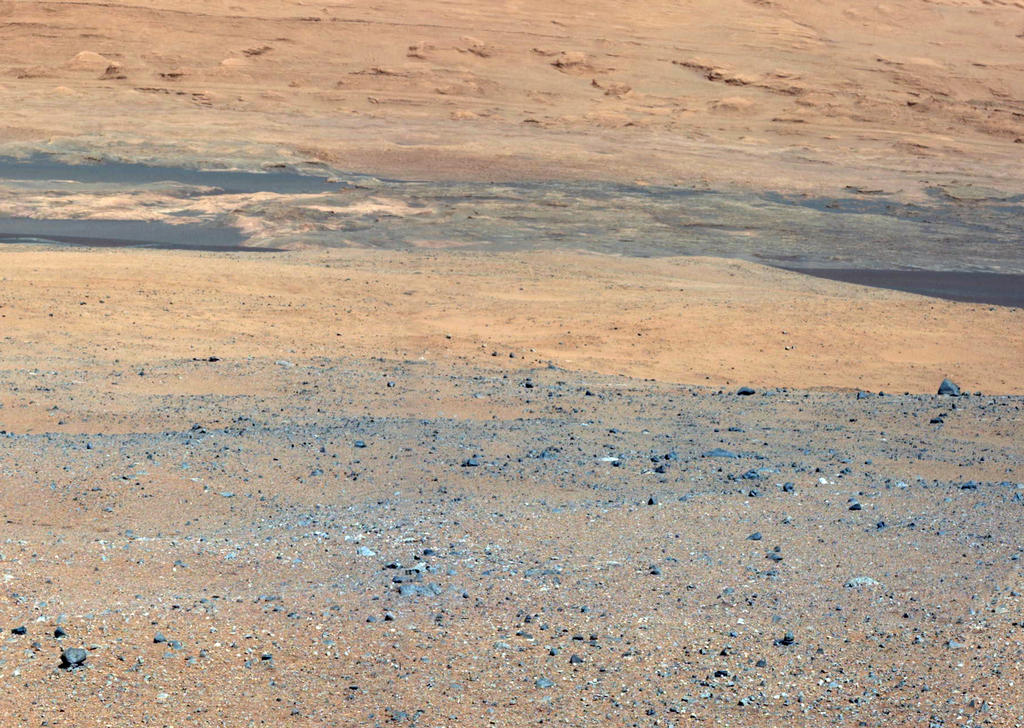
[/spoiler]
[spoiler=Color, Wall of Gale Crater]
This color image from NASA's Curiosity rover shows part of the wall of Gale Crater, the location on Mars where the rover landed on Aug. 5, 2012 PDT (Aug. 6, 2012 EDT). This is part of a larger, high-resolution color mosaic made from images obtained by Curiosity's Mast Camera.
This image of the crater wall is north of the landing site, or behind the rover. Here, a network of valleys believed to have formed by water erosion enters Gale Crater from the outside. This is the first view scientists have had of a fluvial system - one relating to a river or stream -- from the surface of Mars. Known and studied since the 1970s beginning with NASA's Viking missions, such networks date from a period in Martian history when water flowed freely across the surface. The main channel deposit seen here resembles a dirt road ascending into the mountains, which are actually the north wall and rim of Gale Crater.
Although Curiosity is about 11 miles (18 kilometers) away from this area and the view is obscured somewhat by dust and haze, the image provides new insights into the style of sediment transport within this system. Curiosity has no current plans to visit this valley system, since the primary objective of the rover is south of the landing site. But images taken later and with the 100-millimeter Mastcam are likely to allow scientists to study the area in significantly more detail. 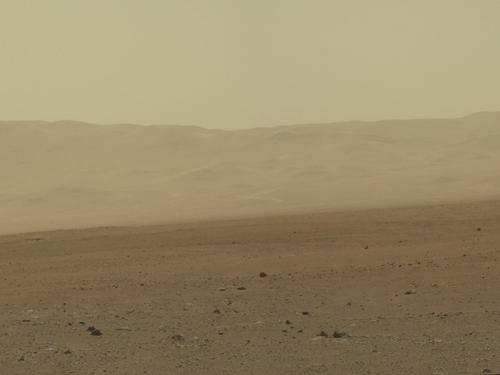
[/spoiler]
[spoiler=Color, Rock Uncovered by Rockets]
This color image from NASA's Curiosity rover shows an area excavated by the blast of the Mars Science Laboratory’s descent stage rocket engines. This is part of a larger, high-resolution color mosaic made from images obtained by Curiosity's Mast Camera.
With the loose debris blasted away by the rockets, details of the underlying materials are clearly seen. Of particular note is a well-defined, topmost layer that contains fragments of rock embedded in a matix of finer material. Shown in the inset in the figure are pebbles up to 1.25 inches (about 3 centimeters) across (upper two arrows) and a larger clast 4 inches (11.5 centimeters) long protruding up by about 2 inches (10 centimeters) from the layer in which it is embedded. Clast-rich sedimentary layers can form in a number of ways. Their mechanisms of formation can be distinguished by the size, shape, surface textures and positioning with respect to each other of the fragments in the layers. 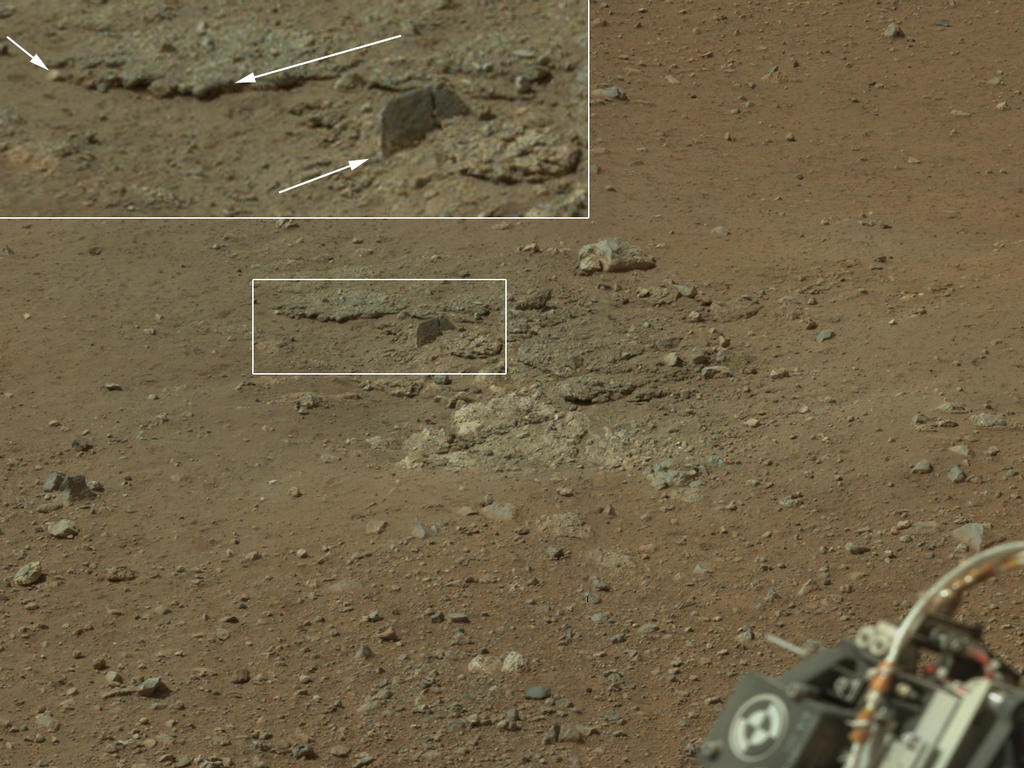
[/spoiler]
[spoiler=BW, Mastcam Shadow]
This is the first image taken by the Navigation cameras on NASA's Curiosity rover. It shows the shadow of the rover's now-upright mast in the center, and the arm's shadow at left. The arm itself can be seen in the foreground.
The navigation camera is used to help find the sun -- information that is needed for locating, and communicating, with Earth. After the camera pointed at the sun, it turned in the opposite direction and took this picture. The position of the shadow helps confirm the sun's location.
The "augmented reality" or AR tag seen in the foreground can be used in the future with smart phones to obtain more information about the mission. 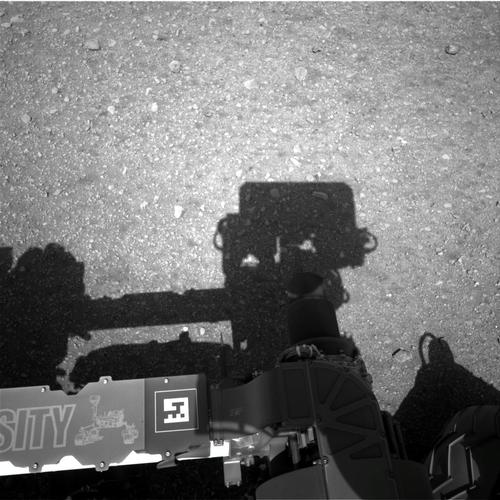
[/spoiler]
--Andy








 [/spoiler]
 [/spoiler]
 [/spoiler]
 [/spoiler]
 [/spoiler]