Page 3 of 6
Re: Now a F*ckin' Space Science Thread
Posted: Wed Aug 22, 2012 4:38 pm
by Juan_Bottom

If you could hear a dying star, what would it sound like?
Astronomers at the University of Michigan have discovered a star located around four billion light years away that is in the process of being devoured by a supermassive black hole.
They decided to translate the frequencies of signals captured into sound, to try and work out exactly what a star being devoured by a black hole would sound like - if it were possible to hear sound in space, and if you could get close enough to hear without being sucked in yourself that is!
http://cnnradio.cnn.com/2012/08/16/the- ... ?hpt=hp_t2
Re: Now a F*ckin' Space Science Thread
Posted: Wed Aug 22, 2012 6:24 pm
by Juan_Bottom
Re: Re:
Posted: Wed Aug 22, 2012 10:56 pm
by tzor
heavycola wrote:tzor wrote:2dimes wrote:Wait is it the real tzor or did someone find his computer still signed in here in front of his skeleton cleaned white and brite by his cats after he died?
DId you expect some cheep imitation?
Yes please. Let's hear your bird noises.
I do a great impression of an emperor penguin.

Re: Now a F*ckin' Space Science Thread
Posted: Wed Aug 22, 2012 11:06 pm
by tzor
Timminz wrote:Get real, Tzor!
You realize that the set of "real" numbers consists of the sets of rational and irrational numbers.
That in order to "get real" I must at the same time get irrational.

Re: Now a F*ckin' Space Science Thread
Posted: Thu Aug 23, 2012 1:50 pm
by rdsrds2120
tzor wrote:Timminz wrote:Get real, Tzor!
You realize that the set of "real" numbers consists of the sets of rational and irrational numbers.
That in order to "get real" I must at the same time get irrational.
Only if you choose the dark side. Being a rational or irrational number will make you real. It's up to you.
SEARCH YOUR FEELINGS, TZOR. YOU KNOW IT TO BE TRUE!!!
Re: Now a F*ckin' Space Science Thread
Posted: Thu Aug 23, 2012 2:12 pm
by thegreekdog
Juan_Bottom wrote:If you could hear a dying star, what would it sound like?
Astronomers at the University of Michigan have discovered a star located around four billion light years away that is in the process of being devoured by a supermassive black hole.
They decided to translate the frequencies of signals captured into sound, to try and work out exactly what a star being devoured by a black hole would sound like - if it were possible to hear sound in space, and if you could get close enough to hear without being sucked in yourself that is!
http://cnnradio.cnn.com/2012/08/16/the- ... ?hpt=hp_t2
Heh, heh, heh, accretion disk...
Re: Now a F*ckin' Space Science Thread
Posted: Mon Aug 27, 2012 1:21 pm
by Juan_Bottom

This is the Carina Nebula, between 6,500 and 10,000 light years away from Earth in a constellation of the same name. This single pillar of gas and dust measures three light years in height; the red and purple hues of the nebula come from hot hydrogen gas interacting with ultraviolet radiation from the nebula's massive young stars that are buried within it.
Re: Now a F*ckin' Space Science Thread
Posted: Tue Aug 28, 2012 11:30 pm
by Juan_Bottom
Re: Now a F*ckin' Space Science Thread
Posted: Tue Aug 28, 2012 11:41 pm
by Juan_Bottom

NGC 6888: The Crescent Nebula
Image Credit & Copyright: J-P Metsävainio (Astro Anarchy)
NGC 6888, also known as the Crescent Nebula, is a cosmic bubble about 25 light-years across, blown by winds from its central, bright, massive star. This colorful portrait of the nebula uses narrow band image data combined in the Hubble palatte. It shows emission from sulfur, hydrogen, and oxygen atoms in the wind-blown nebula in red, green and blue hues. NGC 6888's central star is classified as a Wolf-Rayet star (WR 136). The star is shedding its outer envelope in a strong stellar wind, ejecting the equivalent of the Sun's mass every 10,000 years. The nebula's complex structures are likely the result of this strong wind interacting with material ejected in an earlier phase. Burning fuel at a prodigious rate and near the end of its stellar life this star should ultimately go out with a bang in a spectacular supernova explosion. Found in the nebula rich constellation Cygnus, NGC 6888 is about 5,000 light-years away.
Re: Now a F*ckin' Space Science Thread
Posted: Wed Aug 29, 2012 12:25 am
by Juan_Bottom

Two newly submitted studies verify 41 new transiting planets in 20 star systems. These results may increase the number of Kepler's confirmed planets by more than 50 percent: to 116 planets hosted in 67 systems, over half of which contain more than one planet. The papers are currently under scientific peer-review.
Nineteen of the newly validated planetary systems have two closely spaced transiting planets and one system has three. Five of the systems are common to both of these independent studies. The planets range from Earth-size to more than seven times the radius of Earth, but generally orbit so close to their parent stars that they are hot, inhospitable worlds. The planets were confirmed by analyzing Transit Timing Variations (TTVs).
In closely packed systems, the gravitational pull of the planets causes the acceleration or deceleration of a planet along its orbit. These "tugs" cause the orbital period of each planet to change from one orbit to the next. TTV demonstrates that two transiting planet candidates are in the same system and that their masses are planetary in nature.
"These systems, with their large gravitational interactions, give us important clues about how planetary systems form and evolve," said lead researcher Jason Steffen, the Brinson postdoctoral fellow at Fermilab Center for Particle Astrophysics in Batavia, Ill. "This information helps us understand how our own solar system fits into the population of all planetary systems." The two research teams used data from NASA's Kepler space telescope, which measures dips in the brightness of more than 150,000 stars, to search for transiting planets.
"The sheer volume of planet candidates being identified by Kepler is inspiring teams to look at the planet confirmation and characterization process differently. This TTV confirmation technique can be applied to large numbers of systems relatively quickly and with little or no follow-up observations from the ground," said Natalie Batalha, Kepler mission scientist at NASA's Ames Research Center, Moffett Field, Calif. "Perhaps the bottleneck between identifying planet candidates and confirming them just got a little wider."
The diagram below shows the newly submitted transiting planets in green along with the unconfirmed planet candidates in the same system in violet. The systems are ordered horizontally by increasing Kepler number and KOI designation and vertically by orbital period.
 http://www.dailygalaxy.com/my_weblog/20 ... .html#more
How fucking cool is space 'n' shit!?
Re: Now a F*ckin' Space Science Thread
Posted: Wed Aug 29, 2012 7:14 pm
by Juan_Bottom

While the most stunning image that was ever taken by the Hubble Space Telescope is debatable, in my opinion, the image of "The Helix Nebula" (formally dubbed "NGC 7293," but informally known as "The Eye of God) is by far one of the creepiest. It looks as if it could steal your soul if you spent too much time staring at it.
The Helix Nebula is located approximately 700 light-years from Earth in the constellation of Aquarius. It's a planetary nebula, which is a nebula that was formed as a result of a low-mass or sun-like star (usually about 8 times less massive than the sun) shedding its outer envelope of gasses as the star dies. While this particular nebula isn't as famous as the Crab or Orion nebulas, it is one of the closest from Earth.
http://apod.nasa.gov/apod/ap030510.html

The most detailed image of the Carina Nebula.
(For our new fans, Nebula are often formed from the gravitational collapse of gas in space or when a star used up its nuclear fuel as it reaches the end of its lifespan, and explodes into a supernova. Nebulae are often the remnants of supernovae.)
The photo revealed previously hidden features to this magnificent molecular cloud. The European telescope peered behind thick clouds of dust and found dusty incubators from which new massive stars are forming. It turns out that this nebula is a stellar nursery to several of the brightest and most massive known stellar giants. One of its massive stars is Eta Carinae, a mysterious and highly unstable star, which was also known as the second brightest star in the night sky for several years.
This new panorama of the Carina nebula has been placed together from hundreds of individual images, creating the most detailed infrared mosaic of the nebula ever taken.
http://www.space.com/14501-space-photo- ... stars.html
Re: Now a F*ckin' Space Science Thread
Posted: Wed Aug 29, 2012 10:05 pm
by Juan_Bottom
Re: Technicality?
Posted: Thu Aug 30, 2012 1:30 am
by Army of GOD
Juan_Bottom wrote:
\actually, when a hydrogen loses an electron, you get a proton. You only get an acid (and, in this case, a superacid, which is even less likely) when it comes in contact with a proton acceptor.
Re: Technicality?
Posted: Thu Aug 30, 2012 2:35 am
by NoSurvivors
tzor wrote:Dear Science; No you didn't land on Mars, you landed a unsenitent and barely intelligent machine on Mars. You couldn't last five minutes in the smallest of solar storms that frequent the solar system. So please stay inside the nice mangetic field of you planet, that I, your Lord, made for you and not for the other planets, like Mars which has no magnetic field like the earth and no atmosphere to speak of either. Sincerely, Religion's Boss, God.
-sigh- so many errors to be corrected by a 16 year old.... Good job. Now; mars has an atmosphere.. Get your facts straight..First, humans even in space suits wouldn't last 1/10th of a second if hit by a solar flare.. Mercury is the only planet in our solar system without one. What you meant was (I think), no breathable air. Mars and Venus used to have magnetospheres just like earth, but Venus turned into a runaway greenhouse effect and mars is too cold and do its core went cold/stopped spinning, and therefore lost its magnetosphere. The gas giants (jupiter, Saturn, Uranus and Neptune) also have magnetospheres as well as one of jupiter's moons I believe. Did you even know what a magnetosphere was? I bet not.. So before you *sadly attempt* to troll, get your facts in line, double or even triple check them... And then post, kind sir.
*edit magnetic field =/= magnetosphere judging by the context..
Also, I like the the pics that Juan is posting..

.
Re: Now a F*ckin' Space Science Thread
Posted: Thu Aug 30, 2012 7:03 am
by PLAYER57832
Those pictures are great!
Re: Now a F*ckin' Space Science Thread
Posted: Thu Aug 30, 2012 9:16 am
by Maugena
RUN MARS... RUN!!
Re: Now a F*ckin' Space Science Thread
Posted: Fri Aug 31, 2012 2:08 am
by Juan_Bottom

Amazing view.

Documented in three new studies, data from NASA’s Wide-field Infrared Survey Explorer mission was used to discover millions of newfound supermassive black holes and extreme galaxies called hot DOGs, or dust-obscured galaxies.
Pasadena, California — Images from the telescope have revealed millions of dusty black hole candidates across the universe and about 1,000 even dustier objects thought to be among the brightest galaxies ever found. These powerful galaxies, which burn brightly with infrared light, are nicknamed hot DOGs.
“WISE has exposed a menagerie of hidden objects,” said Hashima Hasan, WISE program scientist at NASA Headquarters in Washington. “We’ve found an asteroid dancing ahead of Earth in its orbit, the coldest star-like orbs known and now, supermassive black holes and galaxies hiding behind cloaks of dust.”
WISE scanned the whole sky twice in infrared light, completing its survey in early 2011. Like night-vision goggles probing the dark, the telescope captured millions of images of the sky. All the data from the mission have been released publicly, allowing astronomers to dig in and make new discoveries.
The latest findings are helping astronomers better understand how galaxies and the behemoth black holes at their centers grow and evolve together. For example, the giant black hole at the center of our Milky Way galaxy, called Sagittarius A*, has 4 million times the mass of our sun and has gone through periodic feeding frenzies where material falls towards the black hole, heats up and irradiates its surroundings. Bigger central black holes, up to a billion times the mass of our sun, may even shut down star formation in galaxies.
http://scitechdaily.com/nasas-wise-disc ... ack-holes/
Re: Now a F*ckin' Space Science Thread
Posted: Sat Sep 01, 2012 11:44 am
by Juan_Bottom

Photo from the Voyager 1 spacecraft, taken on February 14th, 1990.
This image is of Earth, 4 billion miles (6.4 billion kilometres) distant, showing up as a tiny dot. The following monologue is from Carl Sagan, an American astronomer who was also an author, co-author, or editor of over 20 books. He also published over 600 scientific papers and articles.
“That's here. That's home. That's us. On it, everyone you ever heard of, every human being who ever lived, lived out their lives. The aggregate of all our joys and sufferings, thousands of confident religions, ideologies and economic doctrines, every hunter and forager, every hero and coward, every creator and destroyer of civilizations, every king and peasant, every young couple in love, every hopeful child, every mother and father, every inventor and explorer, every teacher of morals, every corrupt politician, every superstar, every supreme leader, every saint and sinner in the history of our species, lived there on a mote of dust, suspended in a sunbeam.
The Earth is a very small stage in a vast cosmic arena. Think of the rivers of blood spilled by all those generals and emperors so that in glory and in triumph they could become the momentary masters of a fraction of a dot. Think of the endless cruelties visited by the inhabitants of one corner of the dot on scarcely distinguishable inhabitants of some other corner of the dot. How frequent their misunderstandings, how eager they are to kill one another, how fervent their hatreds. Our posturings, our imagined self-importance, the delusion that we have some privileged position in the universe, are challenged by this point of pale light. Our planet is a lonely speck in the great enveloping cosmic dark. In our obscurity -- in all this vastness -- there is no hint that help will come from elsewhere to save us from ourselves. It is up to us. It's been said that astronomy is a humbling, and I might add, a character-building experience. To my mind, there is perhaps no better demonstration of the folly of human conceits than this distant image of our tiny world. To me, it underscores our responsibility to deal more kindly and compassionately with one another and to preserve and cherish that pale blue dot, the only home we've ever known."
Re: Now a F*ckin' Space Science Thread
Posted: Sat Sep 01, 2012 11:44 am
by Juan_Bottom
Re: Now a F*ckin' Space Science Thread
Posted: Sun Sep 02, 2012 5:46 pm
by Juan_Bottom
[bigimg]http://www.clickfactor.gr/infographicsmania.com/wp-content/uploads/2012/07/Shooting-For-Mars-infographic.jpg[/bigimg]
Some day, we're gonna terraform this rock and I'm gonna live there.
Re: Now a F*ckin' Space Science Thread
Posted: Sun Sep 02, 2012 5:54 pm
by Juan_Bottom
Re: Now a F*ckin' Space Science Thread
Posted: Mon Sep 03, 2012 11:03 am
by Juan_Bottom

2012 Winners GalleryCredit: Josh Lake/NASA & ESA
Swirling galaxies, glowing nebulas and shimmering stars: these are the winners in a public contest to unearth beautiful images from the horde of unprocessed data collected by the Hubble Space Telescope.
Re: Technicality?
Posted: Mon Sep 03, 2012 3:59 pm
by tzor
NoSurvivors wrote:[quote="tzor like Mars which has no magnetic field like the earth and no atmosphere to speak of either.
-sigh- so many errors to be corrected by a 16 year old.... Good job. Now; mars has an atmosphere.. Get your facts straight..[/quote]
I won't nit pick on my use of "to speak of" but instead go right to the actual facts.
Atmosphere of MarsThe atmosphere of Mars is relatively thin and is composed mostly of carbon dioxide (95.32%). There has been interest in studying its composition since the detection of trace amounts of methane,[2][3] which may indicate the presence of life on Mars, but may also be produced by a geochemical process, volcanic or hydrothermal activity.[4]
The atmospheric pressure on the surface of Mars averages 600 pascals (0.087 psi), and ranges from a low of 30 pascals (0.0044 psi) on Olympus Mons's peak to over 1,155 pascals (0.1675 psi) in the depths of Hellas Planitia. This compares to Earth's sea level pressure of 101.3 kilopascals (14.69 psi) (i.e. about 0.6% of Earth's). Mars atmospheric mass of 25 teratonnes, compares to Earth's 5148 teratonnes. However, the scale height of the atmosphere is about 11 kilometres (6.8 mi), somewhat higher than Earth's 7 kilometres (4.3 mi). The composition of the Mars atmosphere is 95% carbon dioxide, 3% nitrogen, 1.6% argon, and contains traces of oxygen, water, and methane, for a mean molar mass of 43.34 g/mol.[1][5] The atmosphere is quite dusty, giving the Martian sky a light brown or orange color when seen from the surface; data from the Mars Exploration Rovers indicate that suspended dust particles within the atmosphere are roughly 1.5 micrometres across.[6]
So basically the atmosphere of Mars is six tenths of a percent that of the earth. The psi at Mt Everest is 4 (not 0.0044).
To even compare the atmosphere to that of the earth is downright silly.
Some common sense from a 51 year old, my young lad.
Oh by the way, did you know that technically the "sun" has an atmosphere? And even a "solar wind." Don't try to breathe it, however. You won't be able to tell it apart from a vacuum.
Re: Technicality?
Posted: Mon Sep 03, 2012 4:14 pm
by Symmetry
tzor wrote:NoSurvivors wrote:[quote="tzor like Mars which has no magnetic field like the earth and no atmosphere to speak of either.
-sigh- so many errors to be corrected by a 16 year old.... Good job. Now; mars has an atmosphere.. Get your facts straight..
I won't nit pick on my use of "to speak of" but instead go right to the actual facts.
Atmosphere of MarsThe atmosphere of Mars is relatively thin and is composed mostly of carbon dioxide (95.32%). There has been interest in studying its composition since the detection of trace amounts of methane,[2][3] which may indicate the presence of life on Mars, but may also be produced by a geochemical process, volcanic or hydrothermal activity.[4]
The atmospheric pressure on the surface of Mars averages 600 pascals (0.087 psi), and ranges from a low of 30 pascals (0.0044 psi) on Olympus Mons's peak to over 1,155 pascals (0.1675 psi) in the depths of Hellas Planitia. This compares to Earth's sea level pressure of 101.3 kilopascals (14.69 psi) (i.e. about 0.6% of Earth's). Mars atmospheric mass of 25 teratonnes, compares to Earth's 5148 teratonnes. However, the scale height of the atmosphere is about 11 kilometres (6.8 mi), somewhat higher than Earth's 7 kilometres (4.3 mi). The composition of the Mars atmosphere is 95% carbon dioxide, 3% nitrogen, 1.6% argon, and contains traces of oxygen, water, and methane, for a mean molar mass of 43.34 g/mol.[1][5] The atmosphere is quite dusty, giving the Martian sky a light brown or orange color when seen from the surface; data from the Mars Exploration Rovers indicate that suspended dust particles within the atmosphere are roughly 1.5 micrometres across.[6]
So basically the atmosphere of Mars is six tenths of a percent that of the earth. The psi at Mt Everest is 4 (not 0.0044).
To even compare the atmosphere to that of the earth is downright silly.
Some common sense from a 51 year old, my young lad.
Oh by the way, did you know that technically the "sun" has an atmosphere? And even a "solar wind." Don't try to breathe it, however. You won't be able to tell it apart from a vacuum.[/quote]
No, that's not what he said. Try reading it again. You might avoid the daft mistakes on a second reading.
Re: Now a F*ckin' Space Science Thread
Posted: Mon Sep 03, 2012 6:37 pm
by F1fth
This is really old but it's my favorite Hubble picture. The Eagle Nebula, aka the Pillars of Creation, is an interstellar region filled with gas, plasma, and dust. Stars are constantly formed in the cloud and eroded by the light of other newly-created stars. These things are trillions of miles long.
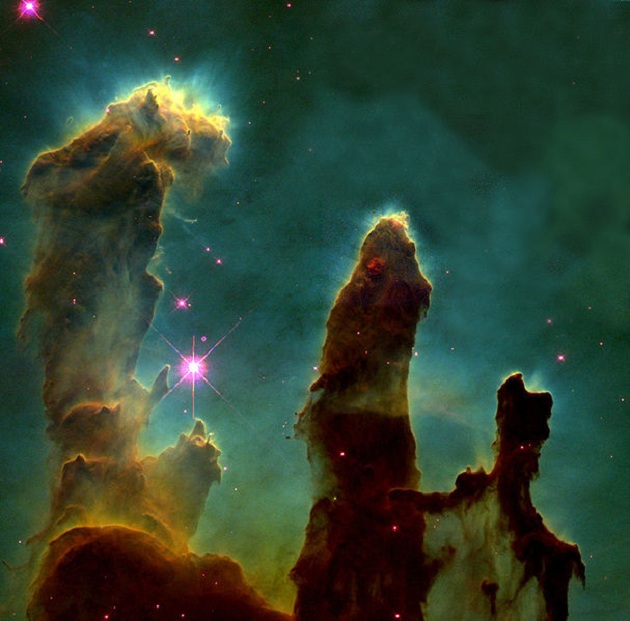
It is also approximately 7000 lightyears away and is speculated by scientists to have been destroyed thousands of years ago by a nearby supernova. Given the distance, it will take another 1000 years we will be able to see it's possible destruction.
It's almost like looking into the past.


