natty dread wrote:Maybe someday we'll get to the point where low-level languages become redundant for everything except the system kernel. On the other hand, it could be that we'll just come up with more resource-hungry applications that still require coding with lower-level languages - the phenomenon is best seen in computer games: no matter how powerful a new gaming hardware is, someone is going to come up with ways to utilize all of its potential...
I think eventually most people will be using higher level languages, seems like the natural trend. I mean, at one point, C was considered high level.
Also, I remember reading this article about the making of some really old games The challenges they had to solve due to very limited hardware resources were just insane. I dunno if games today have to worry THAT much about performance and footprint. And surely the whole "let's pour a shitload of money into making the game super-duper realistic" must be nearing the tapering point. They pretty much almost look real already.
This scavenger hunt is getting boring. Let's go work on the treehouse!
I am firmly of the opinion that if something doesn't have a year on it, every time the expiration date rolls around it is good again for the two weeks preceding that date.
Re: Comics
Posted: Mon Jul 30, 2012 6:22 pm
by Haggis_McMutton
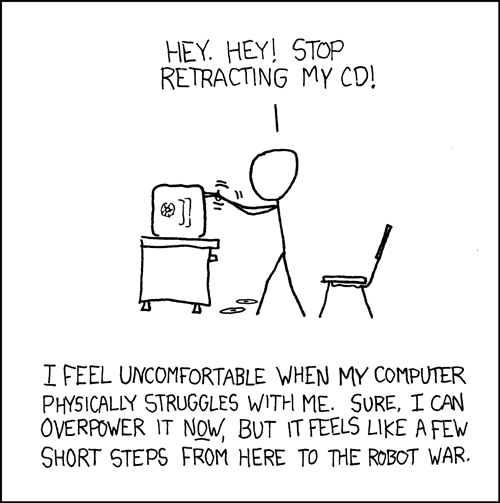
Oh, found an oddly appropriate one:
Unsafe vehicles, hills, and philosophy go hand in hand.
Re: Comics
Posted: Mon Jul 30, 2012 11:21 pm
by natty dread
Haggis_McMutton wrote:I think eventually most people will be using higher level languages, seems like the natural trend. I mean, at one point, C was considered high level.
Also, I remember reading this article about the making of some really old games The challenges they had to solve due to very limited hardware resources were just insane. I dunno if games today have to worry THAT much about performance and footprint. And surely the whole "let's pour a shitload of money into making the game super-duper realistic" must be nearing the tapering point. They pretty much almost look real already.
But there's an almost infinite amount of things that computing power can be used for. Not just more realistic graphics (although, if we get 3d screens with parallax viewing, that's going to take a fair bit of computating power to render all the possible view points you can look at the screen from) but also things like physics engines, completely destructible environments, ultra-massive sandbox games (like, how about a game where the entire nation of USA is rendered... or hey, how about the entire world)... imagination is the limit. And that's not even counting AI... imagination is the limit, really.
And then there's all kinds of scientific uses - scientists are already creating immense grids and networks for computing because regular supercomputers just aren't fast enough for some calculations.
No, I think we're going to need lower level languages for quite some time. And let's not forget environmental concerns - more effective code uses less CPU resources, thus requiring the CPU to use less power, thus consuming less real world resources.
natty dread wrote:But there's an almost infinite amount of things that computing power can be used for. Not just more realistic graphics (although, if we get 3d screens with parallax viewing, that's going to take a fair bit of computating power to render all the possible view points you can look at the screen from) but also things like physics engines, completely destructible environments, ultra-massive sandbox games (like, how about a game where the entire nation of USA is rendered... or hey, how about the entire world)... imagination is the limit. And that's not even counting AI... imagination is the limit, really.
And then there's all kinds of scientific uses - scientists are already creating immense grids and networks for computing because regular supercomputers just aren't fast enough for some calculations.
No, I think we're going to need lower level languages for quite some time. And let's not forget environmental concerns - more effective code uses less CPU resources, thus requiring the CPU to use less power, thus consuming less real world resources.
Ok, but the flipside is we might be able to develop compilers/interpreters smart enough such that the difference between writting low and high level is minimal. (with different paradigmes such as functional languages one might argue that you are expressing the concepts in a clearer way and that a smart enough compiler could generate more efficient byte code than you'd be able to yourself.) I don't know how many people there are left today that could actually write a somewhat complex application more efficiently in assembly than in C. Virtually all efficiency tricks are already performed by the C compiler.
Re: Comics
Posted: Tue Jul 31, 2012 9:20 am
by Haggis_McMutton
Family going to bed at 10 PM is so much worse than jet lag.
Correlation doesn't imply causation, but it does waggle its eyebrows suggestively and gesture furtively while mouthing 'look over there'.
Re: Comics
Posted: Tue Jul 31, 2012 1:19 pm
by natty dread
Haggis_McMutton wrote:
natty dread wrote:But there's an almost infinite amount of things that computing power can be used for. Not just more realistic graphics (although, if we get 3d screens with parallax viewing, that's going to take a fair bit of computating power to render all the possible view points you can look at the screen from) but also things like physics engines, completely destructible environments, ultra-massive sandbox games (like, how about a game where the entire nation of USA is rendered... or hey, how about the entire world)... imagination is the limit. And that's not even counting AI... imagination is the limit, really.
And then there's all kinds of scientific uses - scientists are already creating immense grids and networks for computing because regular supercomputers just aren't fast enough for some calculations.
No, I think we're going to need lower level languages for quite some time. And let's not forget environmental concerns - more effective code uses less CPU resources, thus requiring the CPU to use less power, thus consuming less real world resources.
Ok, but the flipside is we might be able to develop compilers/interpreters smart enough such that the difference between writting low and high level is minimal. (with different paradigmes such as functional languages one might argue that you are expressing the concepts in a clearer way and that a smart enough compiler could generate more efficient byte code than you'd be able to yourself.)
Ok, yes, compilers can develop, and maybe at some point we will just code programs that code other programs... however, the syntax or paradigm of the language isn't the main point, it's more about what kind of code it produces - if the language compiles to bytecode that needs to be interpreted at runtime, that always adds another level of virtualization which slows down the program.
I don't know how many people there are left today that could actually write a somewhat complex application more efficiently in assembly than in C. Virtually all efficiency tricks are already performed by the C compiler.
Actually, assembler is still being used as part of programs written in C etc. because sometimes you just need to squeeze out that extra bit of performance. It's no longer practical to write entire programs in assembler, because programs have become so big and complex, but when some function or method needs a speed boost, assembler can still give faster code.