pmchugh wrote:PLAYER57832 wrote:Not standard.
Castration of male pigs is claimed at 77% in Europe, (
http://www.sciencedaily.com/releases/20 ... 114148.htm) Getting numbers for the US seemed harder, all I can see on google is people claiming nearly 100% but without sources.
lol-- earlier you were talking about real and true abuse, which is what I said is rare. Castration as done properly and normally is not at all painful for the animal and makes them calmer/happier. you anthropomorphize and want to call that abuse, but earlier you were talking about true abuse and then you did a switcheroo to castration.
pmchugh wrote:This comes down to; you can not eat meat and be sure none of this happens or you can investigate the specific farm from which your pork comes from to ensure this abuse doesn't happen. I don't care which you do.
Yeah, like I said.. INVESTIGATE.
I can when I know the farmers who raise the animals or raise them myself. You assume a lot that is incorrect. I am not guessing. I know what happens on farms. I admit to having lately bought chicken that likely comes from horrible sources, but my red meat (and some of the birds/fish as well) is either wild caught locally or butchered from a local farmer and by a local butcher, both of whom I actually know.
PLAYER57832 wrote:And here you make the final error, as have most of those above. You start with the assumption that growing animals is abusive and better than growing crops. This is just plain false, because some of he worst environmental damage is actually from crops. Growing cotton in Central California -- growing cotton just about anywhere, in fact. Etc, etc. Heavy use of pesticides, monoculture, etc, etc.... those are real, serious problems that are not solved by just going vegetarien or even organic.
pmchugh wrote:PLAYER57832 wrote:pmchugh wrote:"The amount of grains fed to US livestock is sufficient to feed about 840 million people who follow a plant-based diet".
true, but irrelevant. This is done because currently grain is very, very cheap, not because its necessary or most efficient.
That is the part you have correct, factory farming can lead to laziness, in the name of "efficiency", but its not a requirement.
It is relevant to my point, "Animals are an inefficient use of food crops. If you replace the animals you are eating with crops, you are actually consuming less crops.". Perhaps I should have started, "The typical Animals that we consume" to be more precise.
No, because you were trying to refute my point. I am saying that model needs to be changed. We agree on that. Where I disagree is when you claim that going vegetarian is the better, or perhaps the only way to do that. On that I firmly disagree. I disagree for a few reasons. First, you cannot just substitute crops for animals. Animals have the unique ability to travel on their own. This means they can create food from lands that are generally unproductive, lands that could (for a variety of reasons) never produce crops. Seen that way, they are not competing, they are adding to the food system. Also, as I did say above, animals can consume/make use of food waste/silage/roughage that we cannot or will not eat.
The key is that this does not mean massive productions of huge lots of animals, it means a more holistic and integrated system. Ironically, that is more or less what we have had historically with a few missteps in various times and locations.
here, a public example from a source you can hardly call biased toward commercial agriculture.:
http://www.motherearthnews.com/homestea ... azglo.aspx pmchugh wrote:PLAYER57832 wrote:OK, except you just changed terms. See, factory farming and intensive farming are not the same thing. Factory farming is a term used primarily to abusive operations specifically. Intensive farming.. that does not require abuse, and can be beneficial IF done properly. Sadly, they often are not, but going vegetarian is actually counter-productive, because it hurts the smaller farmers more. You need to not just avoid the bad guys, you need to actively support the good guys..and also not that there are "good guys" AND "bad guys" in BOTH vegetable/grain and animal production systems.
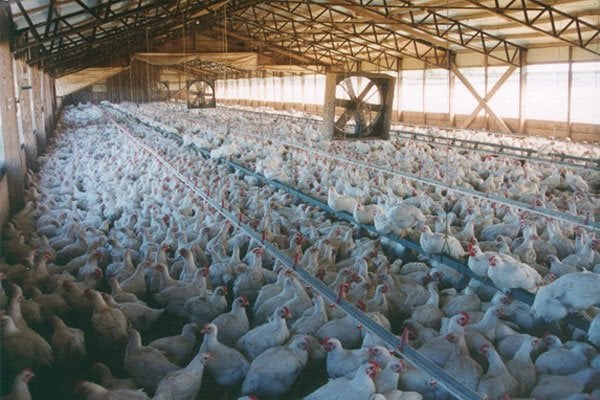
I don't believe that you can have scalable means of production that is not harmful. How can you keep chickens in an area where each of them has just larger than an A4 sheet of paper and hope to give them meaningful and joyful lives? How can a small group of human beings adequately look after 8,389 pigs? (average Hog farm size in the US circa 2009)
There you go again, defining the terms in ways that are not real. "Intensive farming" does not mean either raising chickens in a space the size of a large piece of paper OR raising 8,000 pigs together.
Also, your I am not sure where you get those figures, the US agricensus shows an average of just over 3,000 per farm in 2012. (source:
http://www.agcensus.usda.gov/Publicatio ... g_Farming/ ) Because the trend is fewer farmers who are growing more, I find it unlikely that 8.000 pigs is a real average today. It might be an average for factory farms, but again.. then would be to have already defined the extreme as standard.
Anyway, when I say "intensive", I mean growing lots of items in a relatively small space.
Relatively small means maximum efficiency of space, not just cramming animals together. In fact, cramming them that tightly leads to heavy dependence on antibiotics in animals, heavy use of pesticides and fertilizers in crops. Combining the two leads to a better, more efficient system... but a full explanation requires more discussion. I am just dealing with this one point right now.
I would put a realistic pig count at a few hundred, though with some appropriate, adaptive equipment (things like self-feeders and the like), you might approach 5-600 pigs. My dad never liked to go beyond 200 cows (with 2 full time milkers). My neighbors raised quite a few chickens -- never really knew the count. they were raised in boxes suspended off the ground, but they had room to move around, etc. Those standards have changed and definitely become intensified, but the most recent trend is to reverse that. "Free range" is now a pretty popular term (though sometimes its quite a joke).
The initial point was what is the justification of factory farming. I took the "devil's advocate" position, one I don't truly agree with, saying that it is efficient. Then I said that basic argument is not fully true. Its only true if you think of farms as being no different than machinery production plants, which is where the term "factory farm" came about. If you understand both animals and crops, plus the natural environment, you see that we need them all to work together. That is what yields REAL efficiency. Everything is used, and used wisely. There is little or no waste.. no true waste, because basically everything has a purpose and is used.
pmchugh wrote:PLAYER57832 wrote:pmchugh wrote:I am not basing my views on a PETA blog either but on rational and sceptical observation of the available materials on the conditions in which our food is raised. You will forgive me for making my own judgements and not simply taking your word for it because you are older than me, or you grew up on a farm or any other credential you wish to claim.
LOL -- fine, but please look at ALL the data, not just what you find conveniently on the internet. I, myself have. I would expect no less. Its just irritating when I see touted as "truth" what I know is simply not truth. Finding truth takes work, though, and following the easy answer satisfies many.. to the harm of the real solutions.
No one is perfect and no one knows everything, but I read some very biased pro-meat sources to encounter opposing points of view. If you have a problem with people basing their choices on lack of information imagine living in a society where most people justify their habits with; "protein tho", "food chain tho", "plants feel pain tho". If everyone looked into the issue seriously there would be much, much less meat consumed in our respective countries.
[/quote][/quote][/quote]The answer is to educate yourself, THEN educate others.
You assume I have not and do not, which is why I took the patronizing tone... and yes, it was not exactly the best tactic, but I am human and do get frustrated by hearing the exact same arguments repeated with very little change except that the information supposedly backing the opinions gets less and less real foundation. I mean, even though I pretty specifically said I grew up on a farm, you still came back with "you cannot know what goes on where you get your meat". Actually, I do.. the good AND the bad. As I noted above, I do buy some meat from cheaper, factory sources. It is not what I wish, but getting into that involves more than the discussion topic here involves. I do a LOT better than most people, actually do buy a LOT of my food from very local sources (what I don't grow myself, that is).
And.. if everyone truly looked at the WHOLE situation, they would eat less meat, but not for most of the reasons you have said, and also, less meat is quite different from "we have to be vegetarian". That difference is pretty huge. Mother Earth -- yes. Peta-no.