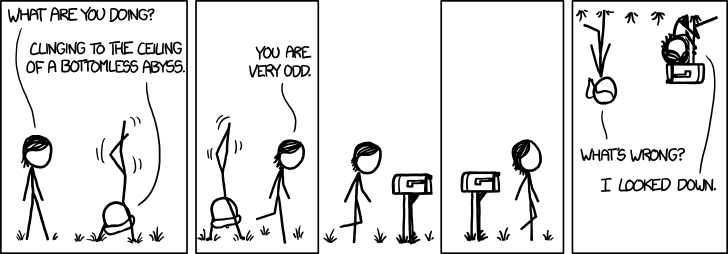
- Click image to enlarge.


Moderator: Community Team


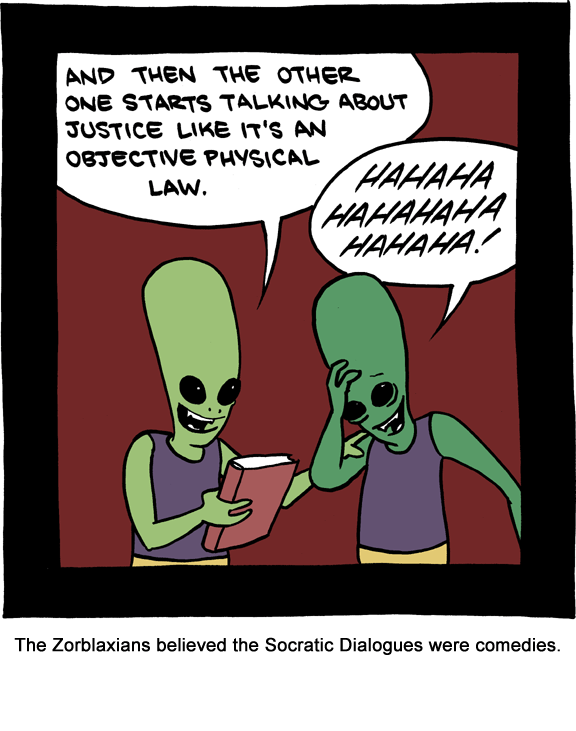


Napoleon Ier wrote:You people need to grow up to be honest.

Stopped after 20 minutes. My productivity suffers enough.Neoteny wrote:The XKCD click and drag...
Are you fucking kidding? I've wasted so much time...
aage wrote:Never trust CYOC or pancake.


I love this Jim Carrey bit on this subject (because I felt the same exact way):thegreekdog wrote:I've actually thought about the first one before (e.g., that guy could totally push me in front of that bus). I've also thought about something like it - the trust we put into machines. I take a high speed elevator up to the 30th floor on a daily basis; I drive a deadly vehicle; etc.
This also interests me. There are a lot of aspects to address in this matter, but the main concept I'm trying to express is as follows:BigBallinStalin wrote:What we're looking at is nearly all of us following the rules of the game. Our incentives, we face and operate along, reward us for not doing such stupid things. Sure, there are cracks because it isn't perfect. But what's interesting about this is that these rules are informal. They're not codified, yet we generally behave in accordance with them. Sure, there are formal laws (Govt says, "Don't kill people!"), but those aren't the only kind of rules at play.

Oh of course this is evolutionary, in the sense that the evolutionary perspective has much to offer to the social sciences in this regard.ManBungalow wrote:I have similar thoughts to those just above. I was recently walking along a pavement (true story) by a road and was strolling round a corner when a car drove round the corner in the opposite direction. Basically, it was driving straight at me until it turned the corner of the road, following the curvature of the road as you do. Most people wouldn't bat an eyelid at that. If I'm walking along, and the car is driving around and doing nothing wrong, what's the problem? It just occurred to me at that moment (and there was nothing special about that moment for any particular reason) that a heavy locomotive was driving straight towards - and I was aware of it at the time - me at a considerable speed, and I was trusting that it would turn without even stopping to consciously think about it.
It interests me how the primitive (though by no means redundant) instincts/reactions we have are adapted to - and shape the nature of - our modern lifestyles. If one really stops to analyse anything that a person does, it can somehow be related to some evolutionary characteristic.
Check out that link from scienceblogs.com. And F. A. Hayek devoted much of his work to showing how the underlined is not true (The Fatal Conceit, The Constitution of Liberty, The Use of Knowledge in Society, etc.). If we blend Hayek's insights with those of Elinor Ostrom's on polycentrism--basically, self-governance/local governance, then the underlined becomes truer--but only in particular circumstances. As we scale up the government (federal government, provincial/State government), then it becomes less true/less effective in fulfilling such goals. In other words, the central planning becomes further isolated from the local knowledge/information and incentives of those over which it governs, thus rendering it marginally less effective. The lack of a price mechanism, as defined by markets without state intervention, also contributes to this ineffectiveness as well (use of knowledge in society).ManBungalow wrote:This also interests me. There are a lot of aspects to address in this matter, but the main concept I'm trying to express is as follows:BigBallinStalin wrote:What we're looking at is nearly all of us following the rules of the game. Our incentives, we face and operate along, reward us for not doing such stupid things. Sure, there are cracks because it isn't perfect. But what's interesting about this is that these rules are informal. They're not codified, yet we generally behave in accordance with them. Sure, there are formal laws (Govt says, "Don't kill people!"), but those aren't the only kind of rules at play.
The government (or similar) can impose meticulously defined legislation/rules for every aspect of our lives and that which goes on around us. There are always exceptions and subjective interpretations which make trying to enforce very specific rules something of a fallacy.
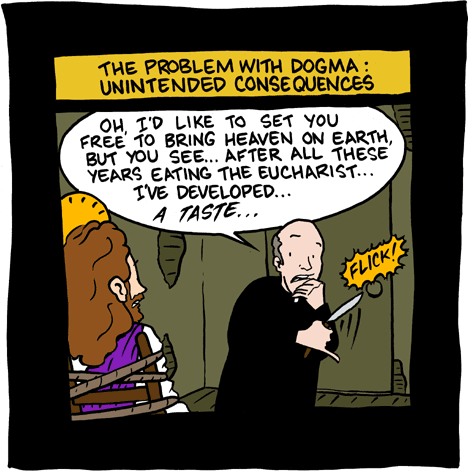
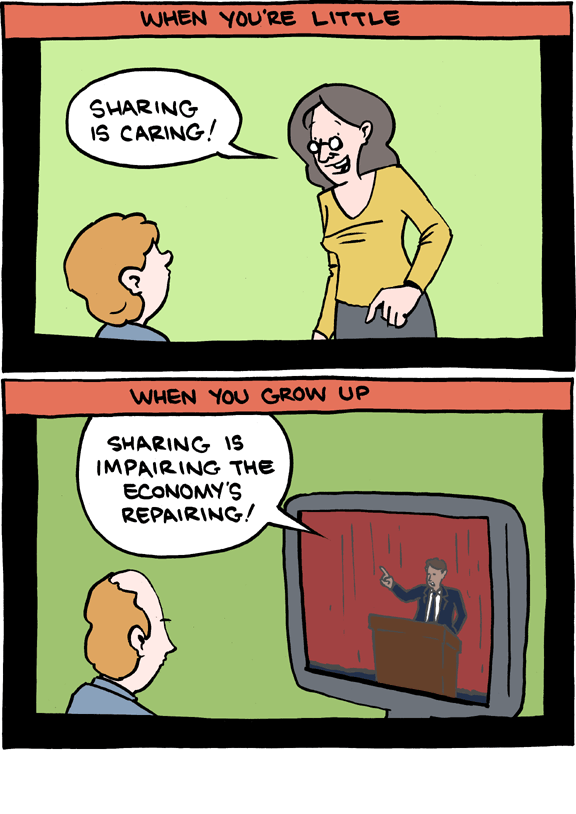
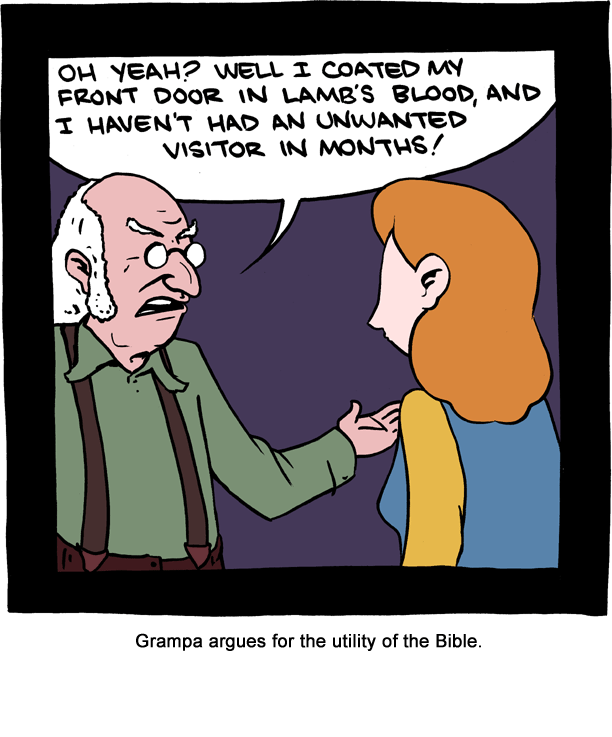
Also, comics.


Lol, why do you care so much about other people's beliefs? Were you picked on as a child or something? There's no logical explanation for putting so much energy into something that has zero to do with you personally so the reason has to be psychological.Haggis_McMutton wrote: