jusplay4fun wrote:Too much socialism led to economic stagnation in Sweden (and in other countries, too, but Sweden is highlighted in my quote). I think the EU overall stagnation (few new jobs for young people, too much protection of "old" ways and companies and sectors of the economy) is detrimental to raising economic standards for ALL peoples of that nation/entity.
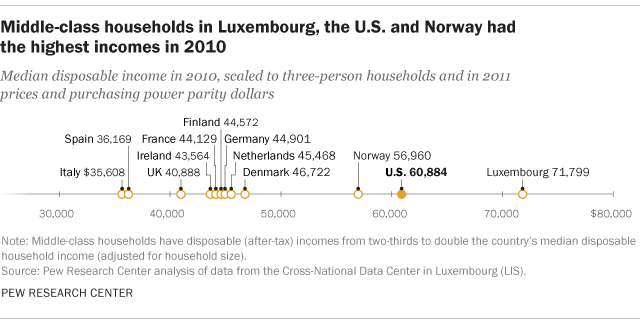
And yet, people in Europe are able to enjoy life, while people in North America spend all their time either working or paying bills or stressing and worrying about their next round of working and paying bills.
In my lifetime, the GNP (in real terms, after adjusting for inflation) of the U.S. has quadrupled, and the GNP of Canada has increased almost as much, a factor of 3.6 or something like that. And not one single solitary fucking penny of that has trickled down to the working man. Every single penny has gone to increased corporate profits and the increased fortunes of their billionaire owners. The working man produces more and more and gets paid less and less.
In the time of our fathers, one man could support a family comfortably on one income. Today, most families have three incomes and still can't pay their bills. Good jobs continue to disappear and are replaced with part-time and temporary jobs with less pay.
The company I work for is pretty typical. When they first got the contract in my area, in 2005, we had 65 full-time employees here and a similar number of seasonal contract workers. Today, we have about 25 full-time employees and probably about 120 seasonal contract workers. We do pretty much the same work, maintaining the same length of highway to the same standards. The only difference is that the number of people earning a decent living has been slashed by two-thirds, while a large number of people lives on pins and needles, never knowing whether they've going to get called or not next week, unable to meaningfully budget or plan. My region is only about 1% of the company, so that's probably about 4000 people across the country who have had good jobs taken away and had them replaced with shit jobs. Each full-time position cut means probably $20,000 in extra profit, so in aggregate that's about $80 million extra profit every year that goes into the bosses' pocket. And of course there's the usual song and dance about how we need that for research and innovation, but it's bullshit. We're in a mature industry, we still do things mostly the same way that they were done in 1950, and what little R&D is there is, is done by our suppliers at their expense. The $80 million a year is just gravy for the boss to stash away in an offshore account, and whatever he doesn't spend on hookers and blow, he can leave to his kids so they can buy more companies and destroy more lives.
It used to be that companies might have to lay off staff and cut wages during lean times, but they would expand staff and raise wages in good times. Now they lay off staff and cut wages in good times and in bad. It's not unusual to hear a company announce record profits and a new round of layoffs in the same week.
We've been in a sustained boom for 40 years (with a couple minor recessionary blips that were over in a flash). The economy grows and grows, corporate profits break new records every day, and yet good jobs disappear, poverty continues to rise, and by every meaningful standard our lives get worse. The working man of today is statistically less likely than his father to own his own home, to be debt free, to be able to retire in comfort, to be able to take a foreign vacation.
Just as an example, when my parents came to Canada in '64, the median income was $4,500 and the median house price was $19,000. Easy math; you can see that you could, in theory, earn enough to buy a house in just a little over four years. Of course in practice it would take longer because you still have to eat, etc., but in theory at least, the average employed person could buy the average house in a little over four years. Today, the median employment income is $37,000 and the median house price is $688,000. That means today, one would have to work almost 19 years to earn enough to buy a house. Again, that's in theory -- in practice one still needs to eat, etc., so it takes much longer. Small wonder that many people entering the workforce nowadays don't even entertain the fantasy of being homeowners and resign themselves to stoking the landlord forever.
The astronomical prices of houses nowadays reflect the fact that there's just so much money floating around in the world. The fact that working wages are NOT similarly astronomical reflects the fact that all the vast wealth created by this sustained boom has not been shared with the workers who earned it. It has all gone to the balance sheets of the corporations and their billionaire owners.
Forty years ago we were told if we cut red tape, slash taxes, remove barriers to the movement of wealth, it would usher in a new era of vast prosperity. We did all that, and it did usher in a new era of vast prosperity, but only for a tiny minority. I was a big libertarian in those days. I loved Reagan and Thatcher. I really believed that a rising tide lifts all boats. I knew the rich would get richer, of course, but I really thought that some reasonable fraction would be shared with everyone. If you had told me forty years ago that the rich would insist on keeping 100% of the new wealth, that they would actually have the nerve to demand wage cuts from their employees even while their own incomes were doubling and tripling and quadrupling, I would have called you a liar.
So, yeah. Maybe socialism does lead to economic stagnation. If it allows people to enjoy life, maybe it's a price worth paying. What good is an economy blasting off into the stratosphere, if it doesn't provide a reasonable standard of living to the people busting their ass seventy hours a week to make it possible?